Metal Displacement Reactions
2 guided lessons · 18 checks · 2. Inorganic Chemistry → Reactivity Series
Guided lessons for this note
Which concept don't you understand yet?
We'll explain it simply and check your understanding. Pick any lesson — any order works.
0 of 18 checks correct so far
Lesson 1 of 2
Metal displacement reactions
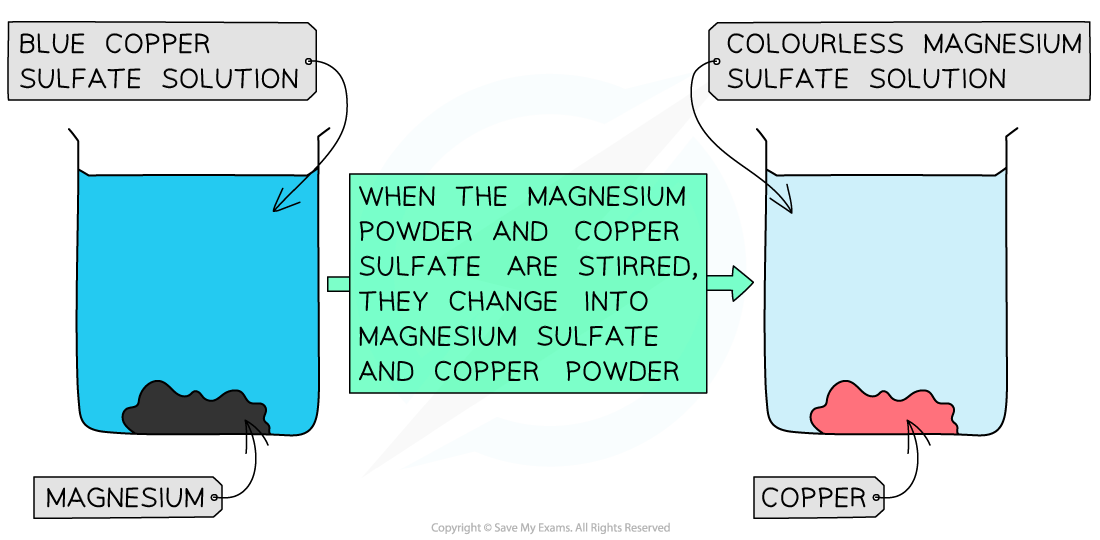
Reactivity falls going down the series, so the stronger metal pushes a weaker one out of its compounds. Two routes show this: heating a metal together with a metal oxide, and standing a metal in the watery solution of another metal's compound. Heating copper(II) oxide with zinc, for example, leaves the zinc holding the oxygen, and the zinc is the reducing agent in the reaction.
What you know already
From Metals Reacting with Water & Acids you have seen how vigour with water and acids ranks the metals. This note adds the second ranking tool: displacement. A more reactive metal takes a less reactive metal's place in its oxide or in its salt solution, and deciding which displacements succeed orders any pair of metals without needing water at all.
Key points of understanding
- A more reactive metal displaces a less reactive metal from its compounds.
- One route heats a metal together with a metal oxide.
- Zinc reduces copper(II) oxide on heating: Zn + CuO gives ZnO + Cu.
- The reducing agent in that reaction is the zinc, which takes the oxygen for itself.
- Sodium oxide and magnesium show no reaction, because sodium already outranks magnesium.
Choose a confidence level to continue.
Prefer to read it all at once? Show the full lesson as a page
1.Metal displacement reactions
Reactivity falls going down the series, so the stronger metal pushes a weaker one out of its compounds. Two routes show this: heating a metal together with a metal oxide, and standing a metal in the watery solution of another metal's compound. Heating copper(II) oxide with zinc, for example, leaves the zinc holding the oxygen, and the zinc is the reducing agent in the reaction.
Key points
- A more reactive metal displaces a less reactive metal from its compounds.
- One route heats a metal together with a metal oxide.
- Zinc reduces copper(II) oxide on heating: Zn + CuO gives ZnO + Cu.
- The reducing agent in that reaction is the zinc, which takes the oxygen for itself.
- Sodium oxide and magnesium show no reaction, because sodium already outranks magnesium.
Guided content from the SME authoring corpus — note rn_gBGX339WBpwyCrFF, pinned at 6fb25fc02d1a · promoted SyllabAI/syllabai-resources e967e75f1339