Practical: Prepare Copper(II)Sulfate
2 guided lessons · 18 checks · 2. Inorganic Chemistry → Acids, Bases & Salt Preparations
Guided lessons for this note
Which concept don't you understand yet?
We'll explain it simply and check your understanding. Pick any lesson — any order works.
0 of 18 checks correct so far
Lesson 1 of 2
Method
This practical makes a familiar blue salt from two simple starting materials: an acid and an insoluble black base. The first stage covers the reaction itself, from warming the acid to adding copper(II) oxide until it is in excess. Filtering then removes the leftover solid, leaving a clean blue solution behind.
What you know already
You already know from Acids, Alkalis & Titrations that acids react with bases to form salts and water. This practical puts that reaction to work in the laboratory: an insoluble base, copper(II) oxide, is stirred into warm acid until the acid is used up, and the salt it forms is recovered as blue crystals. Every step you will follow exists to keep that product pure and dry.
Key points of understanding
- The aim is a pure, dry batch of hydrated copper(II) sulfate crystals, made from copper(II) oxide.
- Warming the dilute sulfuric acid gently speeds up the reaction with the base.
- Copper(II) oxide is added slowly to the hot acid and stirred until it is in excess.
- Being in excess means the base stops dissolving and a suspension forms in the acid.
- Filtering removes the excess solid base, leaving the salt solution in the evaporating basin.
Choose a confidence level to continue.
Prefer to read it all at once? Show the full lesson as a page
1.Method
This practical makes a familiar blue salt from two simple starting materials: an acid and an insoluble black base. The first stage covers the reaction itself, from warming the acid to adding copper(II) oxide until it is in excess. Filtering then removes the leftover solid, leaving a clean blue solution behind.
Key points
- The aim is a pure, dry batch of hydrated copper(II) sulfate crystals, made from copper(II) oxide.
- Warming the dilute sulfuric acid gently speeds up the reaction with the base.
- Copper(II) oxide is added slowly to the hot acid and stirred until it is in excess.
- Being in excess means the base stops dissolving and a suspension forms in the acid.
- Filtering removes the excess solid base, leaving the salt solution in the evaporating basin.
First pass
Warm the dilute acid, stir in copper(II) oxide until some solid will no longer dissolve, then filter the mixture.
Analogy — It is like making hot chocolate: keep stirring in powder until it piles up undissolved at the bottom, then strain the lumps out.
Exam pointer — Learn the apparatus names as well as the steps; the exam hint singles out apparatus names as a common gap.
Going deeper
The acid reacts with the insoluble base to form the soluble salt in solution; adding base beyond what reacts guarantees every bit of acid is used up, and filtration then removes the unreacted solid.
Analogy — Think of inviting just enough guests to finish the food: you keep adding until some are left standing, which proves the food is all gone.
Exam pointer — Be ready to explain why the base is added in excess: leftover acid would become dangerously concentrated during evaporation.
Checks
0 of 9 attempted · 0 correct
2.Results
The second stage turns the blue solution into the crystals the exam asks for. Evaporation concentrates the solution until it is saturated, a cold glass rod confirms the point is reached, and crystallisation is then left to happen on its own. The final crystals should be bright blue and regularly shaped.
Key points
- The solution is heated gently to evaporate water and make it saturated.
- Dipping a cold glass rod into the solution checks saturation, as crystals form on the end.
- The filtrate is left in a warm place to dry and crystallise.
- Excess solution is decanted away, and the crystals are allowed to dry.
- Good crystals of hydrated copper(II) sulfate are bright blue and regularly shaped.
First pass
Heat the filtered solution gently to saturate it, test with a cold glass rod, then leave it to crystallise and dry.
Analogy — It is like reducing a soup until a spoonful coats the spoon: the cold rod is your taste test, and crystals forming mean the liquid can hold no more.
Exam pointer — Describe the crystals as bright blue and regularly shaped when asked for the expected results, and know the apparatus used at every stage.
Going deeper
Gentle heating drives off water until the solution is saturated, which the cold-rod test confirms; slow crystallisation in a warm place follows, then decanting and drying leave the pure hydrated crystals.
Analogy — Picture the solution as a crowded train: as water evaporates, the salt can no longer all fit in solution, so it steps out in an orderly line as crystals.
Exam pointer — Water-bath or electric heating is specified for evaporation; the direct Bunsen flame was only for the initial warming, a distinction worth knowing.
Checks
0 of 9 attempted · 0 correct
From the revision note
Diagrams on this note's page that are not tied to a specific lesson.
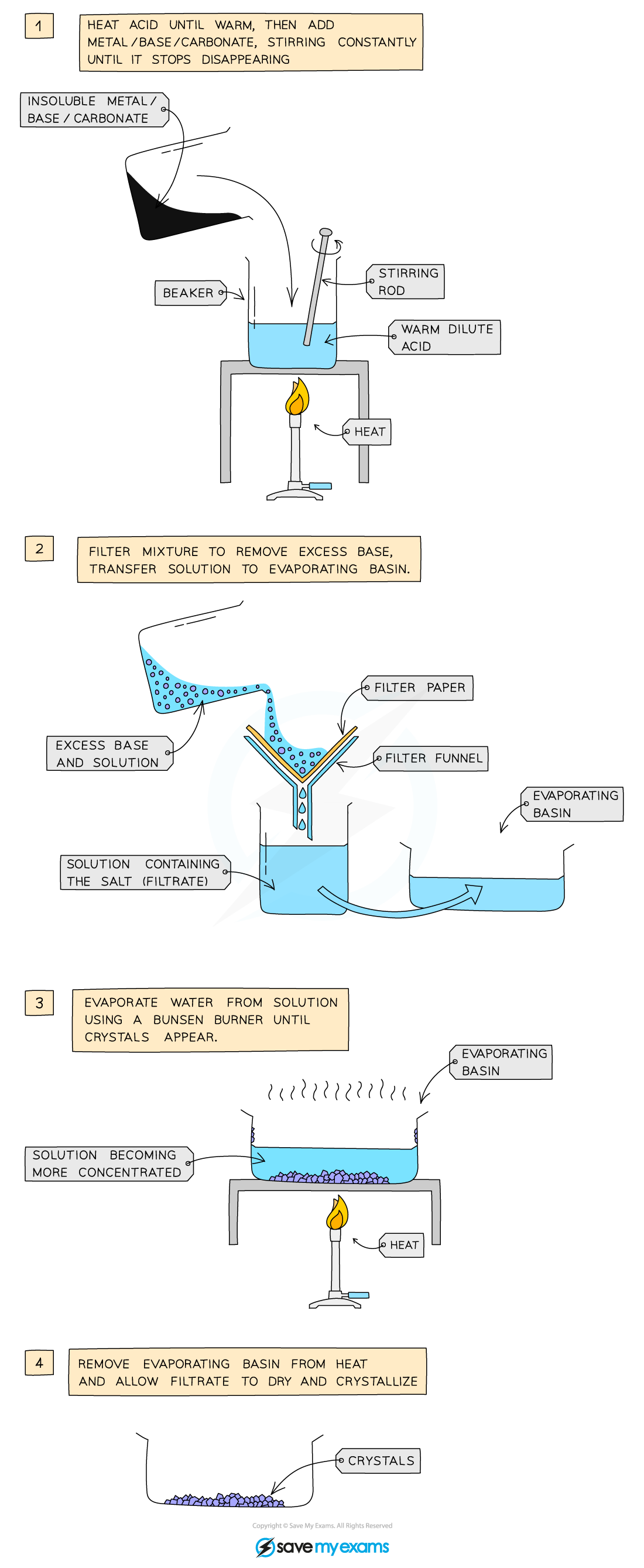
The preparation of copper(II) sulfate by the insoluble base method
Guided content from the SME authoring corpus — note rn_fQSYvKRMDBj3s2Bx, pinned at 78ad6a2073c6 · promoted SyllabAI/syllabai-resources e967e75f1339