Group 1: Reactivity & Electronic Configurations
2 guided lessons · 18 checks · 2. Inorganic Chemistry → Group 1 (Alkali Metals)
Guided lessons for this note
Which concept don't you understand yet?
We'll explain it simply and check your understanding. Pick any lesson — any order works.
0 of 18 checks correct so far
Lesson 1 of 2
Group 1: Reactivity & Electronic Configurations
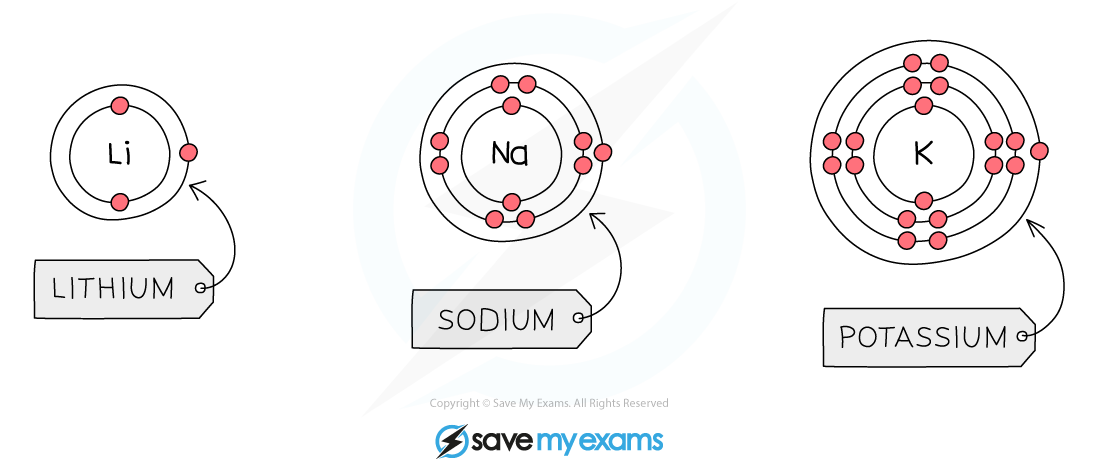
Every Group 1 atom carries exactly one electron in its outermost shell, and that single electron governs the metal's chemistry. When a Group 1 element reacts, its atom only needs to lose that one electron, so a 1+ ion forms at once. The shell beneath is already full, so the ion ends up with the same stable electron arrangement as a noble gas.
What you know already
From Group 1 (Alkali Metals) you already know these soft, low-density metals as the group that reacts readily with water and air. This note explains the reactivity trend down the group using electron shells: every alkali metal atom has one outer electron to lose, and losing that electron becomes easier the further it sits from the nucleus.
Key points of understanding
- On descending Group 1, each metal reacts more vigorously than the one above it.
- When a Group 1 element reacts, its atom needs to lose only the single electron in its outer shell.
- Losing that outer electron forms a 1+ ion with a full outer shell.
- The filled shell underneath becomes the outermost shell, so the ion gains a noble gas configuration.
- Sharing the one-outer-electron pattern is why the alkali metals have such similar reactions.
Choose a confidence level to continue.
Prefer to read it all at once? Show the full lesson as a page
1.Group 1: Reactivity & Electronic Configurations
Every Group 1 atom carries exactly one electron in its outermost shell, and that single electron governs the metal's chemistry. When a Group 1 element reacts, its atom only needs to lose that one electron, so a 1+ ion forms at once. The shell beneath is already full, so the ion ends up with the same stable electron arrangement as a noble gas.
Key points
- On descending Group 1, each metal reacts more vigorously than the one above it.
- When a Group 1 element reacts, its atom needs to lose only the single electron in its outer shell.
- Losing that outer electron forms a 1+ ion with a full outer shell.
- The filled shell underneath becomes the outermost shell, so the ion gains a noble gas configuration.
- Sharing the one-outer-electron pattern is why the alkali metals have such similar reactions.
Guided content from the SME authoring corpus — note rn_V9tPMnX6Hq2XnqcP, pinned at 6fb25fc02d1a · promoted SyllabAI/syllabai-resources e967e75f1339