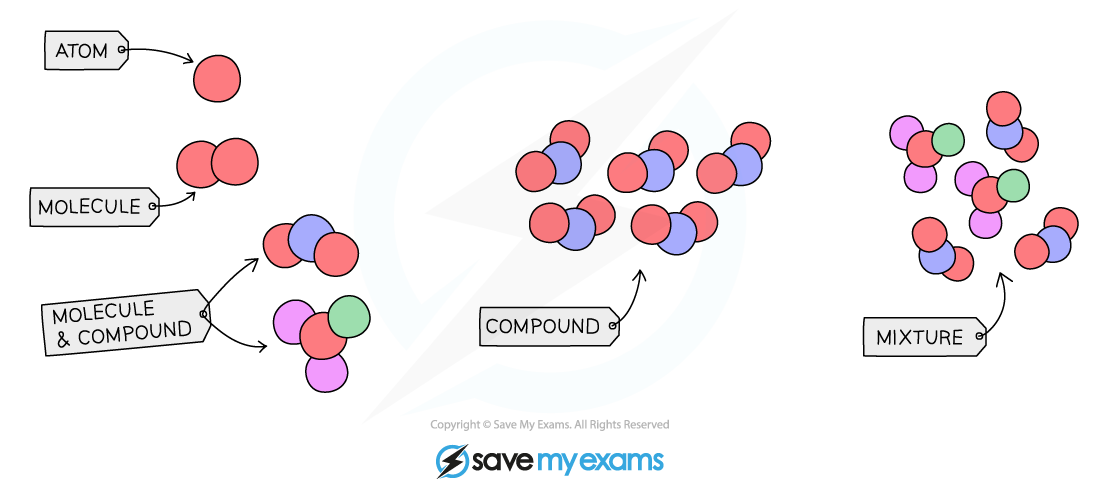
Element, Compound or Mixture
2 guided lessons · 18 checks · 1. Principles of Chemistry → Elements, Compounds & Mixtures
Guided lessons for this note
Which concept don't you understand yet?
We'll explain it simply and check your understanding. Pick any lesson — any order works.
0 of 18 checks correct so far
Lesson 1 of 2
Elements and Compounds
Every substance in chemistry belongs to exactly one of three families: an element, a compound or a mixture. This lesson takes the two families whose particles are chemically joined — elements, where every atom holds the same number of protons, and compounds, where two or more different elements are bonded into something new that behaves as one substance.
What you know already
You already know from States of Matter that every substance is built from particles. This note uses that idea to sort every substance into one of three families — an element, a compound or a mixture — by asking two questions: are the atoms all of the same kind, and are any different kinds chemically joined?
Key points of understanding
- All substances fall into exactly one of three classes: element, compound or mixture.
- An element is made of atoms that all hold the same number of protons.
- The periodic table holds 118 elements, for example copper, iron and magnesium.
- A compound joins two or more different elements by chemical bonds into one substance.
- No physical method can split a compound back into the elements it contains.
Choose a confidence level to continue.
Prefer to read it all at once? Show the full lesson as a page
1.Elements and Compounds
Every substance in chemistry belongs to exactly one of three families: an element, a compound or a mixture. This lesson takes the two families whose particles are chemically joined — elements, where every atom holds the same number of protons, and compounds, where two or more different elements are bonded into something new that behaves as one substance.
Key points
- All substances fall into exactly one of three classes: element, compound or mixture.
- An element is made of atoms that all hold the same number of protons.
- The periodic table holds 118 elements, for example copper, iron and magnesium.
- A compound joins two or more different elements by chemical bonds into one substance.
- No physical method can split a compound back into the elements it contains.
Guided content from the SME authoring corpus — note rn_TWGVV6RXN3Ktqb9h, pinned at 96c261a3a06e · promoted SyllabAI/syllabai-resources e967e75f1339