Diffusion & Dilution
2 guided lessons · 18 checks · 1. Principles of Chemistry → States of Matter
Guided lessons for this note
Which concept don't you understand yet?
We'll explain it simply and check your understanding. Pick any lesson — any order works.
0 of 18 checks correct so far
Lesson 1 of 2
Diffusion
Release bromine gas at the bottom of a jar and, within minutes, the red-brown colour has climbed into a second jar above it. Nothing stirred the gas, yet its particles travelled on their own. That self-driven spreading is called diffusion, and it happens in liquids as well as gases.
What you know already
You already know from States of Matter that everything is made of particles, moving differently in solids, liquids and gases. This note turns that model into evidence: two classic experiments, the spread of bromine gas and the fading of a purple solution, only make sense if tiny moving particles really exist. Diffusion and dilution are the particle theory made visible.
Key points of understanding
- Diffusion happens in gases and liquids because their particles are in random motion.
- Particles travel from regions of high concentration towards regions where it is low.
- Given time, the particles end up evenly spread throughout the available space.
- Diffusion needs no energy input, but it speeds up at higher temperatures.
- It is slower in liquids than in gases because liquid particles are closely packed and move slowly.
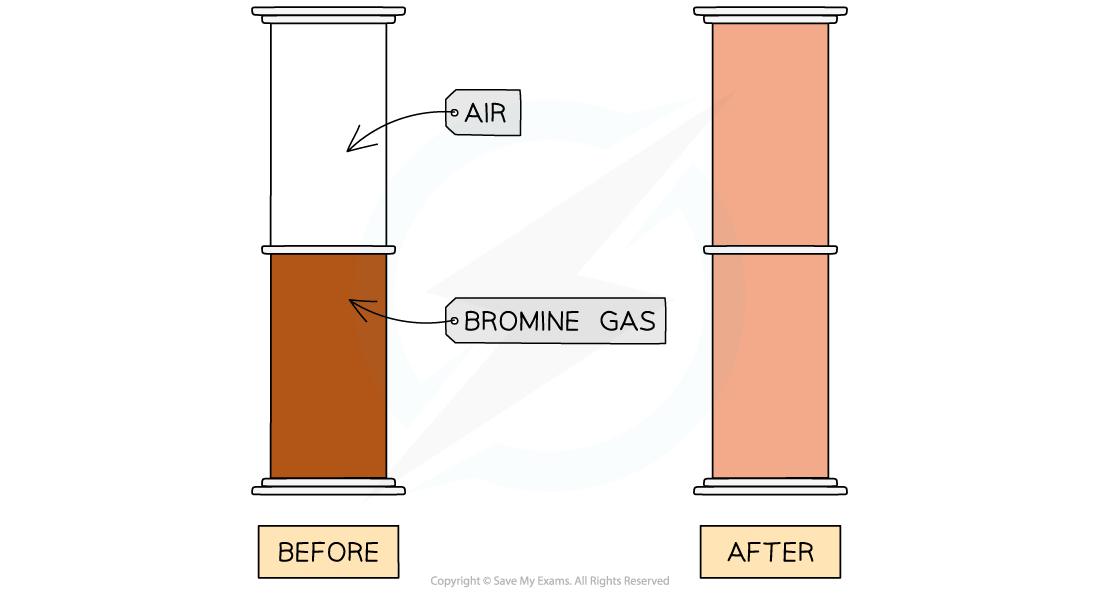
Diffusion of red-brown bromine gas
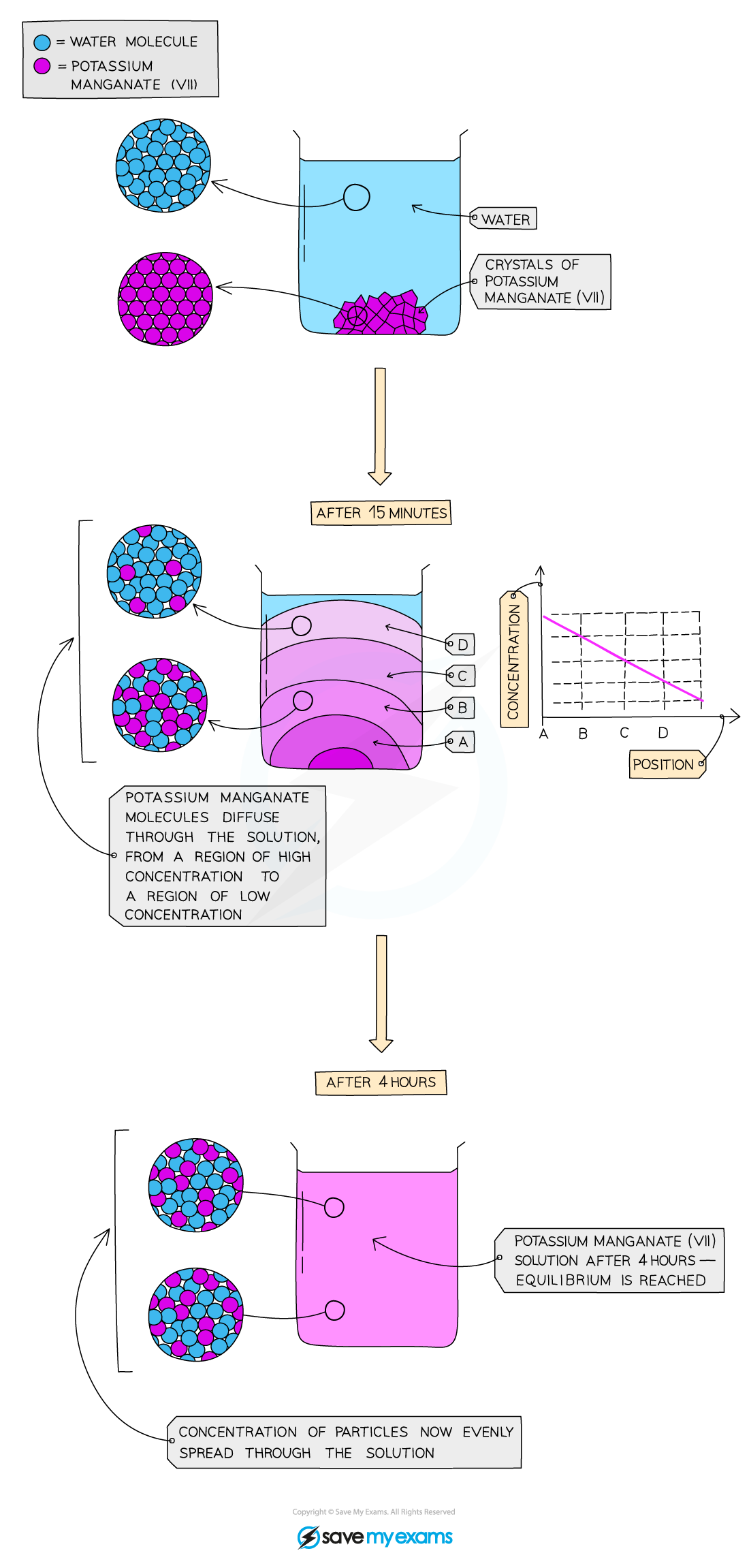
Diffusion of potassium manganate(VII) in water over time
Choose a confidence level to continue.
Prefer to read it all at once? Show the full lesson as a page
1.Diffusion
Release bromine gas at the bottom of a jar and, within minutes, the red-brown colour has climbed into a second jar above it. Nothing stirred the gas, yet its particles travelled on their own. That self-driven spreading is called diffusion, and it happens in liquids as well as gases.
Diffusion of red-brown bromine gas
Diffusion of potassium manganate(VII) in water over time
Key points
- Diffusion happens in gases and liquids because their particles are in random motion.
Guided content from the SME authoring corpus — note rn_S7GPh8BBPBbmhYKm, pinned at 96c261a3a06e · promoted SyllabAI/syllabai-resources e967e75f1339