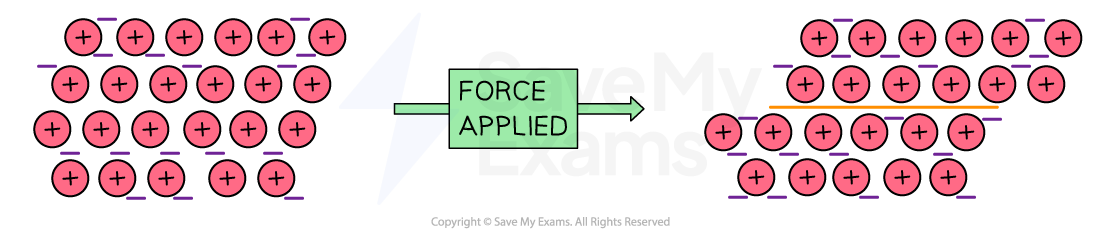
Metallic Bonding
2 guided lessons · 18 checks · 1. Principles of Chemistry → Metallic Bonding
Guided lessons for this note
Which concept don't you understand yet?
We'll explain it simply and check your understanding. Pick any lesson — any order works.
0 of 18 checks correct so far
Lesson 1 of 2
Metallic bonding & the lattice diagram
A metal is a giant structure of atoms arranged in a regular pattern. Within the lattice the atoms release their outer electrons, turning into positive ions, while the released electrons become delocalised and move freely between the ions like a sea. The metallic bond is the strong attraction between those positive ions and the delocalised electrons, and a simple 2-D diagram shows ions in rows with the electrons scattered between them.
What you know already
From Ionic Bonding you already know that metal atoms lose their outer electrons to form positive ions. This note keeps those electrons instead: in a pure metal the outer electrons are released into a shared sea that flows around an array of positive ions, and that single picture explains conduction, malleability and the high melting points of metals.
Key points of understanding
- A metal is a giant structure whose atoms sit in a regular, repeating pattern.
- Within the lattice the atoms lose their outer electrons, becoming positive metal ions.
- The released outer electrons are delocalised and move freely between the positive ions.
- The metallic bond is the strong pull that the positive ions and the electron sea exert on each other.
- A 2-D diagram of the metallic lattice shows rows of ions with delocalised electrons between them.
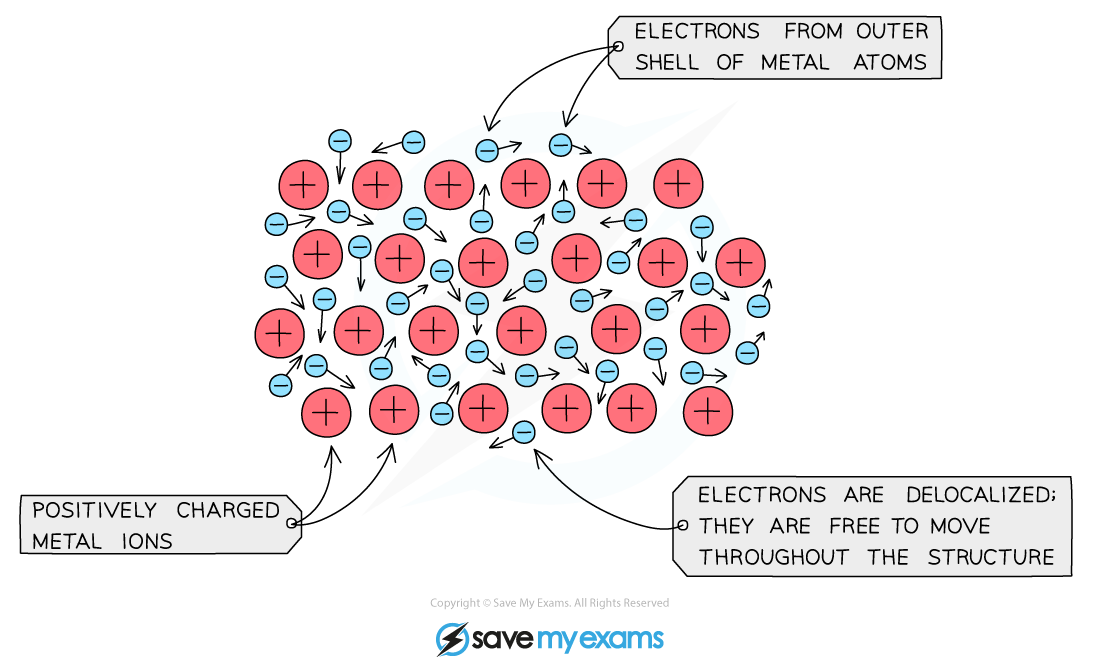
Metallic bonds exist between positive metal ions and delocalised electrons
Choose a confidence level to continue.
Prefer to read it all at once? Show the full lesson as a page
1.Metallic bonding & the lattice diagram
A metal is a giant structure of atoms arranged in a regular pattern. Within the lattice the atoms release their outer electrons, turning into positive ions, while the released electrons become delocalised and move freely between the ions like a sea. The metallic bond is the strong attraction between those positive ions and the delocalised electrons, and a simple 2-D diagram shows ions in rows with the electrons scattered between them.
Metallic bonds exist between positive metal ions and delocalised electrons
Key points
Guided content from the SME authoring corpus — note rn_Hp2nK8XpN2SmjdQc, pinned at fa1f302050ba · promoted SyllabAI/syllabai-resources e967e75f1339