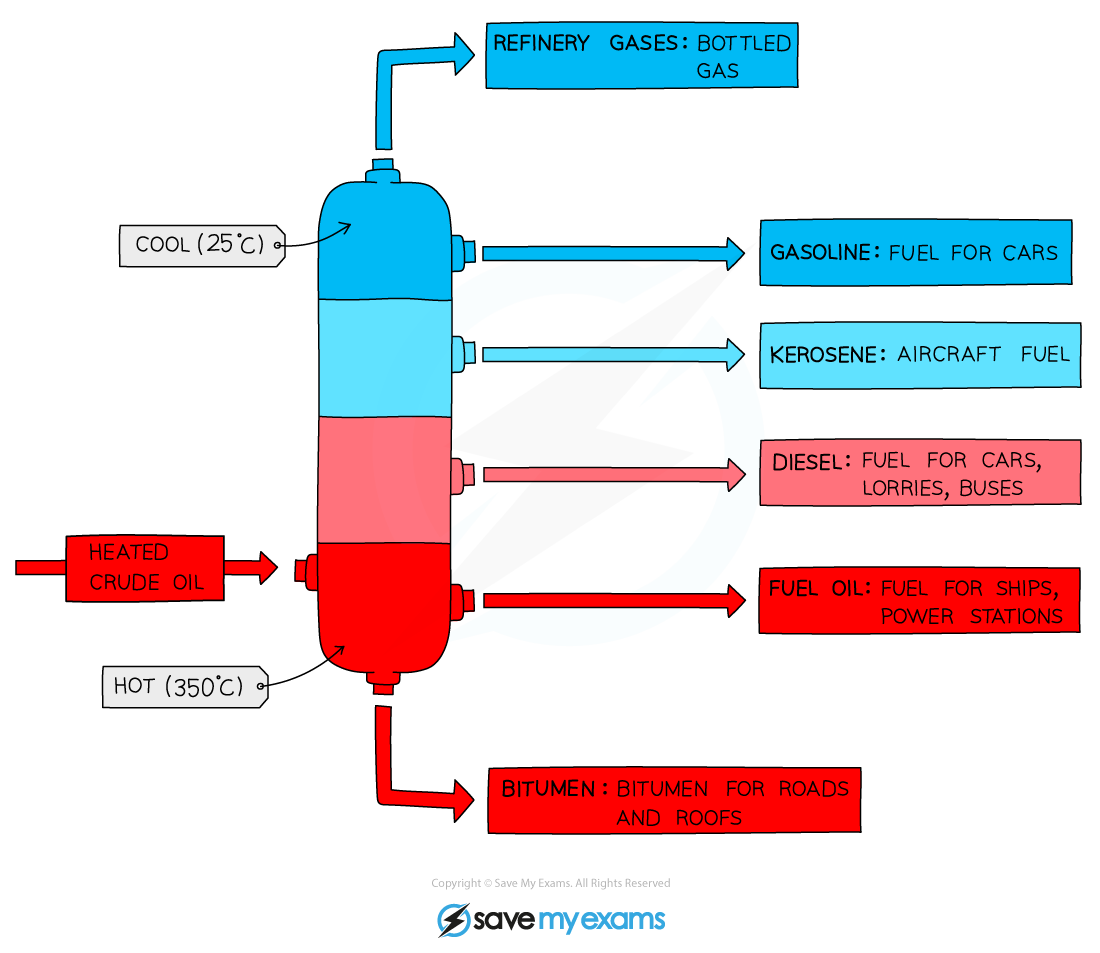
Crude Oil & Fractional Distillation
3 guided lessons · 27 checks · 4. Organic Chemistry → Crude Oil
Guided lessons for this note
Which concept don't you understand yet?
We'll explain it simply and check your understanding. Pick any lesson — any order works.
0 of 27 checks correct so far
Lesson 1 of 3
The mixture and the column that sorts it
Crude oil straight from the ground is a useless jumble, yet its separated parts power the world. This lesson follows the mixture into the fractionating column and explains why each group of molecules leaves where it does.
What you know already
From Classifying Organic Reactions you already know the three reaction types organic molecules undergo. This note meets the raw material they come from: crude oil, the column that sorts it, the six fractions worth learning by name, and the trends in their properties you must be able to explain.
Key points of understanding
- Crude oil is a mixture of hydrocarbons, which makes the crude itself of little direct use.
- The useful groups inside it are called fractions, each containing hydrocarbons of similar chain lengths.
- Fractional distillation separates the fractions because molecules of similar chain length have similar boiling points.
- Crude oil is heated so it vaporises, and the vapours enter a fractionating column that is hot at the bottom and cooler at the top.
- Vapours with high boiling points condense low down the column, while those with lower boiling points rise before condensing near the top.
Choose a confidence level to continue.
Prefer to read it all at once? Show the full lesson as a page
1.The mixture and the column that sorts it
Crude oil straight from the ground is a useless jumble, yet its separated parts power the world. This lesson follows the mixture into the fractionating column and explains why each group of molecules leaves where it does.
Key points
- Crude oil is a mixture of hydrocarbons, which makes the crude itself of little direct use.
- The useful groups inside it are called fractions, each containing hydrocarbons of similar chain lengths.
- Fractional distillation separates the fractions because molecules of similar chain length have similar boiling points.
Guided content from the SME authoring corpus — note rn_H9chr9BWCfXYW472, pinned at 52acc7ec1650 · promoted SyllabAI/syllabai-resources e967e75f1339