Esters
2 guided lessons · 18 checks · 4. Organic Chemistry → Esters
Guided lessons for this note
Which concept don't you understand yet?
We'll explain it simply and check your understanding. Pick any lesson — any order works.
0 of 18 checks correct so far
Lesson 1 of 2
Making esters from alcohols and acids
Alcohols and carboxylic acids join hands in an esterification reaction, releasing water as they bond. The product carries the -COO- link and, for the two smallest partners, the sweet oily liquid called ethyl ethanoate. This lesson draws the functional group and the equation that balances both products.
What you know already
From Reactions of Carboxylic Acids you already know the -COOH group giving salts with metals and carbonates. This note introduces a gentler partner: alcohols, which join the acid directly and build the sweet-smelling ester family used across kitchens and perfume counters.
Key points of understanding
- An alcohol and a carboxylic acid react to make an ester in an esterification reaction.
- Esters carry the functional group R-COO-R between two carbon chains.
- Ethanoic acid with ethanol and a concentrated sulfuric acid catalyst gives ethyl ethanoate.
- The equation reads CH3COOH + C2H5OH giving CH3COOC2H5 + H2O.
- A molecule of water is released as the two reactants join.
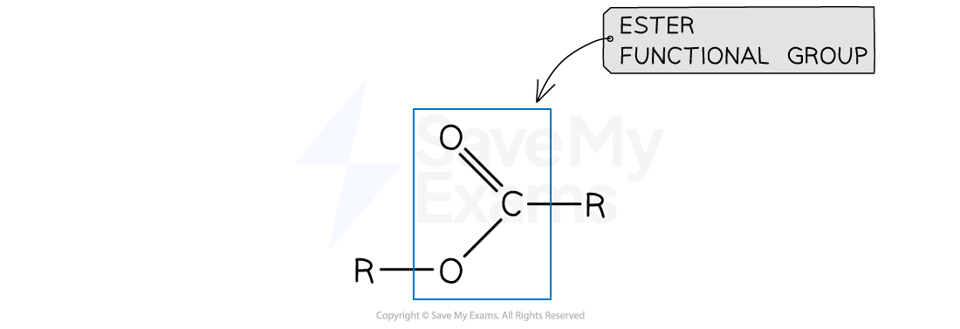
Esters are compounds with the functional group R-COO-R
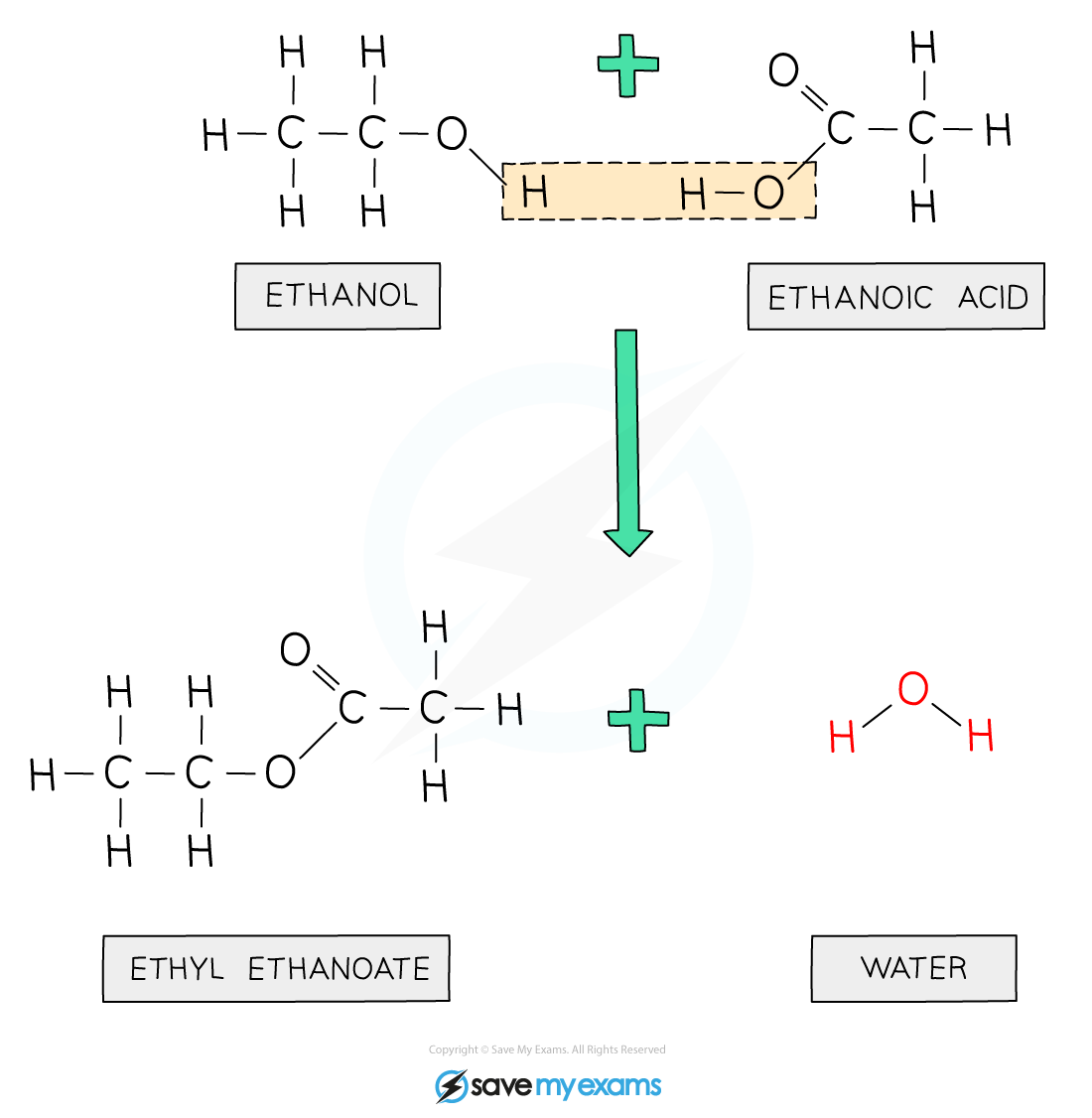
During this esterification reaction, a molecule of water is also produced
Choose a confidence level to continue.
Prefer to read it all at once? Show the full lesson as a page
1.Making esters from alcohols and acids
Alcohols and carboxylic acids join hands in an esterification reaction, releasing water as they bond. The product carries the -COO- link and, for the two smallest partners, the sweet oily liquid called ethyl ethanoate. This lesson draws the functional group and the equation that balances both products.
Esters are compounds with the functional group R-COO-R
During this esterification reaction, a molecule of water is also produced
Key points
- An alcohol and a carboxylic acid react to make an ester in an esterification reaction.
- Esters carry the functional group R-COO-R between two carbon chains.
- Ethanoic acid with ethanol and a concentrated sulfuric acid catalyst gives ethyl ethanoate.
- The equation reads CH3COOH + C2H5OH giving CH3COOC2H5 + H2O.
- A molecule of water is released as the two reactants join.
First pass
An alcohol plus a carboxylic acid makes an ester, with water also formed. Concentrated sulfuric acid catalyses the joining, and the smallest pairing gives ethyl ethanoate.
Analogy — The reaction is two hands locking: the alcohol hand and the acid hand clasp, and a water molecule slips away like a dropped glove.
Exam pointer — State both products every time: the ester and the water.
Going deeper
Esterification joins an alcohol and a carboxylic acid, with concentrated sulfuric acid as catalyst, and releases one water molecule per bond formed. Ethanoic acid with ethanol yields CH3COOC2H5, the ester ethyl ethanoate of the two smallest partners.
Analogy — Picture the acid handing over one -OH and the alcohol one -H to build water, while their remaining skeletons clip together through the -COO- link.
Exam pointer — Write the equation with both reactants and both products; omitting the water is the common mark-loser.
Checks
0 of 9 attempted · 0 correct
2.Naming esters and their everyday uses
Ester names read backwards from their making: the alcohol lends its -yl part first, the acid lends its -oate part second. The family smells sweet, evaporates readily and turns up in flavourings and perfumes. This lesson turns names into structures and back again.
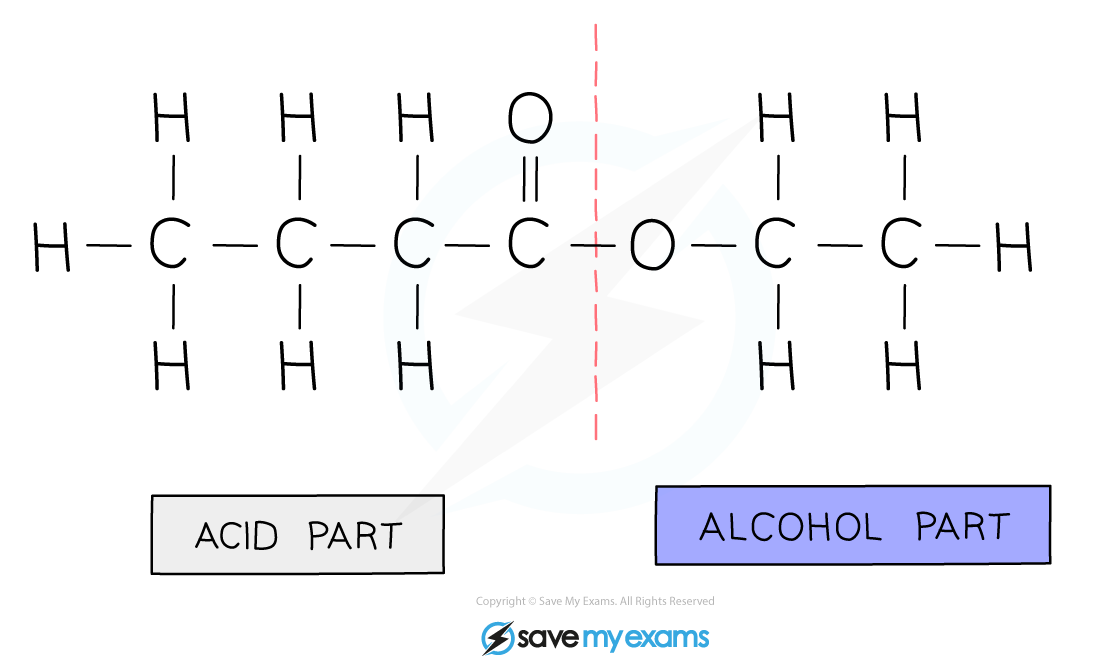
Diagram showing the origin of each carbon chain in ester
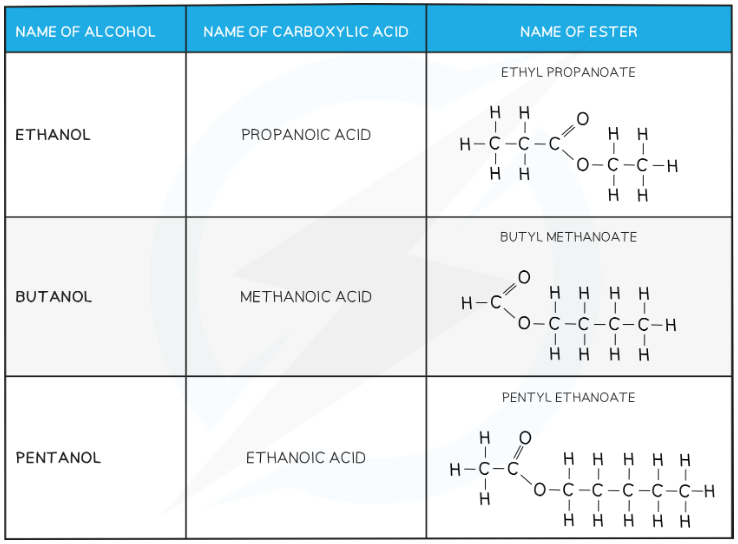
Key points
- The first part of an ester name comes from the alcohol and ends in yl.
- The second part comes from the carboxylic acid and ends in oate.
- Pentanol reacting with butanoic acid gives pentyl butanoate.
- Esters are volatile liquids with distinctive, sweet smells.
- Their uses include food flavourings and perfumes.
First pass
Ester names take yl from the alcohol and oate from the acid: pentanol plus butanoic acid gives pentyl butanoate. The liquids are volatile, sweet-smelling and used in flavourings and perfumes.
Analogy — A name is a handover note: the alcohol signs first in yl, the acid countersigns in oate, and the flavour bottle shelves the result.
Exam pointer — When converting a name back, split it at yl and oate before drawing anything.
Going deeper
The alcohol chain supplies the yl segment and the acid chain the oate segment, so pentanol with butanoic acid yields pentyl butanoate. Members are volatile liquids with strong sweet smells, which is why they serve as food flavourings and perfume ingredients.
Analogy — Volatility is the delivering power of the liquid: molecules leave the surface readily and ride the air to the nose, the whole trick behind a perfume.
Exam pointer — Expect name-to-structure and structure-to-name in both directions; practise until the split at yl and oate is automatic.
Checks
0 of 9 attempted · 0 correct
Guided content from the SME authoring corpus — note rn_BDkhS5vQpRd4hvwf, pinned at 45d591243cae · promoted SyllabAI/syllabai-resources e967e75f1339