Group 7 (Halogens)
3 guided lessons · 27 checks · 2. Inorganic Chemistry → Group 7 (Halogens)
Guided lessons for this note
Which concept don't you understand yet?
We'll explain it simply and check your understanding. Pick any lesson — any order works.
0 of 27 checks correct so far
Lesson 1 of 3
Physical properties of Group 7 elements
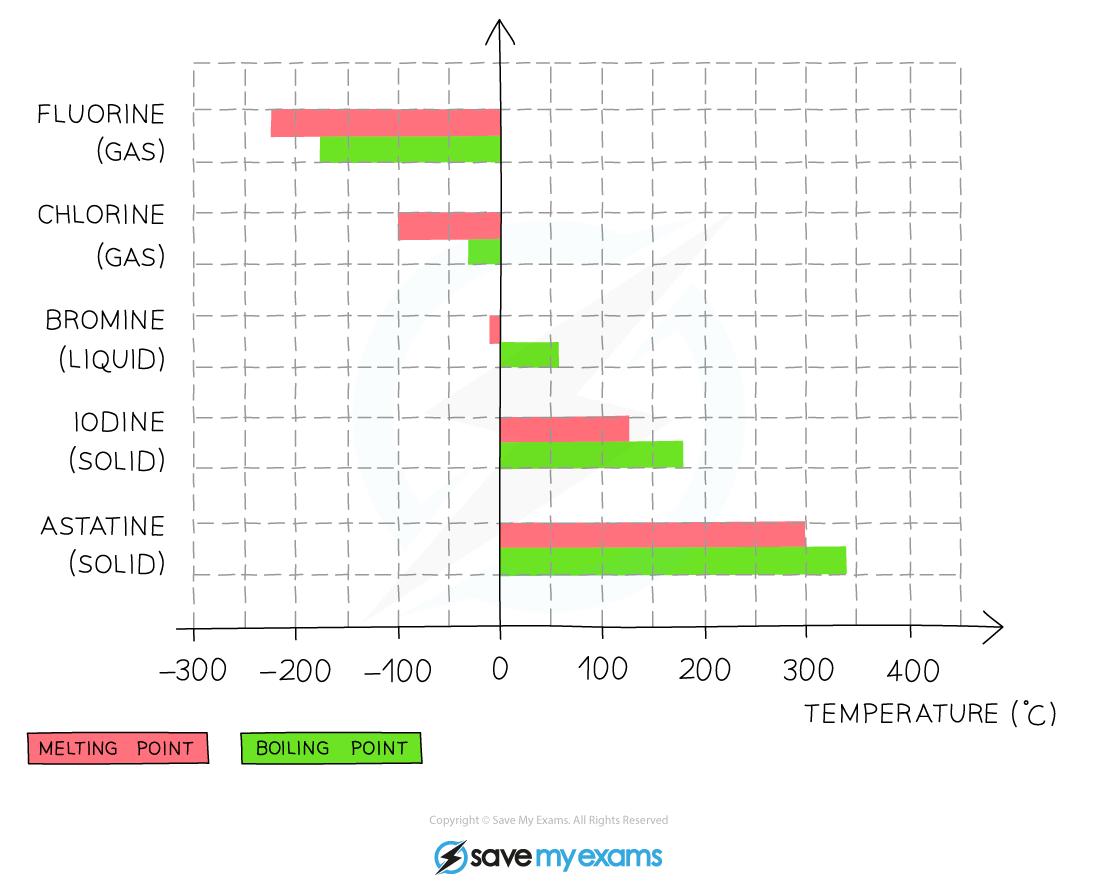
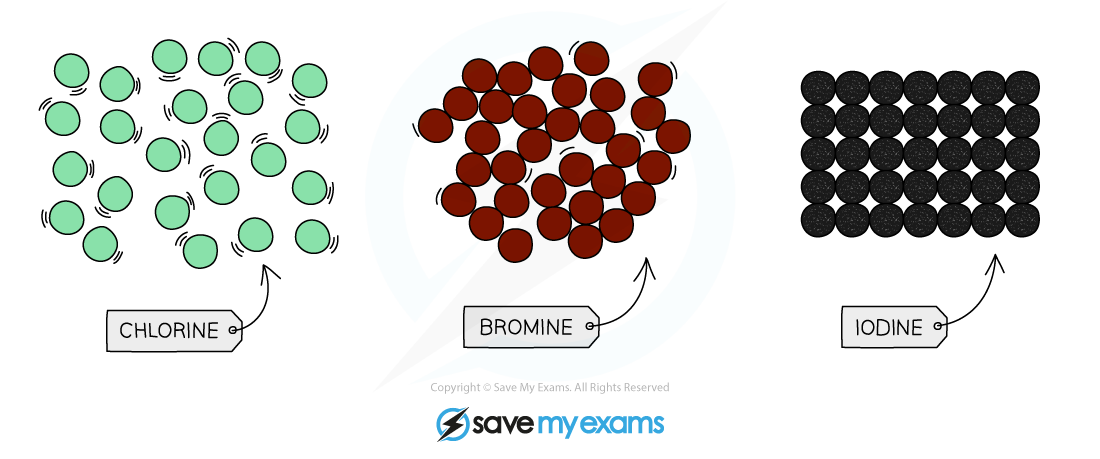
The Group 7 elements are the halogens: fluorine, chlorine, bromine, iodine and astatine, all poisonous non-metals with seven electrons in their outer shell. Each halogen forms diatomic molecules, meaning two atoms joined by a single covalent bond. At room temperature the group spans every state, from fluorine and chlorine as gases, through bromine as a liquid, to iodine as a solid.
What you know already
From Group 7 (Halogens) you already know that these reactive non-metals sit one column left of the noble gases, each with seven outer electrons. This note adds their states and colours at room temperature, the melting and boiling point trend, how the pattern predicts any member of the group, and how displacement reactions prove the reactivity order.
Key points of understanding
- On descending the group, the halogens melt and boil at steadily higher temperatures.
- Larger atoms give stronger intermolecular forces, so more energy is needed to overcome them.
- Fluorine is a yellow gas, chlorine a pale yellow-green gas, bromine a red-brown liquid and iodine a grey solid.
- The colours of the halogens darken as you descend the group.
- In solution, chlorine appears pale green, bromine orange and iodine dark brown.
Choose a confidence level to continue.
Prefer to read it all at once? Show the full lesson as a page
1.Physical properties of Group 7 elements
The Group 7 elements are the halogens: fluorine, chlorine, bromine, iodine and astatine, all poisonous non-metals with seven electrons in their outer shell. Each halogen forms diatomic molecules, meaning two atoms joined by a single covalent bond. At room temperature the group spans every state, from fluorine and chlorine as gases, through bromine as a liquid, to iodine as a solid.
Key points
- On descending the group, the halogens melt and boil at steadily higher temperatures.
- Larger atoms give stronger intermolecular forces, so more energy is needed to overcome them.
- Fluorine is a yellow gas, chlorine a pale yellow-green gas, bromine a red-brown liquid and iodine a grey solid.
- The colours of the halogens darken as you descend the group.
- In solution, chlorine appears pale green, bromine orange and iodine dark brown.
Guided content from the SME authoring corpus — note rn_7Q8M9nVkr2FxCzxd, pinned at 6fb25fc02d1a · promoted SyllabAI/syllabai-resources e967e75f1339