Practical: Effect of Catalysts on Rate of Reaction
2 guided lessons · 18 checks · 3. Physical Chemistry → Rates of Reaction
Guided lessons for this note
Which concept don't you understand yet?
We'll explain it simply and check your understanding. Pick any lesson — any order works.
0 of 18 checks correct so far
Lesson 1 of 2
Testing solids on hydrogen peroxide
Hydrogen peroxide decomposes quietly on its own, but the right solid makes it fizz. This lesson sets out the aim, the collection apparatus and the six-step method that tests one candidate at a time.
What you know already
From Catalysts you already know that helpers speed reactions without being consumed. This practical races several solid candidates against hydrogen peroxide, collecting the oxygen each one liberates. The graph at the end ranks the catalysts by how fast they worked.
Key points of understanding
- The practical tests how several solid candidates change the speed of peroxide breaking down.
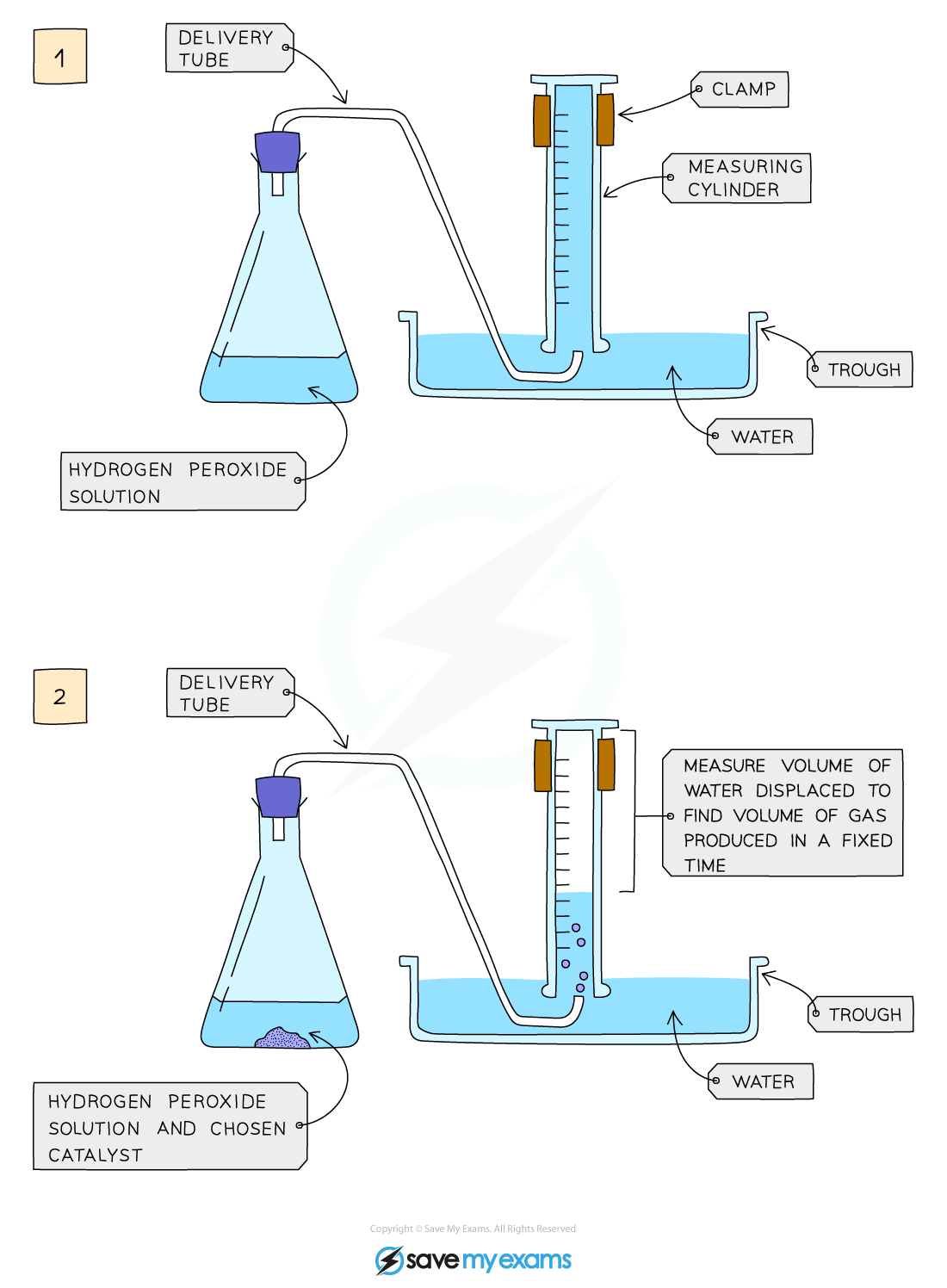
- Hydrogen peroxide is added to a conical flask connected by a delivery tube to an inverted measuring cylinder.
- The chosen catalyst is added, the bung is closed, and the gas volume in a fixed time is measured.
- The experiment is repeated with different catalysts so their results can be compared.
- Candidate solids include the oxides of manganese(IV), lead(II), iron(III) and copper(II).
Choose a confidence level to continue.
Prefer to read it all at once? Show the full lesson as a page
1.Testing solids on hydrogen peroxide
Hydrogen peroxide decomposes quietly on its own, but the right solid makes it fizz. This lesson sets out the aim, the collection apparatus and the six-step method that tests one candidate at a time.
Key points
- The practical tests how several solid candidates change the speed of peroxide breaking down.
- Hydrogen peroxide is added to a conical flask connected by a delivery tube to an inverted measuring cylinder.
- The chosen catalyst is added, the bung is closed, and the gas volume in a fixed time is measured.
- The experiment is repeated with different catalysts so their results can be compared.
Guided content from the SME authoring corpus — note rn_3wZh9qRT7qFJn9QW, pinned at 51a6ed34e715 · promoted SyllabAI/syllabai-resources e967e75f1339