Electrolysis Experiments
2 guided lessons · 18 checks · 1. Principles of Chemistry → Electrolysis
Guided lessons for this note
Which concept don't you understand yet?
We'll explain it simply and check your understanding. Pick any lesson — any order works.
0 of 18 checks correct so far
Lesson 1 of 2
Electrolysis of molten compounds
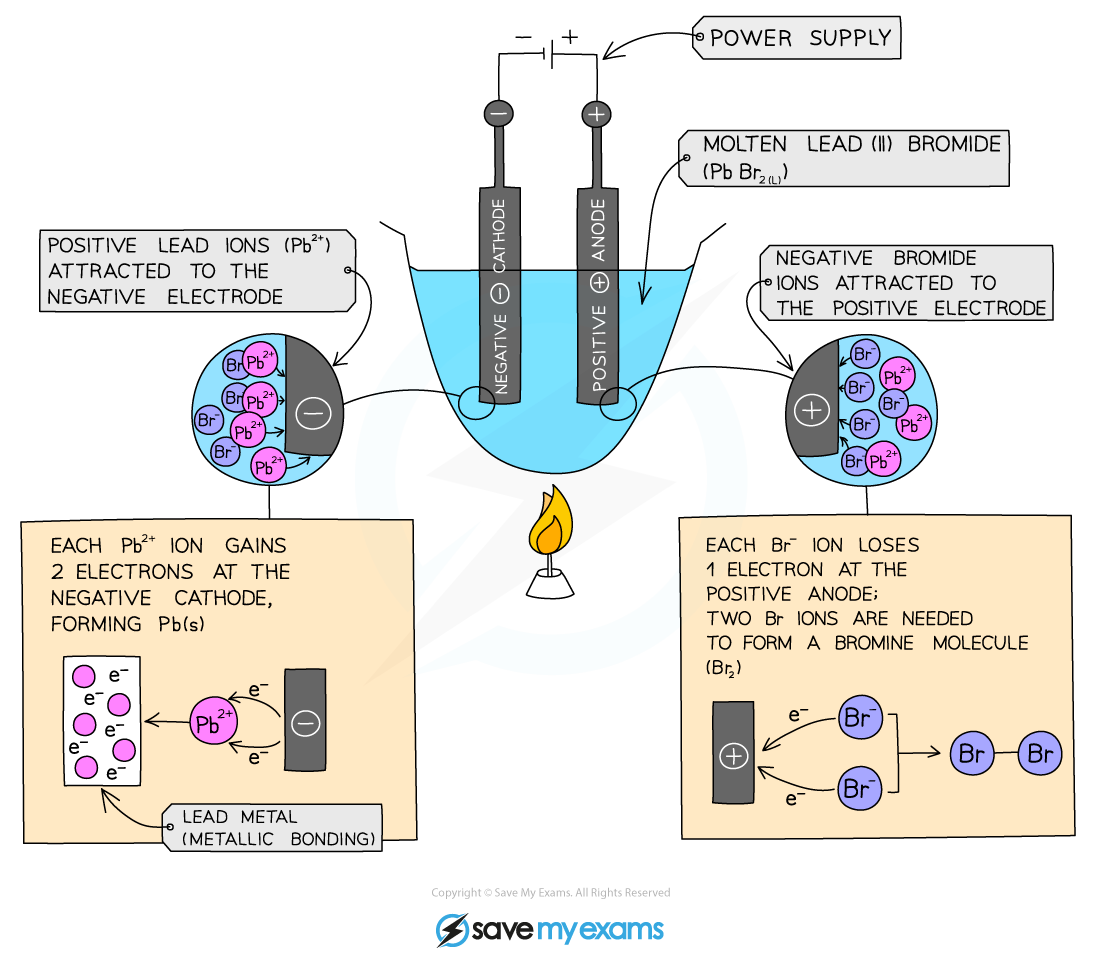
A binary ionic compound contains just two elements joined by ionic bonding, lead(II) bromide being the classic example. Heated past its melting point it becomes molten, its ions can move freely, and it conducts, which allows electrolysis to split it into its two elements. The positive ion always travels to the cathode and the negative ion to the anode, so the cathode product is the metal and the anode product the non-metal.
What you know already
From Explaining Conductivity you know that ionic compounds conduct only when molten or dissolved, and that their ions then migrate to the electrodes. This note turns that knowledge into laboratory experiments: electrolysis of molten compounds such as lead(II) bromide, electrolysis of aqueous solutions, and the rules that predict which product appears at each electrode.
Key points of understanding
- A binary ionic compound consists of just two elements joined by ionic bonding, such as lead(II) bromide.
- Heated beyond its melting point, the compound becomes molten and can conduct because its ions move freely.
- The positive ion migrates to the cathode and the negative ion to the anode.
- The cathode product is always the metal, and the anode product is always the non-metal.
- In molten lead(II) bromide, brown bromine gas bubbles at the anode and grey lead deposits at the cathode.
Choose a confidence level to continue.
Prefer to read it all at once? Show the full lesson as a page
1.Electrolysis of molten compounds
A binary ionic compound contains just two elements joined by ionic bonding, lead(II) bromide being the classic example. Heated past its melting point it becomes molten, its ions can move freely, and it conducts, which allows electrolysis to split it into its two elements. The positive ion always travels to the cathode and the negative ion to the anode, so the cathode product is the metal and the anode product the non-metal.
Key points
- A binary ionic compound consists of just two elements joined by ionic bonding, such as lead(II) bromide.
- Heated beyond its melting point, the compound becomes molten and can conduct because its ions move freely.
- The positive ion migrates to the cathode and the negative ion to the anode.
- The cathode product is always the metal, and the anode product is always the non-metal.
- In molten lead(II) bromide, brown bromine gas bubbles at the anode and grey lead deposits at the cathode.
First pass
Melt the compound and its two ions become mobile, so a current can pass. Opposite charges steer them: the metal ion reaches the cathode and turns into metal, the non-metal ion reaches the anode and turns into the non-metal, as lead(II) bromide shows with grey lead and brown bromine.
Analogy — Think of a sorting gate at a recycling plant: metal pieces roll one way, non-metal pieces the other, and the two collection bins fill with pure, separate products.
Exam pointer — Describe the method with its equipment words: crucible, heat until molten, two graphite rod electrodes, and a power pack; the observation words are bubbling brown gas and grey deposit.
Going deeper
The experiment works because the molten state removes the lattice constraint: freed ions carry the current, so the melt undergoes electrolysis and decomposes into its elements. Charge decides where each ion ends up, with positive ions gaining electrons at the cathode to form the metal and negative ions losing electrons at the anode to form the non-metal.
Analogy — Picture two exits from a crowded hall, one marked plus and one marked minus: everyone walks to the exit opposite to their ticket, and each exit turns its crowd into a single pure product.
Exam pointer — Product questions reduce to one move: identify the two ions, send the positive one to the cathode and the negative one to the anode, then name the element each becomes.
Checks
0 of 9 attempted · 0 correct
2.Electrolysis of aqueous solutions
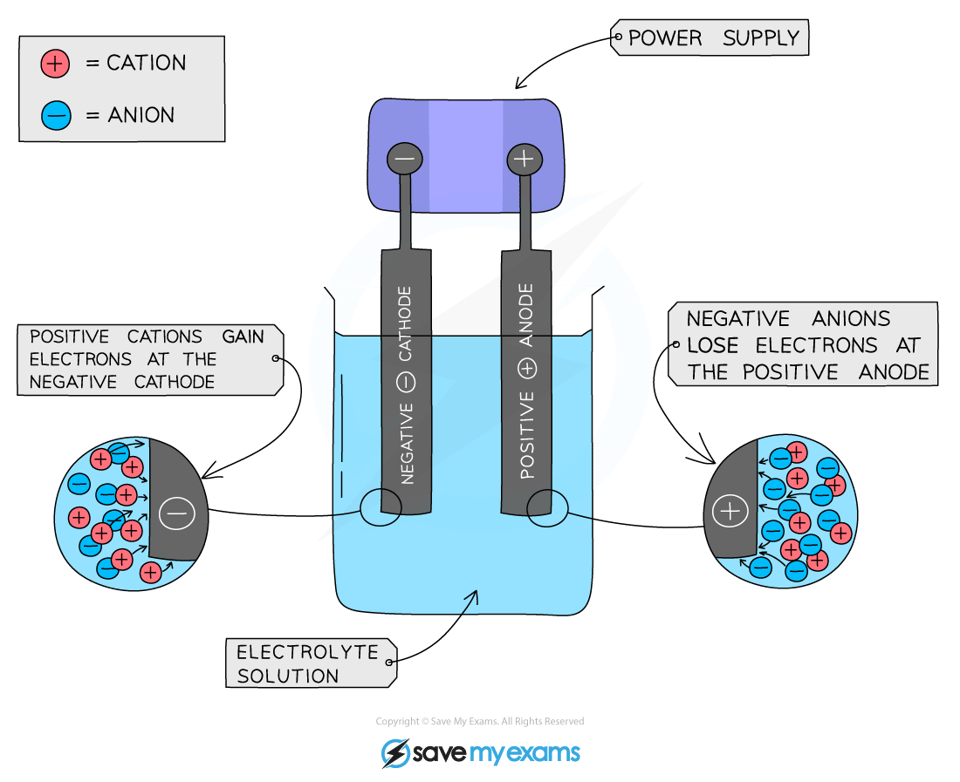
Aqueous solutions bring extra players to electrolysis, because water molecules split into H+ and OH- ions alongside the ions of the dissolved compound. Which ions are discharged depends on their relative reactivity. At the anode a halide ion, if present, is discharged to give a halogen; otherwise OH- is discharged to give oxygen. At the cathode hydrogen emerges unless the metal ion is less reactive than hydrogen itself, in which case the metal deposits instead.
Key points
- Water molecules in the solution split into H+ and OH- ions, which join the ions from the dissolved compound.
- Which ions are discharged is decided by how reactive the elements involved are.
- At the anode, a halide ion is discharged to form a halogen; with no halide present, OH- forms oxygen.
- At the cathode, hydrogen forms if the metal is more reactive than hydrogen; otherwise the metal deposits.
- The electrodes are inert graphite rods, and inverted test tubes over them can collect the gases.
First pass
The water itself donates H+ and OH- ions, so the electrolyte holds two rival sets of ions. Reactivity picks the winners: at the anode the halide wins if there is one, otherwise oxygen forms, and at the cathode hydrogen wins unless the metal is less reactive than hydrogen.
Analogy — Think of two queues for one ride: the queue that gets priority is decided by a fixed rule, and the losing queue simply waits in the solution for another turn.
Exam pointer — Write down every ion present before predicting anything; the exam hint says listing the ions first is the reliable route to the products.
Going deeper
The aqueous electrolyte is a mixture of compound ions and the ions from water's own split into H+ and OH-. Discharge follows relative reactivity: halide ions outrank hydroxide at the anode, producing the halogen, while at the cathode the less reactive candidate is discharged, so hydrogen emerges unless a metal less reactive than hydrogen is present.
Analogy — Picture a dispatch office sending the least stubborn claimant first: reactivity is stubbornness, and the particle that gives up most easily is the one released at the electrode.
Exam pointer — Practise the three named solutions to the point of instant recall: sodium chloride, dilute sulfuric acid and copper(II) sulfate, each with its own cathode and anode products.
Checks
0 of 9 attempted · 0 correct
From the revision note
Diagrams on this note's page that are not tied to a specific lesson.
Lead ions are attracted to the cathode, and bromide ions to the anode
Guided content from the SME authoring corpus — note rn_3YZNCXSQQqXTT6HR, pinned at fa1f302050ba · promoted SyllabAI/syllabai-resources e967e75f1339