The Three States of Matter
2 guided lessons · 18 checks · 1. Principles of Chemistry → States of Matter
Guided lessons for this note
Which concept don't you understand yet?
We'll explain it simply and check your understanding. Pick any lesson — any order works.
0 of 18 checks correct so far
Lesson 1 of 2
States of matter
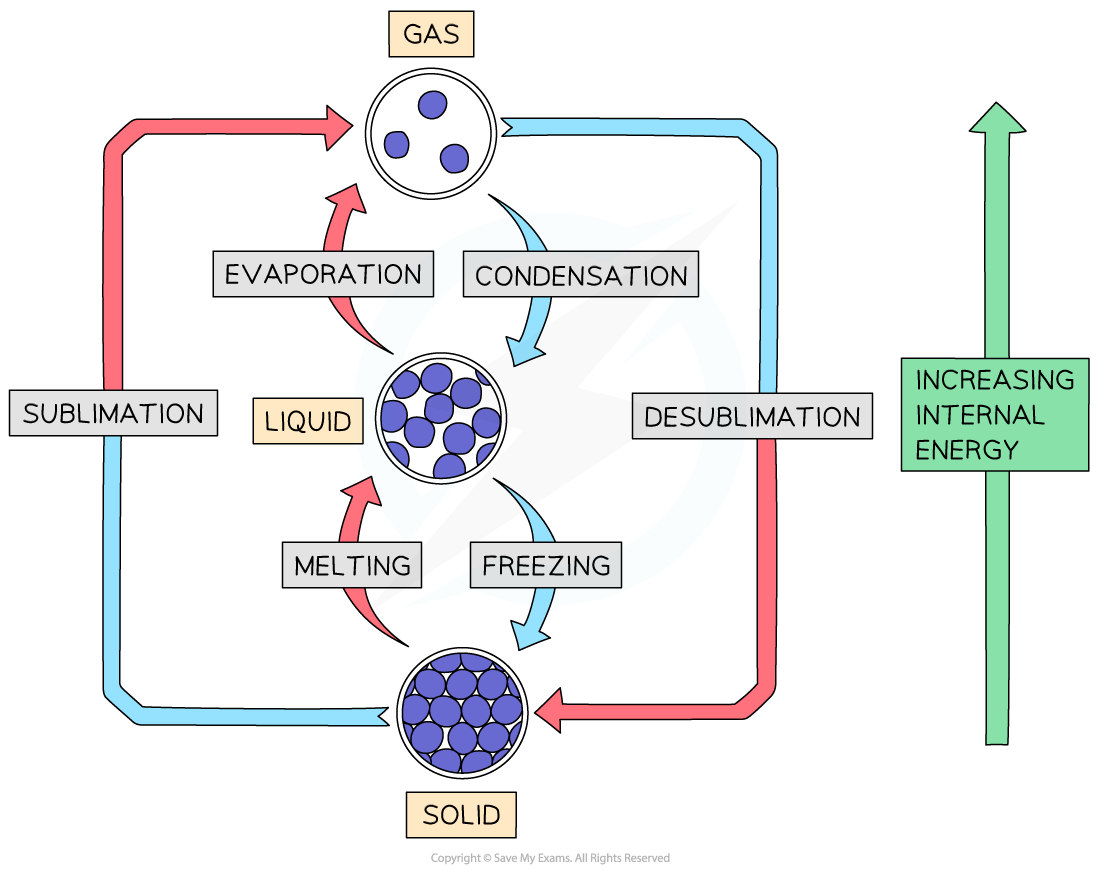
Everything around you exists as a solid, a liquid or a gas, and the same substance can usually move between all three. Chemists explain the differences with a particle model, picturing every particle as a small solid sphere. How those spheres are arranged, how freely they move and how much energy they hold decide which state a material takes.
What you know already
You already know from everyday life that ice melts, puddles dry out and steam fogs a cold window. This topic turns that familiar experience into a precise particle picture: what solids, liquids and gases really are, and what exactly happens when a substance changes from one state to another. By the end you will be able to name every state change and explain it through the behaviour of particles.
Key points of understanding
- Solids, liquids and gases are the three states, and one substance can usually exist in each of them.
- Melting and freezing happen at the melting point; boiling and condensing happen at the boiling point.
- In the model, every particle is drawn as a small solid sphere, whatever the substance.
- Solid particles sit in a regular arrangement, vibrating about fixed positions and very close together.
- Liquid particles are randomly arranged but still close, moving around each other.
- Gas particles are randomly arranged, far apart, and move quickly in all directions.
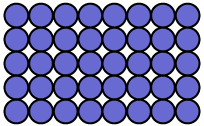
Solid — Diagram
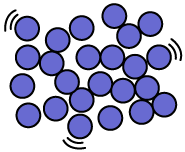
Liquid — Diagram
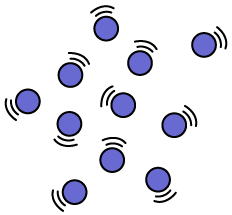
Gas — Diagram
Choose a confidence level to continue.
Prefer to read it all at once? Show the full lesson as a page
1.States of matter
Everything around you exists as a solid, a liquid or a gas, and the same substance can usually move between all three. Chemists explain the differences with a particle model, picturing every particle as a small solid sphere. How those spheres are arranged, how freely they move and how much energy they hold decide which state a material takes.
Solid — Diagram
Liquid — Diagram
Gas — Diagram
Guided content from the SME authoring corpus — note rn_2VnK66PqbvFKdKYt, pinned at 96c261a3a06e · promoted SyllabAI/syllabai-resources e967e75f1339