The Four Factors of Production (Edexcel IGCSE Business)
Capital, enterprise, land and labour
Spec point —
5.3.1· Changing relationships between enterprise, capital, land, and labour:
- Factors of production are the resources used to produce goods & services
The factors of production
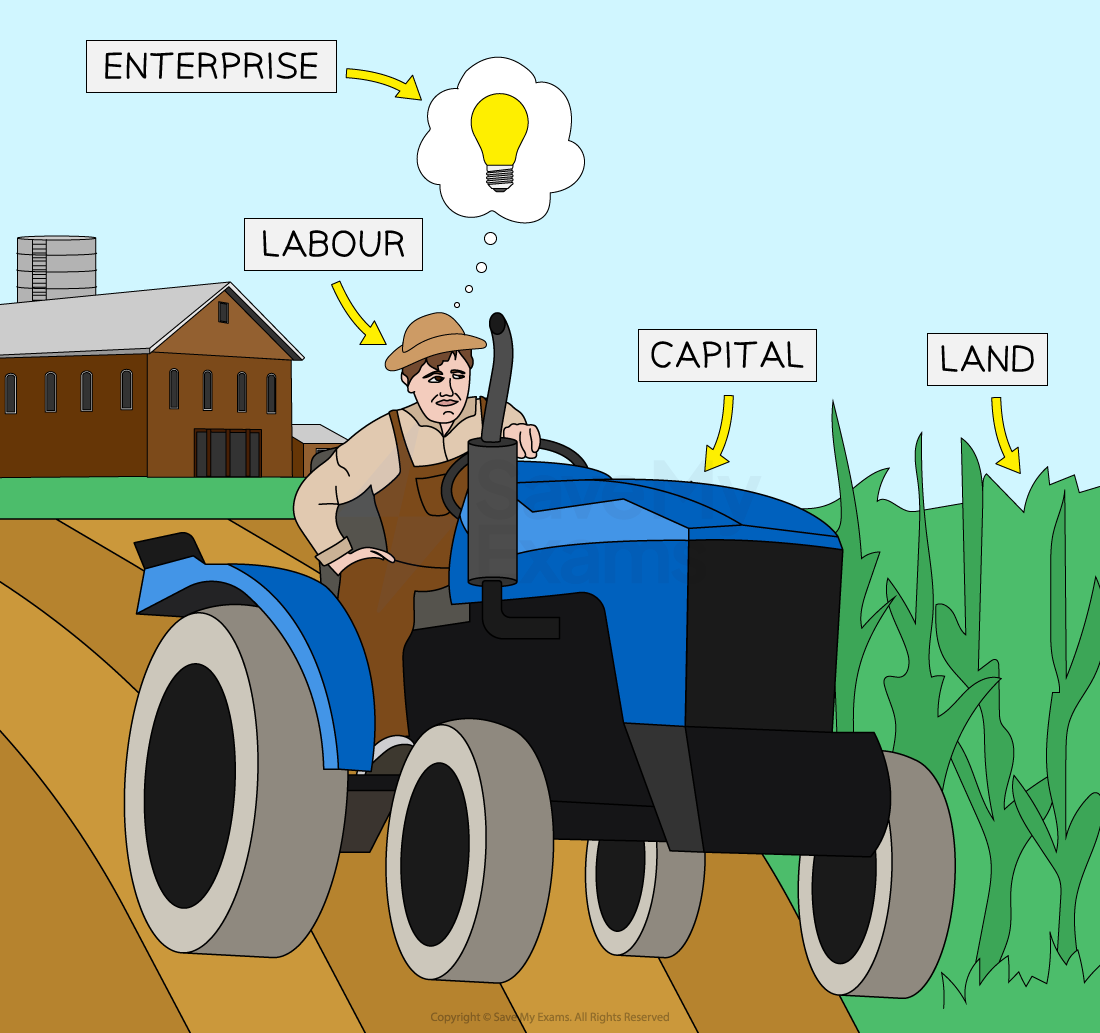
The four factors of production are land, capital, labour and enterprise
-
The production of any good/service requires the use of a combination of all four factors of production
- Goods are physical objects that can be touched (tangible) e.g. mobile phone
- Services are actions or activities that one person performs for another (intangible) e.g manicure, car wash
Explanation of the four factors of production
| Land | Capital |
|---|---|
| - Non man-made natural resources available for production - Some countries have a vast amount of a particular natural resource & so are able to specialise in its production - E.g.Kuwait specialises in the product of oil which accounts for 95% of its exports | - Capital is any man-made resource that is used to produce goods/services - Examples include tools, buildings, machines & computers |
| Labour | Enterprise |
| - The human input into the production process, labour involves mental or physical effort - Not all labour is of the same quality - It can be skilled or unskilled - Some workers are more productive than others because of their education, training and experience | - Enterprise involves taking risks in setting up or running a firm - An entrepreneur decides on the combination of the factors of production necessary to produce goods/services with the aim of generating profit |
Factors of production in capital-intensive and labour-intensive activities
Spec point —
5.3.1· Changing relationships between enterprise, capital, land, and labour: • difference between capital-intensive and labour-intensive activities.
Factors of production in capital-intensive and labour-intensive activities
Capital-intensive processes and factors of production
- In capital-intensive processes there is an emphasis on the use of machinery and technology in production
- Labour is used to complete processes that require specialist skills such as design or to oversee the operation of machinery
Factors of production to produce a car
| Land | Labour | Capital | Enterprise |
|---|---|---|---|
| factory site testing facilities storage facilities | car designer production director production line supervisors supply chain staff | robotic arms conveyor belt rolled steel computers seats dashboards mirrors leather | CEO & Directors |
-
Increased labour costs may encourage businesses to become more capital intensive over time
-
High-output manufacturing businesses are well-suited to employ capital-intensive methods
-
Rapid advances in technology have made more capital-intensive processes more affordable for smaller businesses
- E.g. Developments in 3D printing has brought down the cost of computer-aided design
Drawbacks of capital-intensive production
- High costs to set up and maintain machinery
- Breakdowns can cause significant disruption to production
- Job losses may result when equipment is introduced
- Limited flexibility as machinery is specialised for particular tasks
Labour-intensive processes and factors of production
- In labour-intensive processes there is an emphasis on the use of workers in production
- Machinery is used to complete processes that are hazardous or continuous e.g. fermentation
Factors of production in viticulture (winemaking)
| Land | Labour | Capital | Enterprise |
|---|---|---|---|
| vineyards production facilities storage facilities | head winemaker viticulturist crop maintenance workers seasonal crop pickers bottling/packaging staff quality controller distribution drivers | tractors crop sprayers fermentation vats bottling line | cooperative members |
-
Labour-intensive production is more suited to the production of specialised output where quality and variation are key unique selling points or where the volume of output is small
-
When labour costs are low, there is little incentive to employ more machinery in the production process
- E.g. Labour costs are relatively low in countries such as Thailand and Vietnam where clothing is mass-produced using highly labour-intensive processes
Drawbacks of labour-intensive production
- Humans cannot work for as long or as intensely as production machinery
- Employee costs can increase with the introduction of minimum wage legislation or safety rules
- Workers require training and may need incentives to motivate them
Exam Hint A good way to remember the four factors of production is the acronym CELL: Capital, Enterprise, Land and L abour.
Was this revision note helpful?
Build on this topic