Economies of Scale (Edexcel IGCSE Business)
Internal and external economies of scale
Spec point —
5.1.1· Economies of scale: • internal (falling average total costs as output increases) • external (falling average total costs due to external factors).
Internal and external economies of scale
-
As a business grows, it is able to increases its scale of output
-
This generates efficiencies that lower its average costs (AC) of production
- These efficiencies are called economies of scale
- Economies of scale help large firms lower their costs of production beyond what small firms are able to achieve
-
Economies of scale can result in lower average (or unit) costs, not lower total costs
- The total costs will increase, but at a decreasing rate per unit
Economies of scale and average costs
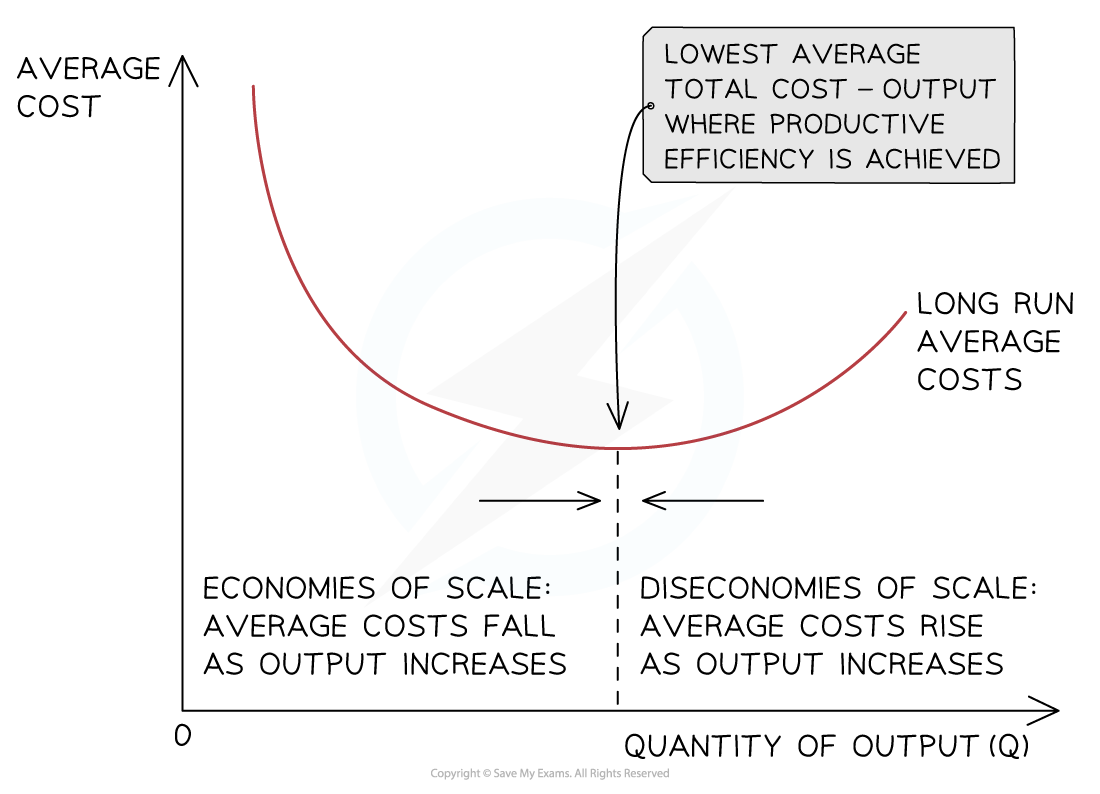
- Economies of scale lower average costs as the scale of output increases*
- With relatively low levels of output, the firms average costs are high
- As the firm increases its output, it begins to benefit from economies of scale which lower the average cost per unit
- The business will reach a level of output at which costs are minimised
- Beyond this point, diseconomies of scale will occur and the average cost will start to rise again
Internal economies of scale
-
Internal economies of scale reduce average costs for a business when it grows
-
Examples of internal economies include
-
Purchasing economies
- Occur when large firms buy raw materials or components in greater volumes, allowing them to receive bulk purchase discounts
- This reduces the average cost per unit and provides a cost advantage over smaller businesses that cannot buy in such large quantities
-
Managerial Economies
- Happen when large firms can afford to employ specialist managers who are highly skilled and efficient at specific tasks
- Greater managerial efficiency lowers the average cost
- Additionally, large firms may attract top talent from other companies, further enhancing their competitive advantage
-
External economies of scale
-
External economies of scale lower average costs for individual businesses when the market as a whole grows
-
Examples of external economies include
-
Better-skilled workforce
- A large and growing industry leads to an increased concentration of workers with industry-specific skills
- These workers require less training and tend to be productive quickly following recruitment
- Local educational institutions are likely to provide skills-based qualifications that are relevant to the growing industry
-
Improved infrastructure
- A growing industry that employs many people is in a good position to persuade local authorities to improve transport and communications structure to meet its needs
- This can make distribution more efficient and improves the effectiveness of business operations
-
Exam Hint When explaining economies of scale, make sure that you fully explain how each type lowers the average costs for the business. This is different to only saying that is lowers the average cost. E.g. Bulk purchases result in the business benefitting from cheaper raw materials, which lowers the cost per unit
Was this revision note helpful?
Build on this topic