Interpreting Cash Flow Forecasts (Edexcel IGCSE Business)
Identifying cash flow Problems
Spec point —
3.2.2· Calculation and interpretation of cash-flow forecasts: • cash inflows • cash outflows • net cash flow • opening and closing balances.
Identifying cash flow problems
-
Drawing up a cash flow forecast helps a business to identify cash flow problems
- Identify periods of cash shortfalls
- Recognise where there is a significant excess of cash
Example of a start-up six-month cash flow forecast (£s)
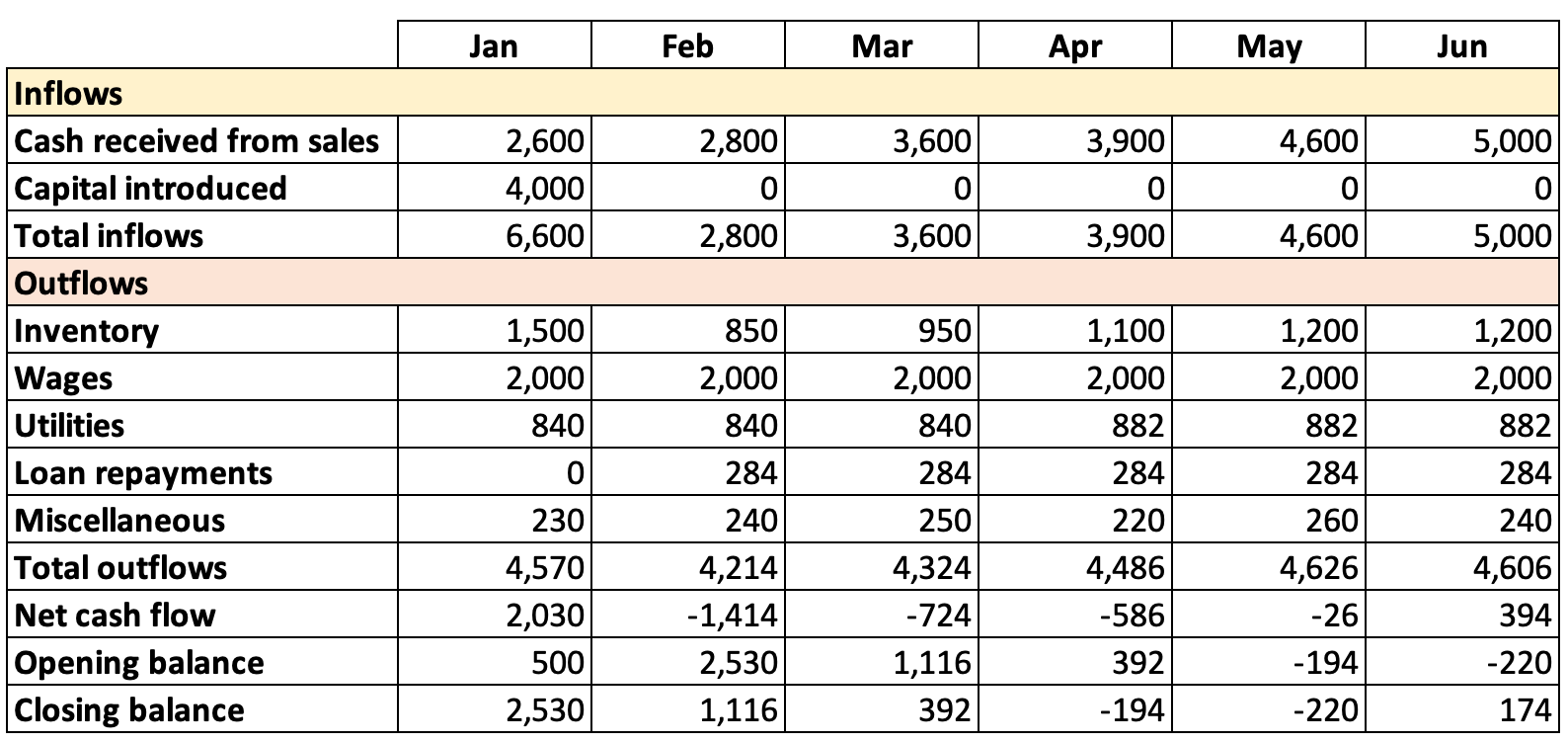
- Overall, this cash flow forecast supports an application for the business to borrow £4,000 in January to cover the initial low inflows, significant outflows and negative net cash flow
- During April and May, the closing balance is negative
- As sales increase from June, inflows are greater than outflows, and the business has a positive cash flow
January
- The cash flow forecast assumes that the bank approves a £4,000 loan in January (capital introduced)
- The opening balance of £500 has been introduced by the owner
- The business is expected to achieve sales of £2,600
- Total inflows are therefore expected to be £6,600 (£2,600 + £4,000)
- Total outflows are expected to be £4,570
- The Net Cash Flow is expected to be £2,030 (£6,600 - £4,570)
- January’s closing balance is expected to be £2,530 (£2,030 + £500)
February
- The closing balance from January becomes the opening balance for February
- Sales of £2,800 are expected to be the total inflows
- Total outflows are expected to be £4,214
- The Net Cash Flow is expected to be -£1,414 (£2,800 - £4,214)
- The closing balance is expected to be £1,116 (-£1,414 + £2,530)
June
- The closing balance from May becomes the opening balance for June
- Sales of £5,000 are the total inflows
- Total outflows are expected to be £4,606
- The Net Cash Flow turns positive and is expected to be £394 (£5,000-£4,606)
- The closing balance is expected to be £174 (£-220 + £394)
Strategies to improve cash flow
Spec point —
3.2.1
-
The cash flow forecast example above identifies a cash flow problem in April and May where the closing balance is negative
-
It has a range of ways to solve this issue to prevent insolvency
- The most suitable method may be to arrange a flexible, short-term overdraft facility with its bank
Ways to solve cash flow problems
| Method | Explanation |
|---|---|
| Reduce the credit period offered to customers | - Collecting money owed from customers more quickly will **increase the level of current assets **in the business - However, customers may move to competing businesses that offer better credit terms |
| Ask suppliers for an extended repayment period e.g an extension from 60 to 90 days | - Current liabilities will not be reduced - The business can use cash it would have paid to suppliers for other purposes - Suppliers may be unwilling to extend credit terms |
| Make use of overdraft facilities or short-term loans | - Current liabilities will** increase** - The business can spend more money than it has in its bank account - Banks may be reluctant to lend to businesses with cash-flow problems |
| Sell off excess stock | - Less liquid current assets will be reduced and converted into more liquid forms of current asset(e.g. cash) - Storage and security costs may also be reduced - Stock may need to be sold at a low price to attract sales |
| Sell assets and lease fixed assets instead (e.g. sale & leaseback | - Both current assets and current liabilities will increase - The business will continue to have the use of assets but must make regular payments to the leasing company |
| Introduce new capital and reduce drawings from the business | - Current assets will be increased - New capital may be introduced by the owner or from additional investors - This may result in the dilution of control of the business |
-
A business can also have too much cash
- If it holds large amounts of cash, it may miss out on the benefits of investing it in fixed assets or savings
- This may represent a significant opportunity cost *especially when interest rates are high
Exam Hint You will not have to construct a cash flow forecast in the exam, though you may have to enter missing figures into a forecast. Make sure you revise calculations for net cash flow, opening balance and closing balance as the formulas are not provided for you.
Was this revision note helpful?
Build on this topic