Calculating Cash Flow Forecasts (Edexcel IGCSE Business)
Introduction to cash flow forecasts
Spec point —
3.2.2· Calculation and interpretation of cash-flow forecasts: • cash inflows • cash outflows • net cash flow • opening and closing balances.
Introduction to cash flow forecasts
-
A cash flow forecast is a prediction of the anticipated cash inflows and cash outflows, usually for a six to twelve month period
-
A business plan should include a cash flow forecast
- Business owners can identify its financial needs
- Lenders such as banks can determine whether loans are capable of being repaid
The uses and limitations of cash flow forecasts
| Uses | Limitations |
|---|---|
| - Cash flow forecasts can support an application for a loan and are an integral part of business decision making - They can help identify where the business may experience cash shortfalls or cash surpluses so that plans can be made to manage these periods (e.g. arranging an overdraft) - Cash flow forecasts aid planning and help a business avoid costly mistakes | - Forecasts are usually based on estimates and in reality inflows and outflows may differ significantly from the estimates - Cash flow forecasts require appropriate skills, insight, research and time to prepare and update adequately - External factors that can impact inflows and outflows may not be reflected in the cash flow forecast |
Constructing a cash flow forecast
Spec point —
3.2.2· Calculation and interpretation of cash-flow forecasts: • cash inflows • cash outflows • net cash flow • opening and closing balances.
Constructing a cash flow forecast
- A business must first gather information about all cash inflows and cash outflows it expects to encounter over the period
- The following steps should then be taken to construct the cash flow forecast
Step 1 - Calculate total cash inflows
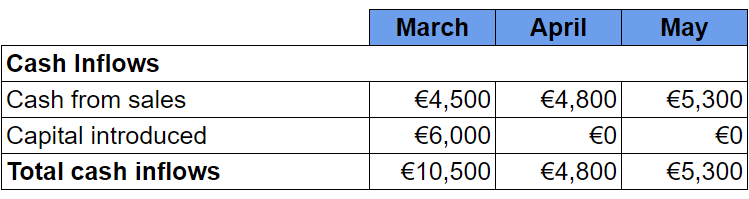
- In this instance, the business expects to receive cash inflows from sales in March, April and May
- Owners' capital of €6,000 will be introduced in March
- The total for each month is calculated by adding cash from sales to capital introduced
Step 2 - Calculate total cash outflows
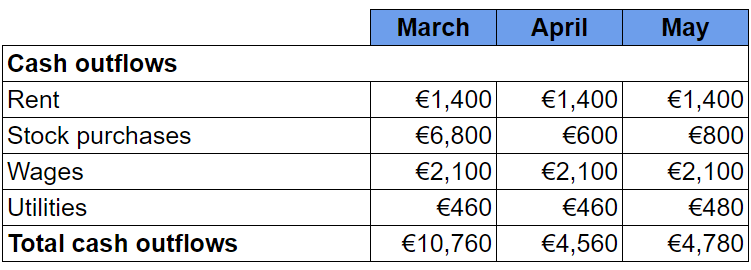
- In this instance, the business expects to pay rent of €1,400 in March, April and May
- It will purchase a significant amount of stock in March with smaller amounts in April and May
- Wages are expected to be €2,100 in each month
- Utilities of €460 will be paid in March and April, increasing to €480 in May
- Total cash outflows each month is calculated by adding these together
Step 3 - Calculate net cash flows
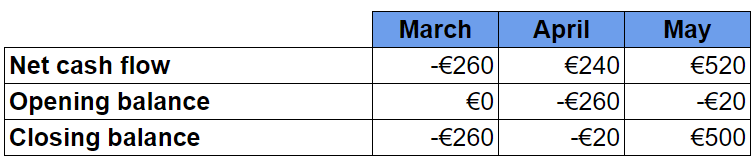
- The net cash flow is calculated by subtracting total cash outflows from total cash inflows
-
In March the net cash flow is €10,500 - €10,760 = €(260)
- Net cash flow is negative as cash outflows are greater than cash inflows
-
In April the net cash flow is €4,800 - €4,560 = €240
-
In May the net cash flow is €5,300 - €4,780 = €520
- In both months, net cash flow is positive as cash inflows are greater than cash outflows
Step 4 - Calculate Opening and Closing Balances
- The opening balance is the previous month’s closing balance carried forward
- The closing balance is calculated by adding the net cash flow to the opening balance
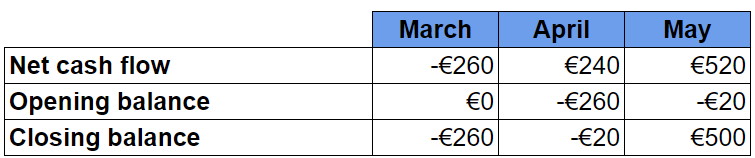
- In March the opening balance of €0 is added to the net cash flow of €(260) to leave a closing balance of €(260)
- In April the closing balance from March is carried forward to become its opening balance of €(260)
- This opening balance is added to April's net cash flow of €240 to leave a closing balance of €(20)
- In May the closing balance from April is carried forward to become its opening balance of €(20)
- This opening balance is added to May's net cash flow of €520 to leave a closing balance of €500
The complete cash flow forecast
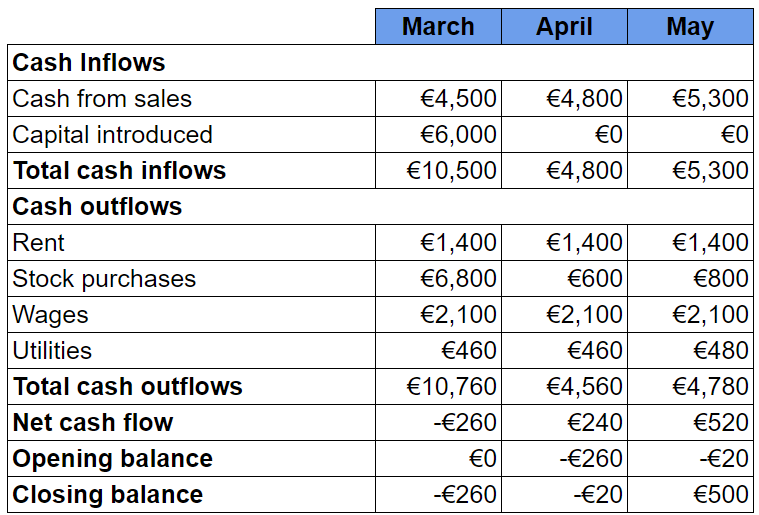
Analysis of the cash flow forecast example
- Overall, this cash flow forecast supports an application for the business to borrow £6,000 in January to cover the initial low inflows, significant outflows and negative net cash flow
- Healthy sales mean that from April, inflows are greater than outflows and the business has a positive net cash flow
Worked Example Here is a simple three-month cash flow forecast for a small seaside café
March April May Cash Inflows Sales 46,000 54,000 61,000 Cash Outflows Inventory 13,000 13,000 13,000 Wages 28,000 28,000 Miscellaneous 3,500 4,000 4,000 Total Cash Outflows 45,000 48,000 Net cash flow 1,500 9,000 Opening balance 4,000 5,500 14,500 Closing balance 14,500 30,500 Complete the cash flow forecast to show
a. Total cash outflows for March
b. Closing balance for March
c. Wages for May
d. Net cash flow for May [4 marks]
Step 1: Add all of March's cash outflows to calculate the total
[1 mark]
Step 2: Add the opening balance to the net cash flow to calculate March's closing balance
[1 mark]
Step 3: Subtract inventory and miscellaneous outflows from total cash outflows to calculate wages
[1 mark]
Step 4: Subtract total cash outflows from total cash inflows to calculate net cash flow
[1 mark]
Exam Hint When calculating opening and closing balances, work through each month in turn.
Always double-check your calculations in cash flow forecasts as one mistake will have a knock-on effect elsewhere and, in some cases, lead you to make inaccurate judgements.
Was this revision note helpful?
Build on this topic