The Importance of Training (Edexcel IGCSE Business)
Why training is important
Spec point —
2.3.1· Include compliance with laws e.g. health & safety; competitiveness
-
Both new and existing staff need to be trained and developed appropriately
- Training is the teaching of new skills
- Development is the improvement of existing skills
-
A well-trained workforce is beneficial to a business for several reasons
The importance of well-trained employees
| Productive staff | Valued staff | Loyal and flexible staff |
|---|---|---|
| - Employees work enthusiastically at the things they’re good at - E.g. employees trained in managing quality are more likely to think about how to improve product standards | - Well-trained employees are likely to be satisfied - They recognise that their employer is spending money and investing time in their development - This is attractive to job applicants | - Labour retention should increase as employees feel they are becoming better at their job and want to keep developing - Skilled and confident staff are likely to be capable of taking on new workplace challenges |
-
Some training is required to meet legal requirements
- Food safety regulations require workers to be trained in the safe handling of ingredients
- Businesses must ensure that some workers have first-aid training
- Employees working with hazardous chemicals must receive appropriate training
Exam Hint You may be asked to explain a benefit of training to a business. Remember to make a clear point and develop it thoroughly using the X → Y → Z structure: X leads to Y and the outcome is Z.
Induction Training
Spec point —
2.3.1· Importance of training to a business and workers: • different types of training and the main purpose • induction incl benefits and limitations
Induction training
-
Induction training is usually delivered as soon as possible after new workers join a business
-
It introduces employees to the organisation, its culture, policies, procedures and their job roles and responsibilities
- E.g. Induction training for new employee at Marks & Spencer covers customer service procedures, product knowledge, store policies and safety procedures
Common elements of induction training
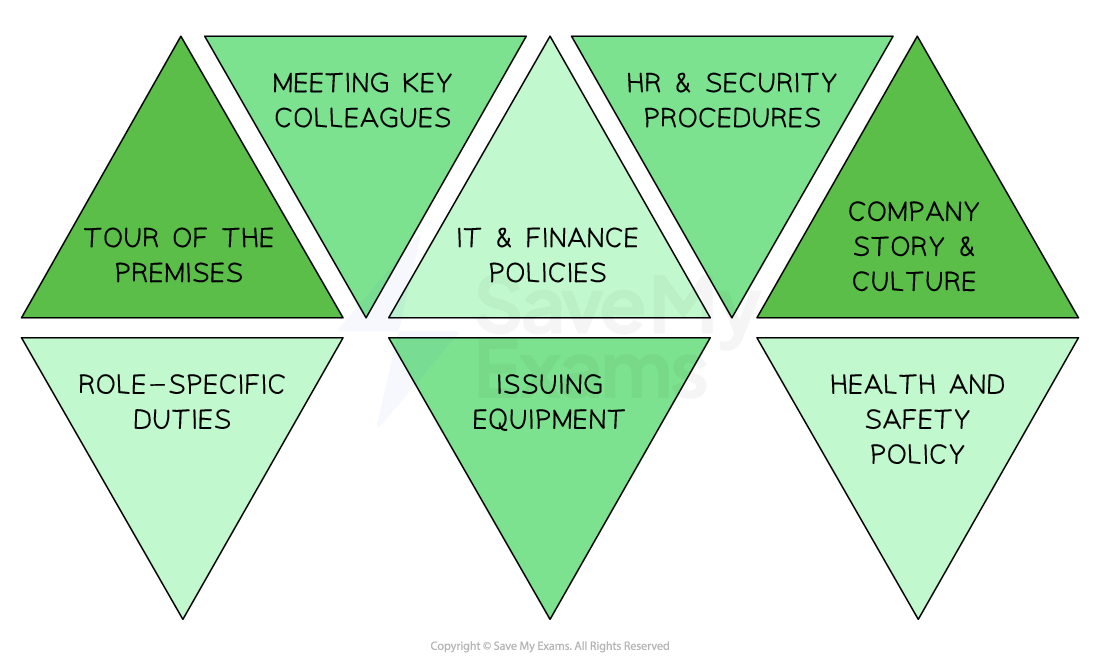
*Induction training usually includes a tour of the premises, meeting key colleagues and instruction on key business policies *
-
Some aspects of induction training need to be revisited by employees regularly
- Health and safety training needs to be carried our regularly, especially when new regulations come into effect
- When business policies change employees need to understand the implications for them in their job role
Advantages and disadvantages of induction training
| Advantages | Disadvantages |
|---|---|
| - Helps new employees to understand their job roles and responsibilities - Improves employee confidence and motivation - Reduces time for new employees to become productive | - Can be time-consuming and expensive to organise - May not cover all aspects of the job role - May not be effective in all cases, leading to employee dissatisfaction and higher turnover rates |
Was this revision note helpful?
Build on this topic