Applying Conservation of Linear Momentum (Edexcel IAL Physics)
Spec point —
83
Applying Conservation of Linear Momentum
- The principle of conservation of linear momentum states:
The total momentum before a collision = the total momentum after a collision provided no external force acts
-
Linear momentum is the momentum of an object that only moves in a straight line
-
Momentum is a vector quantity
- This means oppositely-directed vectors can cancel each other out, resulting in a net momentum of zero
- If, after a collision, an object starts to move in the opposite direction to which it was initially travelling, its velocity will now be negative
-
Momentum, just like energy, is always conserved
Conservation of Linear Momentum in 1D
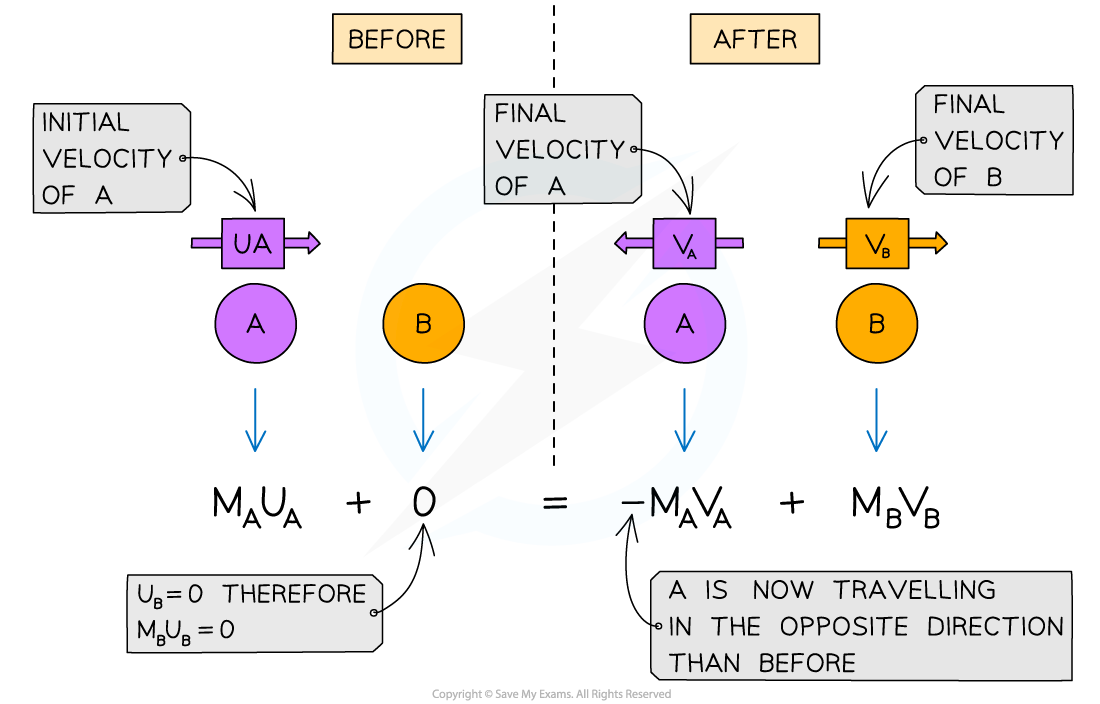
The conservation of momentum in 1D, for two objects A and B colliding then moving apart
Worked Example Trolley A of mass 0.80 kg collides head-on with stationary trolley B whilst travelling at 3.0 m s–1. Trolley B has twice the mass of trolley A. On impact, the trolleys stick together.
Using the conservation of momentum, calculate the common velocity of both trolleys after the collision.
Answer:
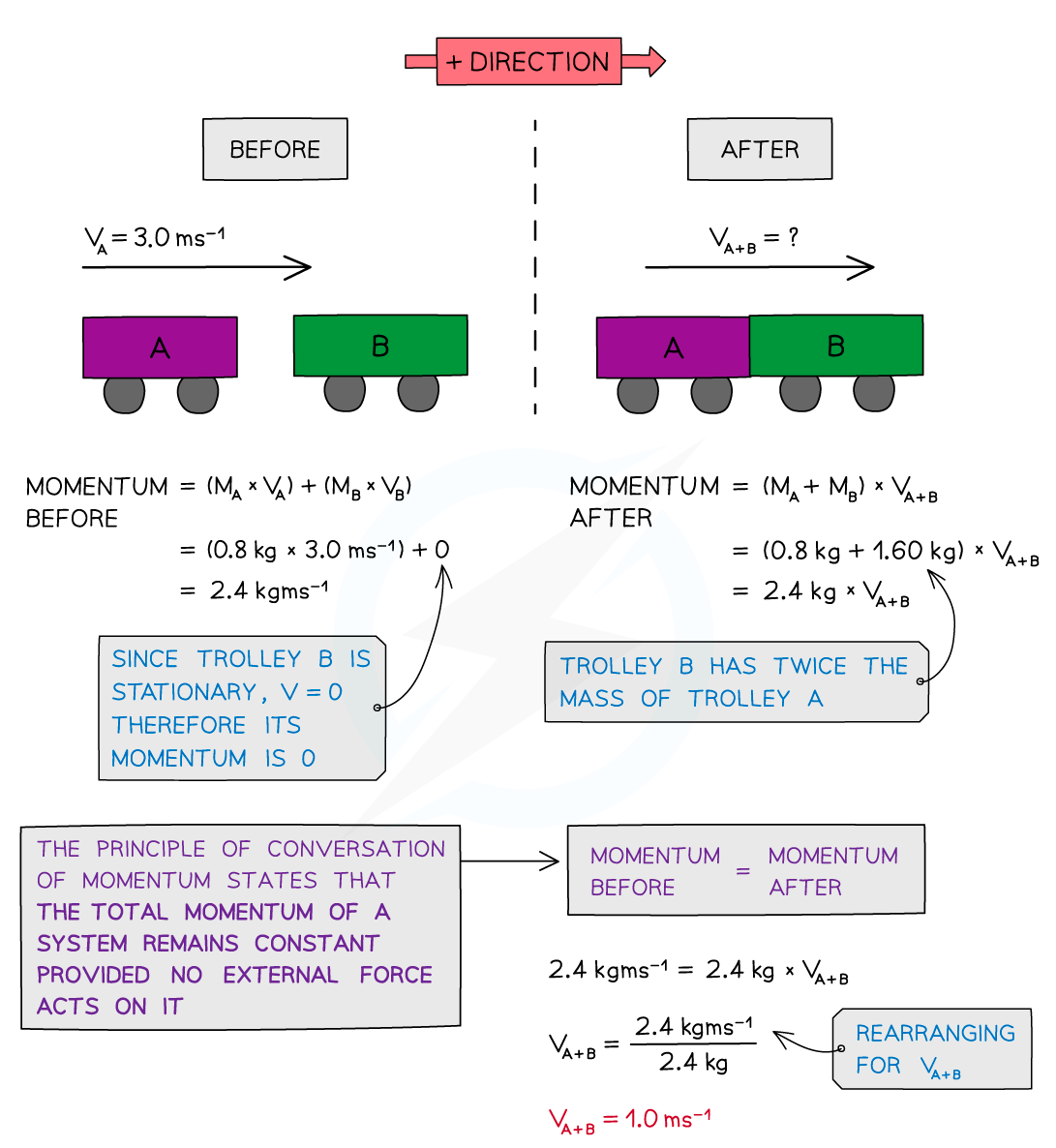
Exam Hint Momentum is a vector quantity, therefore, you should always define a direction to be 'positive' when applying the principle of conservation of momentum. In this worked example, we implicitly took velocity 'to the right' as the positive direction.
Sometimes, however, you might encounter two objects moving towards each other before colliding. If both objects have the same mass m and speed v, then the total momentum (before collision) is zero, because ptotal = (mv) + (–mv) = 0. Note the negative sign indicates a body travelling in the opposite direction.
Conservation of Linear Momentum in 2D
-
For objects moving in 2D, there are components of momentum to consider
- This is similar to projectile motion in 2D, in which we consider horizontal and vertical components of motion
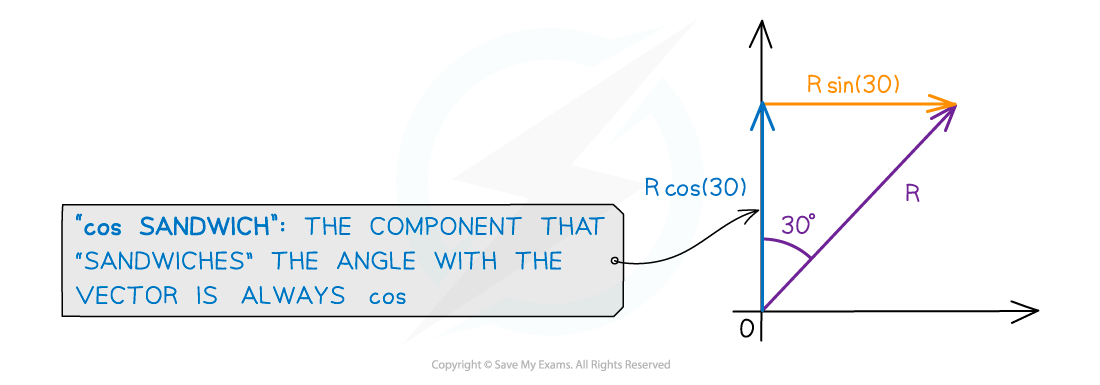
Vector R split into its vertical, R cos (30) and horizontal, R sin (30), components
-
Each component of momentum is conserved separately
- Since momentum is a vector, it can be resolved into horizontal and vertical components
- The sum of horizontal components will be equal before and after a collision
- The sum of vertical components will be equal before and after a collision
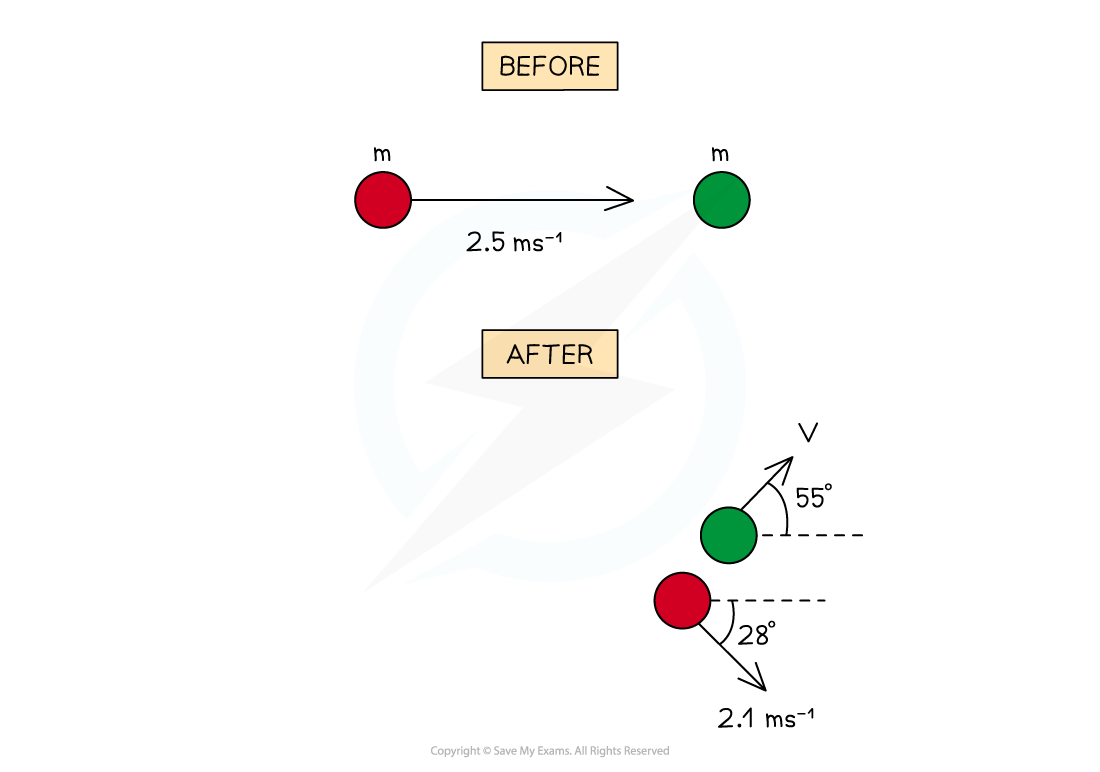
Worked Example A red snooker ball, travelling at 2.5 m s–1, collides with a green snooker ball, which is at rest. Both snooker balls have the same mass m.
The angle of collision is such that the red ball moves off at 28° below the horizontal at 2.1 m s–1 and the green ball moves off at 55° above the horizontal, with a speed v, as shown.
Determine the size of v.
Answer:
Step 1: Apply the conservation of linear momentum in both directions
Since no external forces act during the collision, momentum is conserved in both the:
- horizontal direction (x)
- vertical direction (y)
This means that either of the following could be used:
Total horizontal momentum before= total horizontal momentum after
Total vertical momentum before= total vertical momentum after
Step 2: Resolve the final velocities of the balls into components:
For the red ball
- horizontal velocity = 2.1 cos 28°
- vertical velocity = -2.1 sin 28°
For the green ball
- horizontal velocity = v cos 55°
- vertical velocity = v sin 55°
Step 3: Set up a momentum equation in one of the directions
- The equation will be simpler in the vertical direction since the total initial vertical momentum is zero
Total vertical momentum before = total vertical momentum after
0+0=m (−2.1 sin 28 degree)+m (v sin 55 degree)
Step 4: Simplify and rearrange to calculate v
Exam Hint Generally speaking, whenever you see any vector given at an angle to the horizontal or the vertical (e.g. velocity, or momentum), think "resolve"! It's extremely likely you will need to consider the separate components of motion for a projectiles question or for a conservation of momentum question.
Questions which ask you to use the principle of conservation of linear momentum in 2D are usually worth a lot of marks, so make sure you practise lots of questions involving resolving vectors!
Was this revision note helpful?
Build on this topic