Trig tables
Excerpt: Students are asked to fill the empty cells of two partially completed tables. This resource can be used to strengthen students’ fluency and understanding of links between trig function values in different quadrants and between different trig ratios of the same angle. There is then an option for students to craft their own incomplete table for others to try.
Problem
In the tables below, and any missing functions are from the following list.
Some of the row and column headings are missing. Without using a calculator, try to work out what they could be and complete the table. A function does not appear twice in the same table.
If you think you know what a missing function or value is, make sure you check that it works for all the entries in its row and column!
| undefined | |||
In the next table we have given some more information about Try to identify the missing functions and complete the table. Remember not to use a calculator!
| is reflex | is obtuse | ||
|---|---|---|---|
-
How can you state the exact values of in the st and rd columns of the second table?
-
How might the answers change if could be any value or you could use functions like in the tables?
-
There are some things to help you make your own ‘trig table’ in the section Design your own table.
Solution
In the tables below, and any missing functions are from the following list.
Some of the row and column headings are missing. Without using a calculator, try to work out what they could be and complete the table. A function does not appear twice in the same table.
| undefined | |||
We have lots of tools that could be used to tackle this problem without relying on a calculator. For example, we could
-
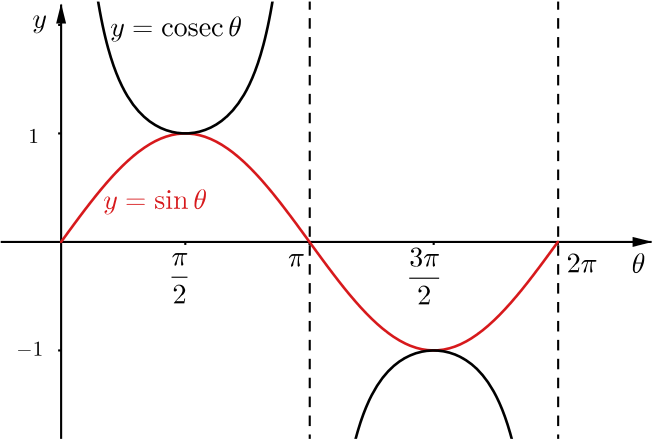
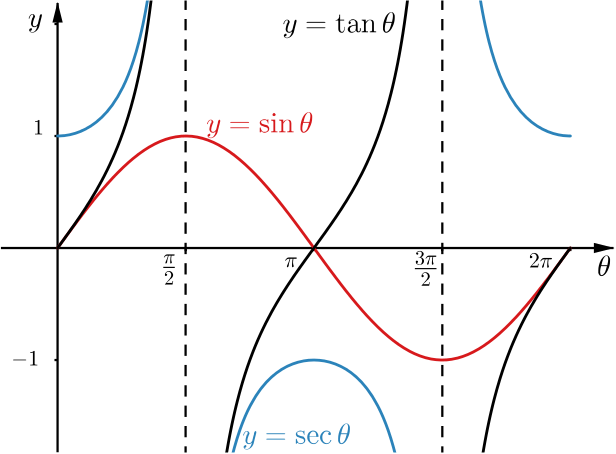
use sketch graphs of the functions
-
use special values of the functions, such as and
-
use triangles or trigonometric identities to work out values of some functions from the values of others
-
use the unit circle diagram and symmetry to work out values of functions for angles bigger than
We will use a mixture of these tools as we describe two approaches to completing the first table.
Approach 1
If is undefined then Therefore is also undefined and the only possibilities for in the first column are and
As the missing function must be or , both of which are only when , so in the first column
We need more information to decide whether the missing function is or
From the top row of the table we see that the value of the missing function can be , so it must be
Now, This means that we can complete the remaining cells in the table without knowing the values of
To find the values of , we can recognise certain special values in the table, such as and , but we need to decide whether this means that the values of are and or angles related to them, such as
From the graphs of these functions, we can check where the functions are positive and negative to decide on the values of
Approach 2
An alternative starting point would be to note that in the third column, , so must be or The only function which has value at either of these values of is , and it only takes this value when The table can now be completed using a similar argument to the one given above.
Completed table
| undefined | |||
| undefined |
How might the answers change if could be any value?
What if you could use functions like to complete the table?
We were limited to Otherwise could take any value of the form and where is an integer. If we were allowed to use functions such as then the problem does not have a unique solution.
This time we have given some more information about Try to identify the missing functions and complete the table. Remember not to use a calculator!
| is reflex | is obtuse | ||
|---|---|---|---|
Let’s start with the second column because we know where certain functions are or Again, is limited to , so is only true when is We can now think about which functions are when Since and are undefined, the only possibilities for the missing functions are and
As both and could be and , we need more information to decide which function goes in the top row and which goes in the bottom row (remember that a function cannot appear twice in the table). Both and are negative when is obtuse and both can be negative or positive when is reflex, so the signs don’t help us here.
Instead, we could use the value of in the third column. One of the Pythagorean identities for trigonometric functions tells us that
If were the correct function for the top row, then substituting for and for should satisfy this identity. If these values don’t satisfy the identity, then we will know that can’t be the function in the top row.
Once we know where and go, we can use trigonometric identities to complete the table, taking into account the signs of these functions for reflex angles.
Completed table
| is reflex | is obtuse | ||
|---|---|---|---|
Why do we know for sure that the value of in the first column is negative?
- How can you also state the values of in the st and rd columns?
We can express in the third column as , but in the first column cannot be written because of the principal value range of How is this value of related to ?
We could also use or and it could be interesting to think about what their principal value ranges must be.
Design your own table
Now try to design your own ‘trig table’ problem. Think about how much information you need to give. Do you want there to be only one way to complete the empty cells?
We have provided some blank tables: one for you to use as the problem table and one for you to fill in as a suggested solution. You can use the ‘Notes’ space to give any extra details such as a range of values of or possible functions that could be used to complete the table.
Things to think about
-
Will you use only functions such as and or will you use variants such as ?
-
Will you restrict the range of values of ? Will you give information such as “ is acute”?
-
How will you make sure your table can be completed without using a calcuator? You could use special values like , as we did in the first table. You could use exact values that come from Pythagorean triples, as we did in the second table. You could specify angles using inverse trigonometric functions, such as How can you make sure these angles are consistent with the range of values you choose for ?