Muddled trig
Excerpt: Students are asked to match various trigonometric functions with their graphs, at the same time as thinking about the notational anomalies involved. The integer scale on the -axis provides an opportunity to discuss radians and degrees and estimations of , and so on.
Problem
We have plotted the graphs of four of the following functions.
Which of these functions have we plotted?
Which properties of the functions and graphs may help you to decide?
How many different functions are there in the list above?
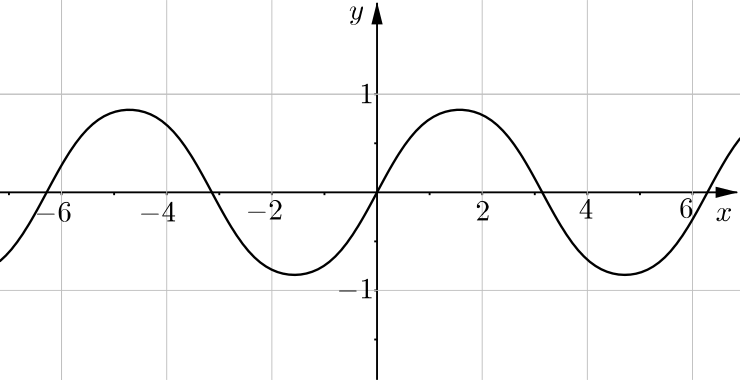
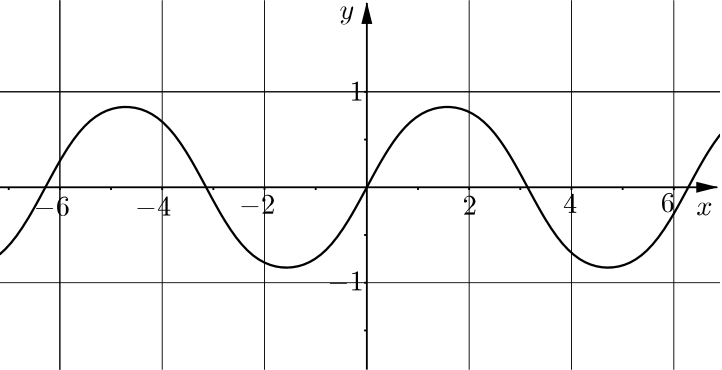
Graph A
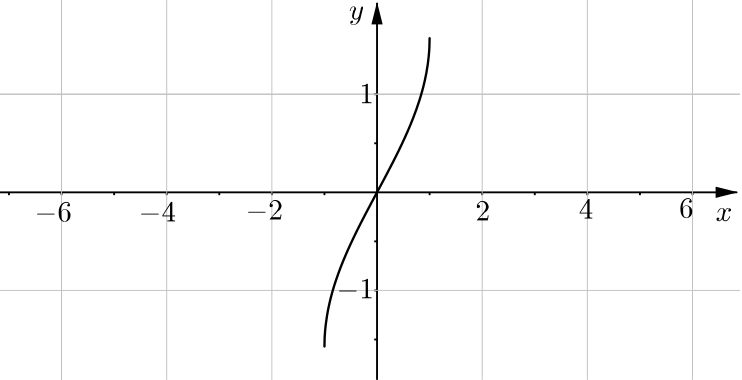
Graph B
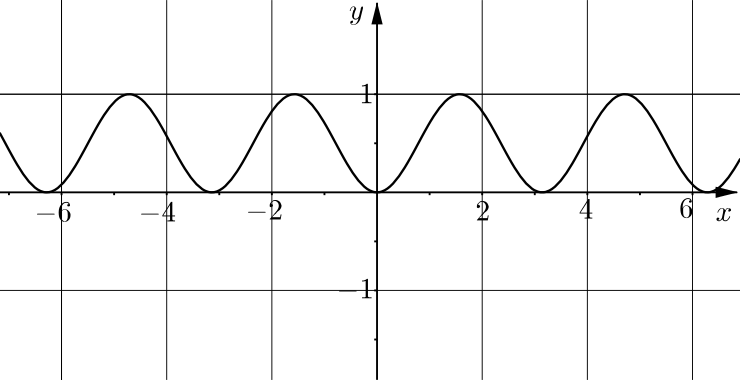
Graph C
Graph D
You might find it helpful to think about function machines for some of these functions, or to describe what the function is doing in words.
The functions and graphs are available to cut out.

Solution
There are many ways to decide which functions have been plotted. We will start by exploring properties of the functions and then use these properties to decide which have been plotted. You may find it helpful to try to sketch the graphs of the functions, or try to match them to the given graphs, as you read.
Thinking about the functions
All of these functions are related to in some way. We can think about the following questions to help identify properties of the functions.
-
What are the domains and ranges of these functions?
-
Are any of these functions periodic and what could the period be?
-
Are these functions odd or even or neither?
We know that is defined for any real number , so its domain is We also know that and the period is .
The rotational symmetry of the graph about the origin means that is an odd function, i.e.
Although the notation might be confusing, means
By thinking about as a composition of functions, we can see that the sine function is applied to and then the result is squared. Therefore the domain of is As the function is a square, it cannot be negative so we must have
You may find it helpful to draw a function machine for or to think about how the domain or range could be affected if we had a different power, such as
From the symmetry of the graph we know that , so and we can check that the period of is not less than
Although is an odd function, , so is an even function.
This could be read as “sine of sine of ”. This function is defined for all real values of As , the range of must be all values between and Note that so the range of is symmetric about
The period of must also be How could you convince yourself of this?
As the graph of is a stretch of the standard sine wave by scale factor parallel to the -axis, the period of is , the domain is and
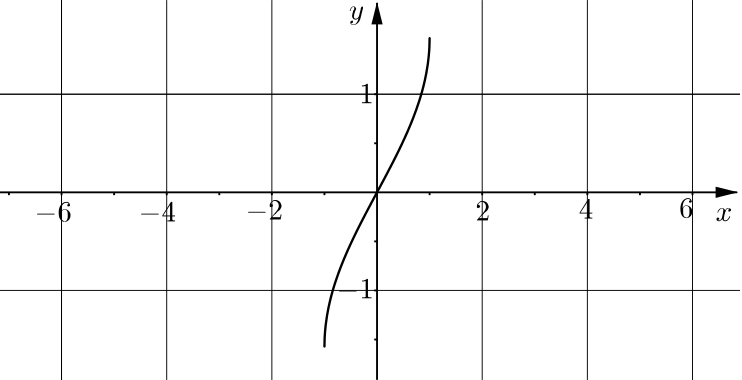
There are lots of values of which give the same value of , but the function is defined to give us an output between and As only has values between and , the domain of is The function is not periodic, and it is an odd function.
This is the same function as and both notations are regularly used. Crucially, is not the same as
Note that this function is also called . The function is not defined if and hence the domain is all real numbers except integer multiples of As must give a value between and , we must have or
From the periodicity of the function, the period of must be
This function is odd because We could also see this by thinking more generally about composition of odd functions.
If you find it confusing that means but does not mean , then you are in good company. The famous mathematician Carl Friedrich Gauss wrote
“ is odious to me, even though Laplace made use of it; should it be feared that might become ambiguous, which would perhaps never occur, or at most very rarely when speaking of , well then, let us write , but not , which by analogy should signify ”
Matching the graphs
Graph A
This looks very much like the standard sine wave as the graph shows an odd function with period slightly greater than However, the -values don’t quite reach or . Therefore we need a different odd, periodic function whose range includes and negative values. We cannot use as this has period This only leaves , which has many similar properties to but its maximum value is , which is less than
Graph B
This graph appears to have period , like Graph A. The vertical asymptotes suggest that this could be the graph of and this is the only candidate with a suitable range.
Graph C
This graph looks like a smaller, translated version of a standard sine wave. The period could be and the graph has no negative values. This leads us to The symmetry in the -axis also tells us that we are looking for an even function and is the only even function in the list.
Graph D
This graph is not periodic and the domain looks as if it could be . Looking at the properties of the available functions we note that is the only candidate, so we have found our match. Note that we could equally well say that is the function shown in Graph D.