Going round in circles
Excerpt: Right-angled triangles are used to introduce , and and identities relating all six trigonometric functions. Then the unit circle is used to explore how these functions behave as varies.
Triangles
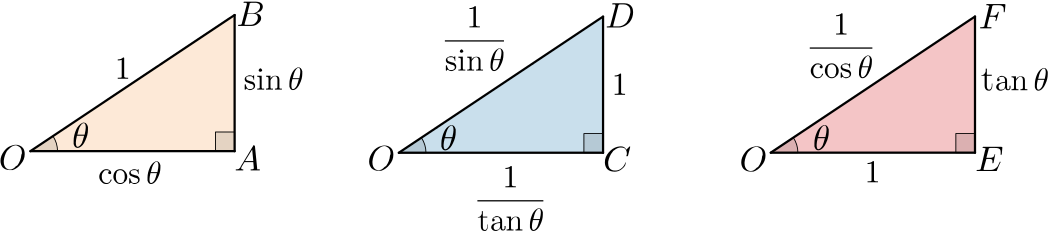
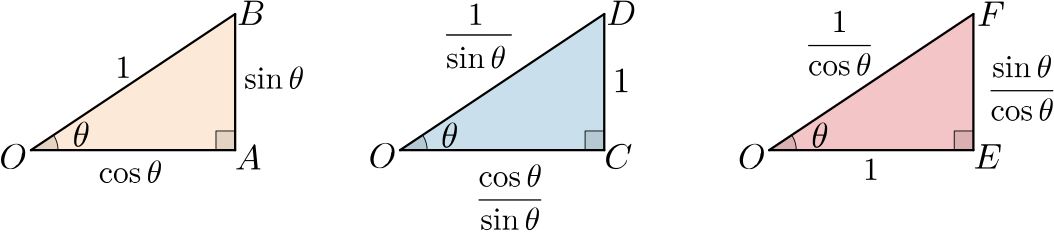
Here are three triangles with some side lengths and angles marked. Express the missing side lengths in terms of , and
-
How can using side length ratios for , and help you?
-
These triangles are all similar. How can you use this to help you?
What do you notice if you compare the results of the two approaches?
New functions from old…
Functions such as are often called reciprocal trig functions and have special names
These are short for “secant”, “cosecant” and “cotangent” respectively; they are usually referred to by their short names.
We now have six trigonometric functions. From the side lengths in the triangles above, what relationships can you find between these functions?

Triangles solution
Here are three triangles with some side lengths and angles marked. Express the missing side lengths in terms of , and
-
How can using side length ratios for , and help you?
-
How can using similar triangles help you?
Using trigonometric ratios
In triangle we are given the hyptenuse and we want to find the opposite and adjacent sides. We know that and , so using gives us and
If we use in triangle we obtain Using gives us
We can also find the side lengths in triangle using these approaches.
Using similar triangles
Note that triangle is similar to triangle and the scale factor for side length is . This gives us and
What happens if we use a similar approach for triangle ?
Solutions
Using trig ratios we obtain the following side lengths.
Using similar triangles we obtain these side lengths.
What do you notice if you compare the results of the two approaches?
From side we have
We now have six trigonometric functions. From the side lengths in the triangles above, what relationships can you find between these functions?
We can start by relabelling the triangles’ sides using , and
Using Pythagoras’ theorem for each triangle gives us three results relating pairs of functions

Circles
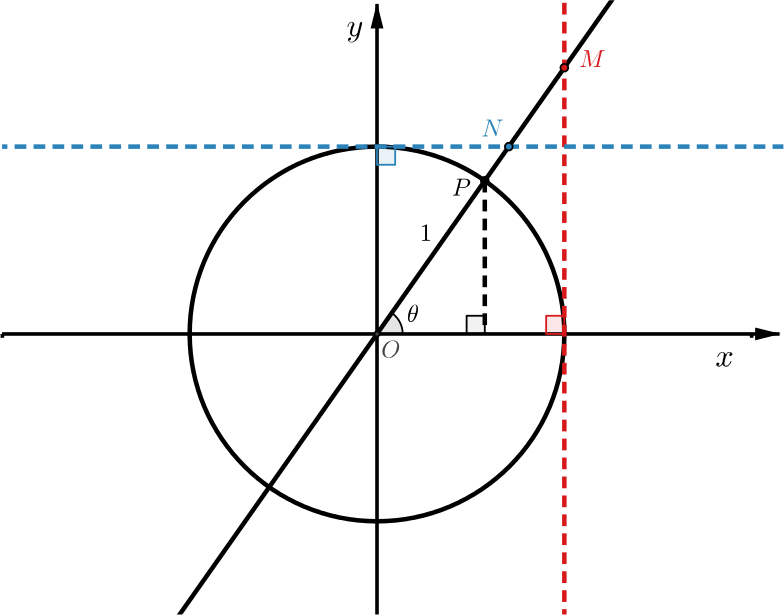
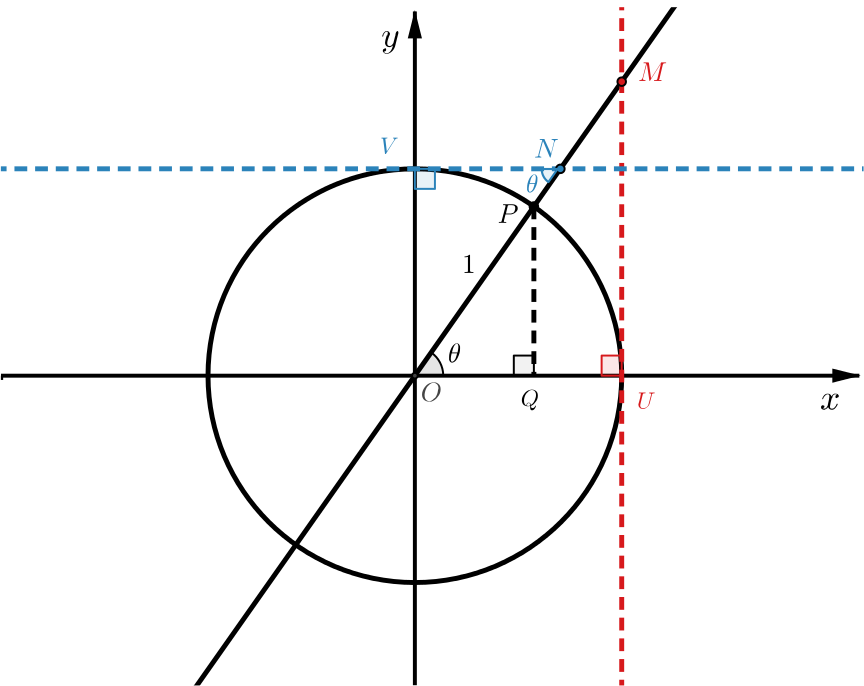
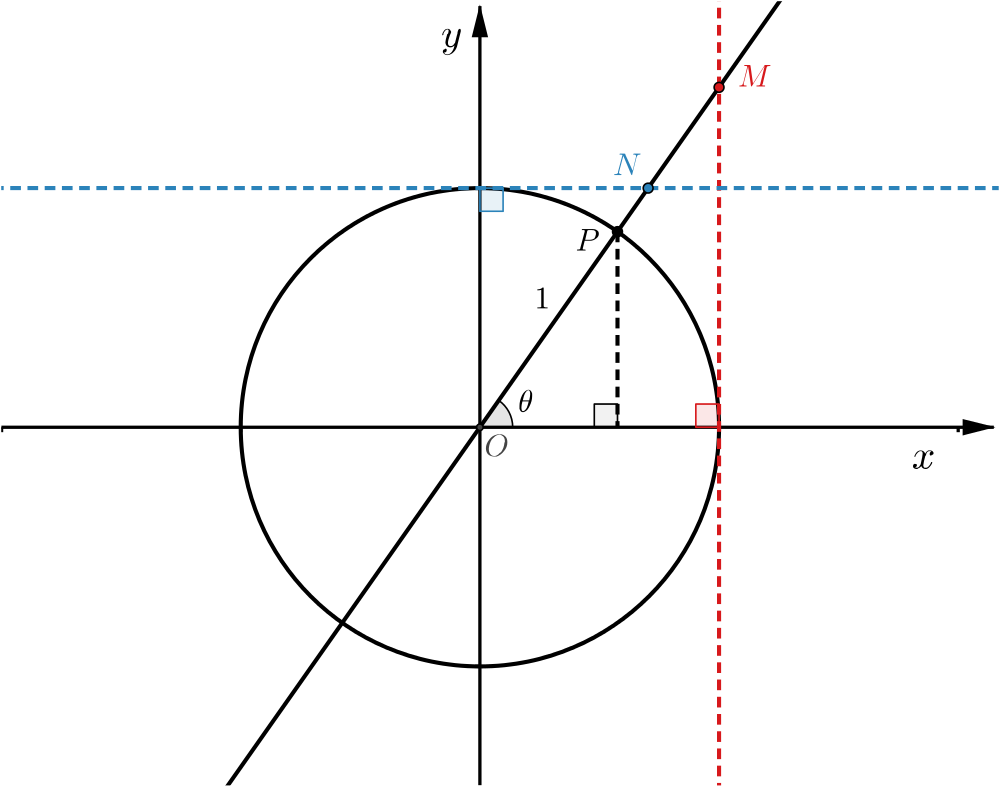
In the diagram below, is a point on a circle of radius and is the angle between and the positive -axis.
We have drawn in the diameter through
-
is the point where the diameter through meets the line
-
is the point where the diameter through meets the line
Using the functions from the triangles problem, work out the coordinates of points , and
As varies, how will and move? What happens when isn’t acute?
-
When will and be moving quickly?
-
Do and always move smoothly?
-
When will their - or -coordinates change sign?
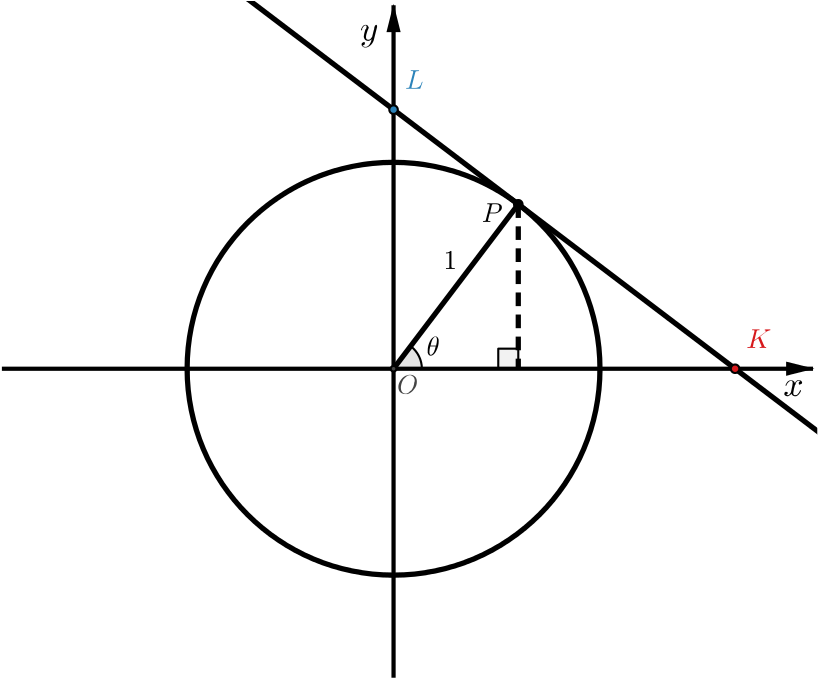
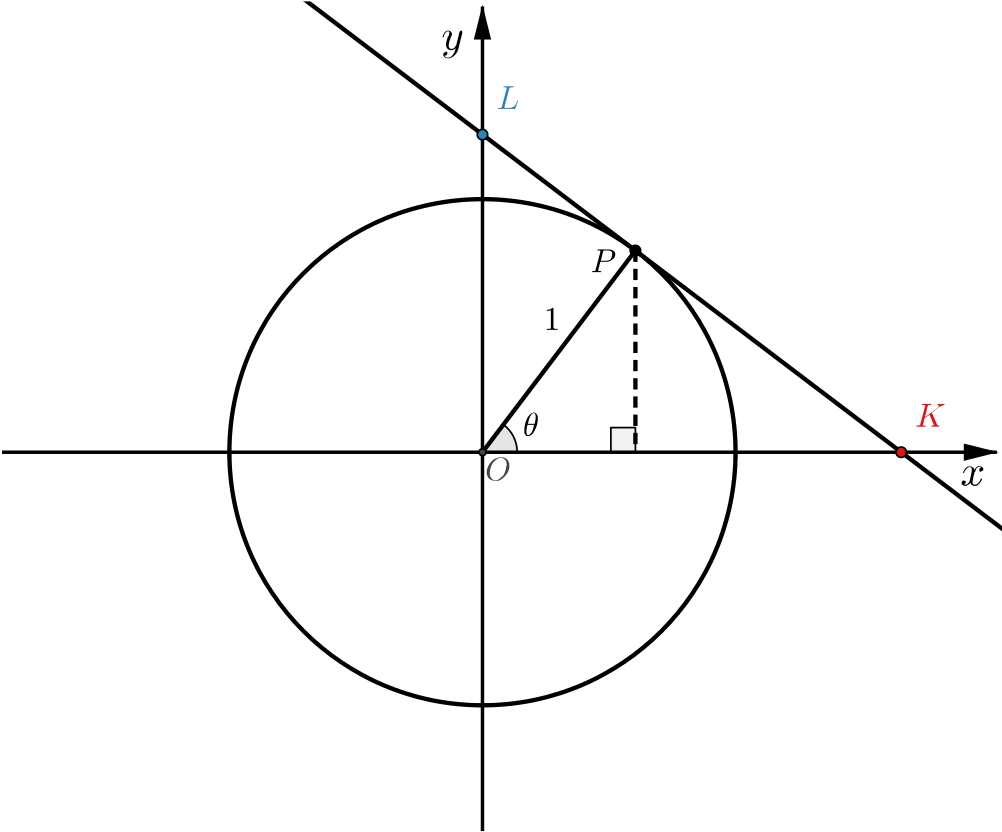
In the next diagram, we have drawn the tangent to the circle at and marked the points where the tangent at meets the axes.
What are the coordinates of and ? How will and move along the axes as varies?
Things you might have noticed
The triangles in the previous part of the problem may help you to work out some side lengths.
We have added some extra labels to the diagram.
The hypotenuse of has length , so has length and has length . This means that the coordinates of are .
To find the -coordinate of , note that has length so has length . Therefore has coordinates . The similarity of triangles and again tells us that .
To find the -coordinate of , note that is parallel to the -axis so angle is As has length , this means the coordinates of are .
As varies, how will and move? What happens when isn’t acute?
-
When will and be moving quickly?
-
Do and always move smoothly?
-
When will their - or -coordinates change sign?
You can see how and move as varies in the GeoGebra file below.
[interactive embed (geogebra-iframe): //www.geogebratube.org/material/iframe/id/eCfgTTuZ/width/595/height/467/border/888888/rc/false/ai/false/sdz/false/smb/false/stb/false/stbh/false/ld/false/sri/true/asb/false/at/html5] — not part of the text import; see the source page.
Download GeoGebra file
Could you sketch graphs of against and against ? Download this file to see the graph of traced out.
In the next diagram, we have drawn the tangent to the circle at and marked the points where the tangent at meets the axes.
What are the coordinates of and ? How will and move along the axes as varies?
The line is a tangent to the circle at , so is at right angles to .
Therefore triangle is right-angled with angle at and adjacent side of length . This means that has length and the coordinates of are .
Likewise, triangle is right-angled with angle at , so has coordinates .
You can see how and move as varies in the GeoGebra file below. Could you sketch graphs of and against ?
[interactive embed (geogebra-iframe): //www.geogebratube.org/material/iframe/id/Apf35Vug/width/595/height/467/border/888888/rc/false/ai/false/sdz/false/smb/false/stb/false/stbh/false/ld/false/sri/true/asb/false/at/html5] — not part of the text import; see the source page.
Download GeoGebra file
We have used to parametrise the circle because as varies, the locus of the point is a circle, centre , radius We could say that parametrises the lines and because the points and trace out these lines as varies. Similarly, we could say that the and axes are parametrised by via the points and respectively.