Can we sketch the inverse of this composite function?
Question
The functions
f
,
g
and
h
are defined by
fgh:x↦lnx,:x↦x1,:x↦x2,(x∈R+),(x∈R+),(x∈R).
Give definitions of each of the functions fg and f−1, and state, in each of the following cases, a relationship between the graphs of
f and fg,
f and f−1.
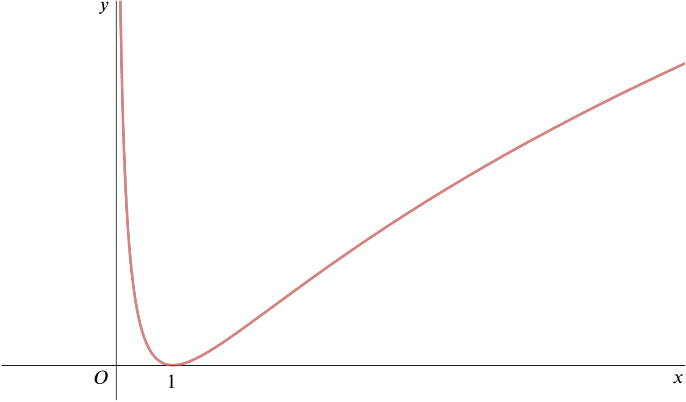
The diagram shows a sketch of the graph y=hf(x). State how the sketch shows that hf is not one–one, and prove that, if α and β, where 0<α<β, are such that hf(α)=hf(β), then α=g(β).
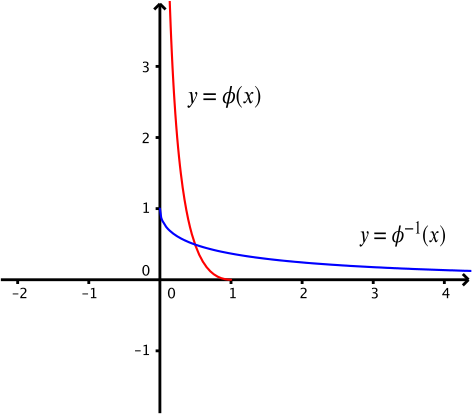
The function ϕ is defined by ϕ:x↦hf(x),(0<x≤1). Sketch the graph of ϕ−1, and give an explicit expression in terms of x for ϕ−1(x).
Suggestion
Give definitions of each of the functions fg and f−1 and state the relationship between the graphs of f and both fg and f−1.
The function lnx is the logarithm to base e of x.
Be careful with the order of your functions when composing them! If we take the function fg, which order for f and g do we apply here?
Would a sketch help us describe the relationship between f and fg? And f and f−1?
State how the sketch shows that hf is not one–one…
What does one–one mean? What do graphs of one–one functions look like?
…and prove that, if α and β, where 0<α<β, are such that hf(α)=hf(β), then α=g(β).
What is the function hf?
How do we find the inverse of a function? And its graph?
What happens if we sketch y=ϕ(x) on a graph, then the line y=x?
How do we find the inverse of a function using algebra?
Can we rearrange y=(lnx)2 to make x the subject? What happens when we take the square root?
Solution
For fg: composing f and g we find fg(x)=f[g(x)]=ln(x1)=−lnx.
For f−1: rearranging the formula y=lnx to make x the subject we find x=ey, so f−1(x)=ex.
…(a) state a relationship between the graphs of f and fg
Reflection in the x–axis.
…(b) state a relationship between the graphs of f and f−1.
Reflection in the line y=x.
The diagram shows a sketch of the graph y=hf(x). State how the sketch shows that hf is not one–one.
There are horizontal lines that cut the graph twice. In fact, for every positive y-value, there are two x-values that hf maps to the y-value.
… and prove that, if α and β, where 0<α<β, are such that hf(α)=hf(β), then α=g(β).
The composition hf(x)=h(lnx)=(lnx)2.
hf(α)⟹(lnα)2⟹lnα=hf(β)=(lnβ)2=−lnβ.
We must have the minus sign here, since
α=β
. Now we have
lnα⟹α=−lnβ=ln(β1)=β1=g(β).
From the graph we see that if α<β, 0<α<1 and β>1.
y⟹−y=(lnx)2=lnx
(since
0<x≤1
, we know
lnx
is negative) and exponentiating both sides gives
x=e−y
Switching x and y we find that the inverse of ϕ is ϕ−1(x)=e−x. We can find the graph of the inverse of a one-one function by reflecting in the line y=x.