Can we find an inverse and sketch a modulus function?
Question
- A function is defined by f:x↦3−2x1 for all values of x except x=23.
- Find the values of x which map on to themselves under the function f.
- Find an expression for f−1.
- Evaluate ff(2).
- Sketch the graph of y=∣x2−4x+3∣ for the domain 0≤x≤5, and state the corresponding range of y.
Solution
We seek x such that f(x)=x, so we need to solve x=3−2x1. Multiplying both sides by 3−2x, we find that 3x−2x2=1, so we must solve the quadratic equation 2x2−3x+1=0. By inspection, we see that 2x2−3x+1=(2x−1)(x−1), therefore the points which are mapped to themselves by f are x=21 and x=1.
- A function is defined by f:x↦3−2x1 for all values of x except x=23.
- Find an expression for f−1.
Write
y=3−2x1
. If we can write
x
in terms of
y
then we have found
f−1
. We have that
3y−2xy=1,
and so
2xy=3y−1,
therefore
x=2y3y−1.
So we have that
f−1(x)=2x3x−1.
- A function is defined by f:x↦3−2x1 for all values of x except x=23.
- Evaluate ff(2).
We have that f(2)=3−41=−1, so ff(2)=f(−1)=3+21=51.
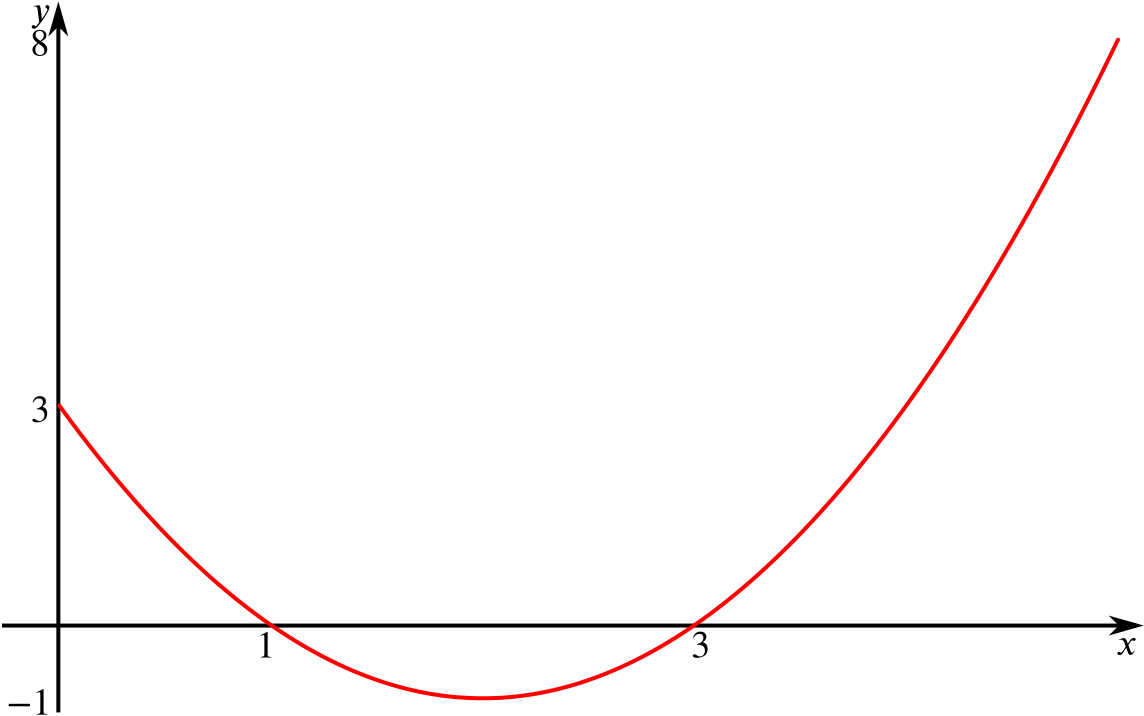
To start with, let’s consider x2−4x+3=(x−1)(x−3). Using our knowledge of quadratics, we can sketch this straightforwardly.
When x=0, x2−4x+3=3, and when x=5, x2−4x+3=8. The minimum occurs at the midpoint of the two roots, when x=2, and here x2−4x+3=−1.
To make this into a sketch of y=∣x2−4x+3∣, we must reflect the part where x2−4x+3<0 in the x-axis.
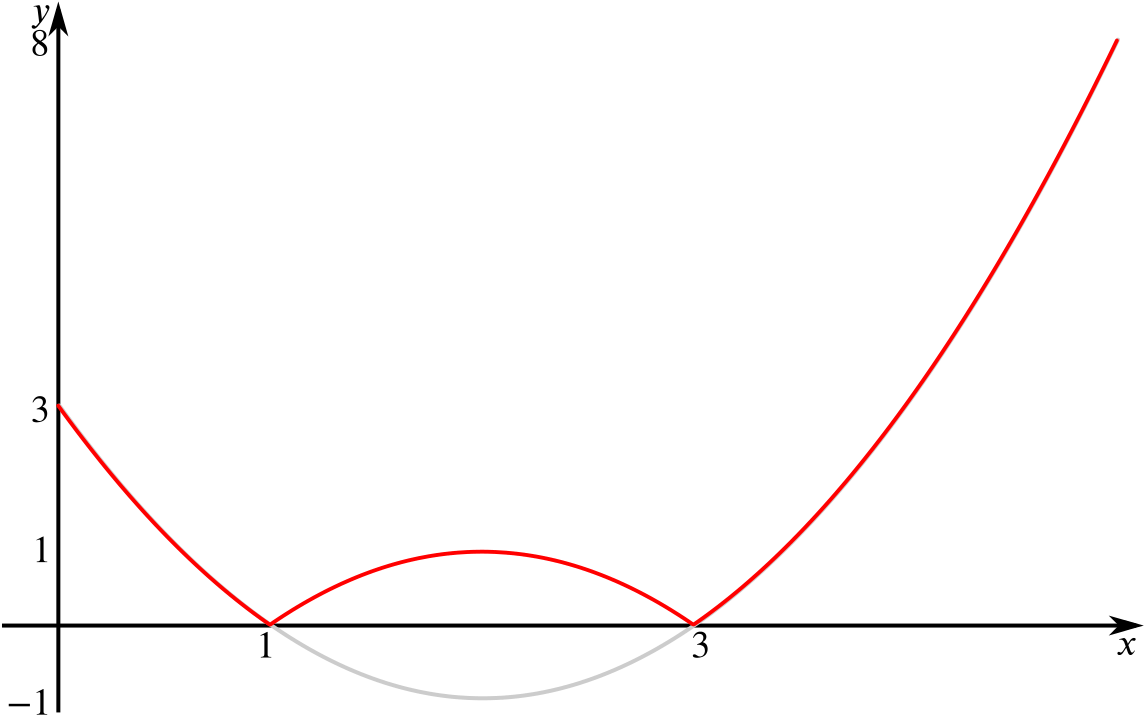
The largest value of y is 8 when x=5. Therefore for the domain 0≤x≤5, we have that the range of y=∣x2−4x+3∣ is 0≤y≤8.