Can we find the inverse of a function in three parts?
Question
The function
has domain
and is defined by
State the range of the function and sketch the graph of . Define the inverse relation in similar form and determine whether this inverse relation is a function.
Suggestion
State the range of the function and sketch the graph of . Define the inverse relation in similar form and determine whether this inverse relation is a function.
The function
has domain
and is defined by
A relation is a set of pairs of values, where the order matters, for example, {(1,4), (2,8), (3,12)}.
You can see that this relation could be associated with the function .
Can you give an example of a relation which cannot be associated with a function like this?
What is the property of a relation that makes it a function? Can you tell if the inverse you found for this question has this property?
Solution
State the range of the function and sketch the graph of .
The function
has domain
and is defined by
We know that the graph is a straight line on the given interval, running from (-3, -2) down to . Note that is included in the graph, but is not.
Similarly, we know that the graph is a straight line on the given interval, running from down to . Note that neither nor is included in the graph.
We should know the graph of , and is a stretch of this by a scale factor of in the -direction. Its starting point on the given interval is , and its endpoint is . Note that is included in the graph, but is not.
The graph of is
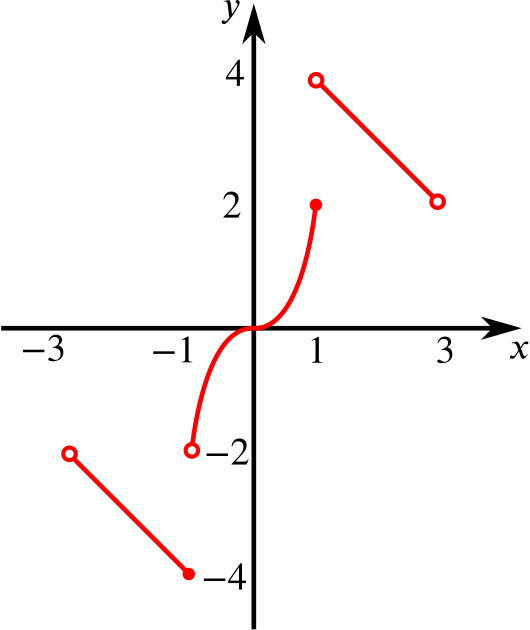
A sketch of
The solid endpoints are included in the graph, while the empty endpoints are not. Therefore the range of is .
We have that
is given by
Then IS a function because, as we can see from our sketch, the function is . The evidence for this is that no horizontal line cuts our graph of in two places.
We say the original function is injective; no point is mapped to two different points by , the inverse.