Can we find the ranges of and , and the function ?
Question
Functions
and
are defined by
State the ranges of and , and show that if denotes the composite function , then
Explain briefly why the composite function cannot be properly defined unless the domain is restricted to a subset of , and state a possible subset which would be suitable.
Define fully the inverses of and , and determine whether or not .
Notational note
Note that the symbol refers to the set of all real numbers, that is, all the numbers on the number line.
Similarly, we denote the integers by , and the rationals (numbers , where and are whole numbers, ) by .
Adding a small subscript “” after any of these symbols means we only include the positive members of the relevant set. So, for example, refers to the positive real numbers. Similarly, a small subscript “” would mean include only the negative numbers in this set.
An alternative notation which is also quite common is to use a superscript “” instead, for example .
Solution
The range of is and the range of is .
It is often helpful for domain and range questions to think about the graph of the relevant functions; here is the graph of :
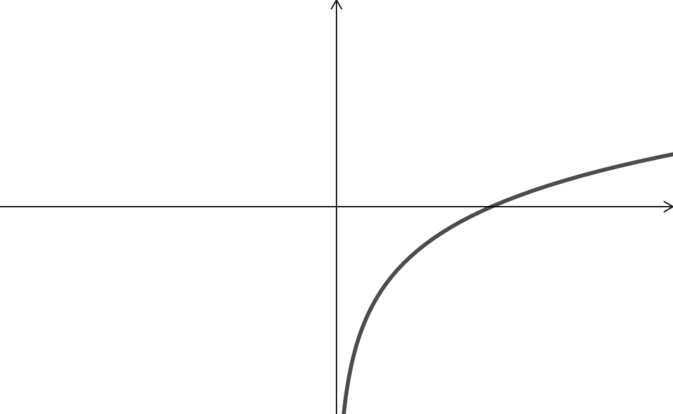
We can see that the graph gives every value for some value, so the range is the whole of .
Here is the graph of (confining the domain to only ):
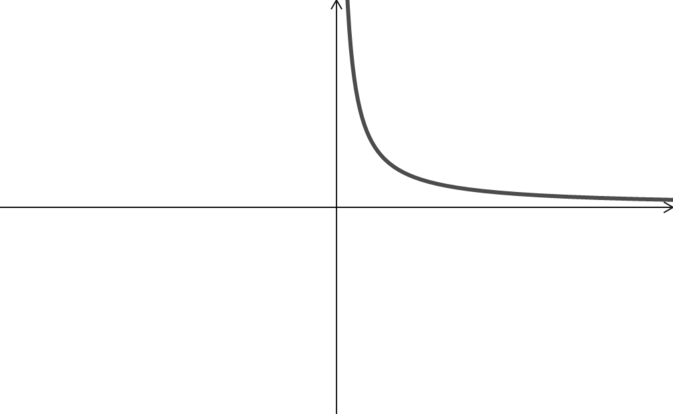
Then it’s clear that the values of which the graph passes through are those greater than zero, so the range of is .
We have
So .
For the composition of two functions, and , to be properly defined, we must have the range of contained within the domain of . (Otherwise, for some in the domain of , we would have not in the domain of , so will not be defined.)
In this case, we are considering so and . Therefore we require the range of to be contained within the domain of .
But the domain of is while the range of is . So the range of is not contained within the domain of , thus is not properly defined unless we restrict the domain to a subset of .
For a suitable subset, we need the range of with this restricted domain to be a subset of . We see that when , so any subset of (the real numbers greater than ) would suffice.
When defining a function, it is vital to specify the domain.
Recall that for any function , the domain of is the range of : every possible output of has to be an allowable input to to get back to the original value.
As , to find the inverse, we can write and rearrange to find in terms of .
What we’re really doing is saying that and then writing . So we are using the result that and are both the identity function.
So in our case,
So for in .
For
, we have
So for in .
For the final part, we start by finding
:
so .
Thus for all , so .