Aromatic Amines (Edexcel IAL Chemistry)
Aromatic Amine - Formation
Spec point —
19.5
-
Phenylamine is an organic compound consisting of a benzene ring and an amine (NH2) functional group
- Phenylamine is sometimes known as aminobenzene or aniline
-
Nitrobenzene, C6H5NO2, can be reduced to phenylamine, C6H5NH2, according to the following two-stage reaction:
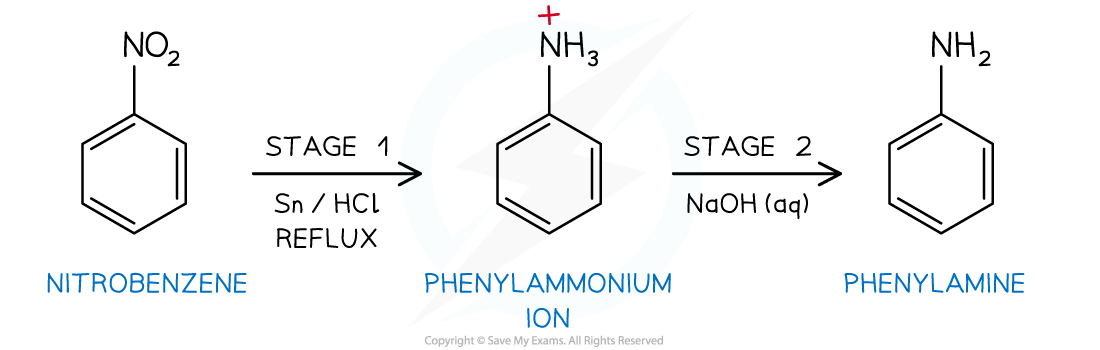
The two-stage reduction reaction of nitrobenzene to phenylamine
Stage 1 - Reduction of nitrobenzene
-
Nitrobenzene, C6H5NO2, is reacted with tin, Sn, and concentrated hydrochloric acid, HCl
- The combination of tin and hydrochloric acid acts as a reducing agent
-
The reaction mixture is heated under reflux in a boiling water bath
-
The nitrobenzene has been reduced, in the presence of acid, by gaining electrons from tin
- The tin is oxidised to a mixture of tin(II), Sn2+, and tin(IV), Sn4+
-
The reduction reaction of nitrobenzene does not form phenylamine directly
-
Due to the acidic conditions, the reduction reaction forms the phenylammonium ion, C6H5NH3+
Stage 2 - Formation of phenylamine
-
Excess sodium hydroxide solution, NaOH (aq), is added to the phenylammonium ions, C6H5NH3+
- This causes them to deprotonate and form the desired phenylamine product
- A mixture of tin compounds, including tin(II) hydroxide and tin(IV) hydroxide is also formed from reactions between the sodium hydroxide solution and the tin ions in stage 1
Stage 3 - Purification of phenylamine
-
The crude phenylamine product undergoes steam distillation to produce a cloudy distillate
-
Sodium chloride is added to the distillate before the mixture is added to a separating funnel
-
Ether is added to the separating funnel resulting in an aqueous layer at the bottom and an organic layer, containing the phenylamine, on the top
- The sodium chloride aids separation by increasing the polarity of the aqueous layer causing the phenylamine to "salt out" into the organic layer
-
The aqueous layer is discarded and the organic layer is distilled
- The ether will boil off easily and is discarded
- The phenylamine fraction that boils off at 180 - 185 oC is retained and can have its boiling point tested to check the purity of the product
Aromatic Amine - Reactions
Spec point —
19.6
- Azo(or diazonium) compounds are organic compounds that have an R1-N=N-R2 group
- They are often used as dyes and are formed in a coupling reaction between the diazonium ion and an alkaline solution of phenol

Azo compounds are characterized by the presence of an R1-N=N-R2group
Coupling of benzenediazonium chloride with phenol in NaOH
- Azo compounds can be formed from the coupling reaction of a benzenediazonium chloride salt with alkaline phenol
- Making an azo dye is a multi-step process
Formation of Azo Compounds Table
| Step | Description | Reaction Conditions |
|---|---|---|
| 1. Formation of nitrous acid | Nitrous acid is very unstable so has to be made in a test tube using sodium nitride (NaNO2) and hydrochloric acid | N/A |
| 2. Diazotization | The reaction between nitrous acid and phenylamine to form the diazonium ion is called diazotization | The reaction mixture must be kept below 10oC using ice as otherwise the diazonium ion will thermally decompose to benzene and nitrogen (N2) Dilute acid (such as HCl) |
| 3. Coupling reaction | The diazonium ion acts as an electrophile and substitutes into the benzene ring of the phenol at the 4th position | Alkaline conditions are required to deprotonate the organic product and form the azo compound |
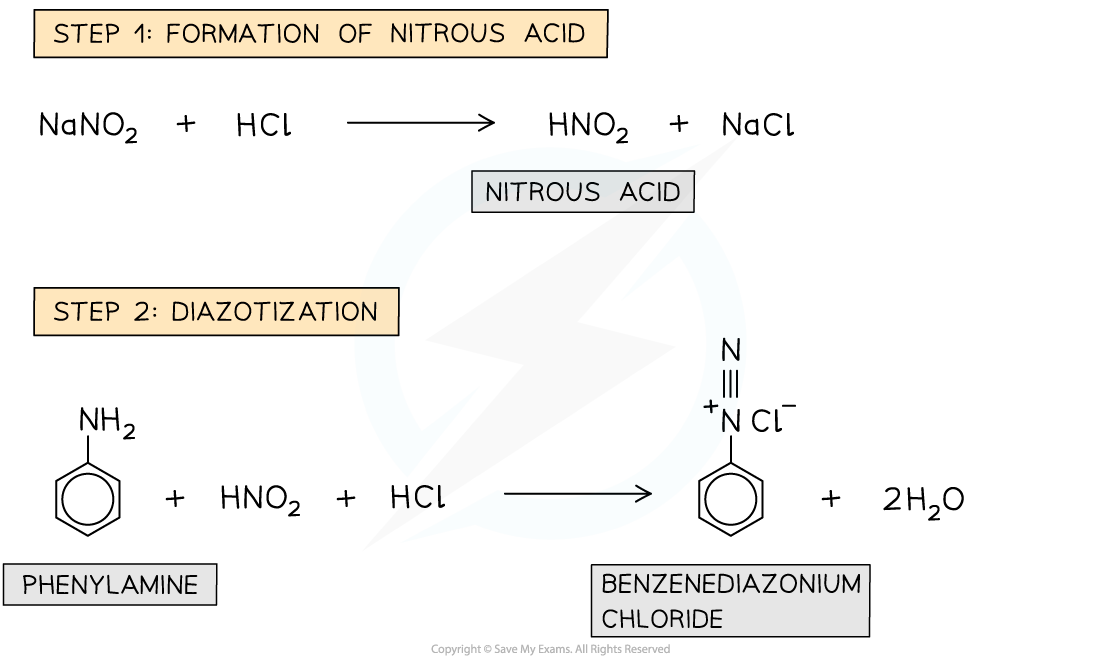
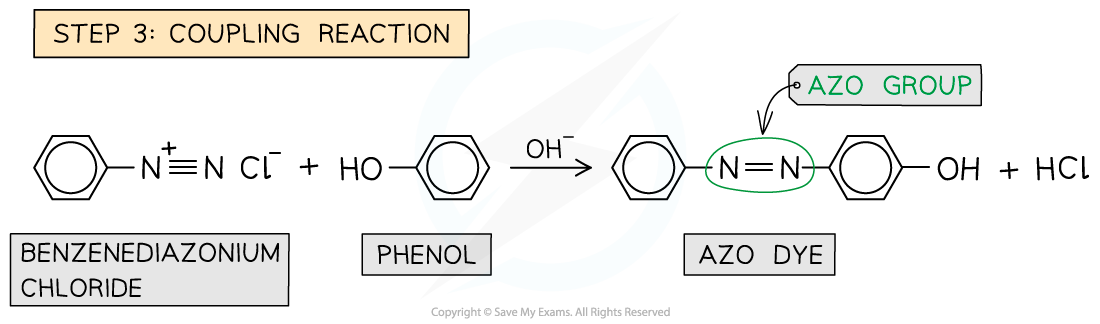
Reaction mechanism of the formation of azo compounds
- The delocalised electrons in the π bonding systems of the two benzene rings are extended through the -N=N- which acts as a bridge between the two rings
- As a result of the delocalisation of electrons throughout the compound, azo compounds are very stable
Was this revision note helpful?