Amides (Edexcel IAL Chemistry)
Exam board Pearson Edexcel · IALUpdated 2026-07-02
Amide Formation
Spec point —
19.7
- Amides are organic compounds with an -CONR2 functional group
- They can be prepared from the condensation reaction between an acyl chloride and ammonia or amine
- In a condensation reaction, two organic molecules join together and in the process eliminate a small molecule
- In this case, the acyl chlorides and ammonia or amine join together to form an amide and eliminate an HCl molecule
Condensation reaction
-
The chlorine atom in acyl chlorides is electronegative and draws electron density from the carbonyl carbon
-
The carbonyl carbon is therefore electron-deficient and can be attacked by nucleophiles
-
The nitrogen atom in ammonia and amines has a lone pair of electrons which can act as a nucleophile and attack the carbonyl carbon
-
As a result, the C-Cl bond is broken and an amide is formed
-
Whether the product is a substituted amide or not, depends on the nature of the nucleophile
- Primary and secondary amines will give a substituted amide
- The reaction of acyl chlorides with ammonia will produce a non-substituted amide
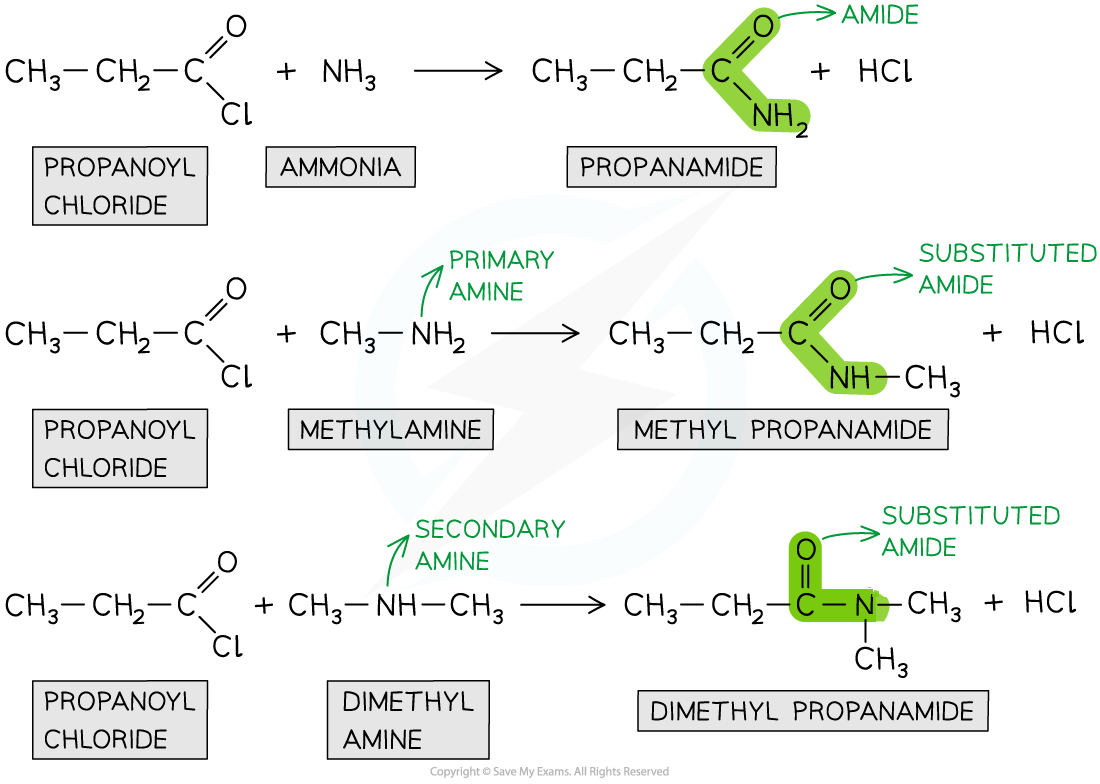
Acyl chlorides undergo condensation reactions with ammonia and amines to form amides
- Note that ammonia is basic and the inorganic product is acidic, so there will be a reaction between the two molecules
NH3+ HCl → NH4Cl
- We can therefore write the overall equation for the reaction of propanoyl chloride and ammonia as
CH3CH2COCl + 2NH3→ CH3CH2CONH2+ NH4Cl
Was this revision note helpful?