Ionisation Energy - Groups 1 & 2 (Edexcel IAL Chemistry)
Exam board Pearson Edexcel · IALUpdated 2026-07-02
Ionisation Energy Trends
Spec point —
8.11
-
All elements in Groups 1 (also called alkali metals) have one electron in their outermost principal quantum shell
-
All elements in Groups 2 (also called alkali earth metals) have two electrons in their outermost principal quantum shell
-
All Group 1 and Group 2 metals can form ionic compounds in which they donate these outermost electrons(so they act as reducing agents) to become an ion with either a +1 or +2 charge (so they themselves become oxidised)
-
Going down the group, the metals become more reactive
- This can be explained by looking at the Group 2 ionisation energies:
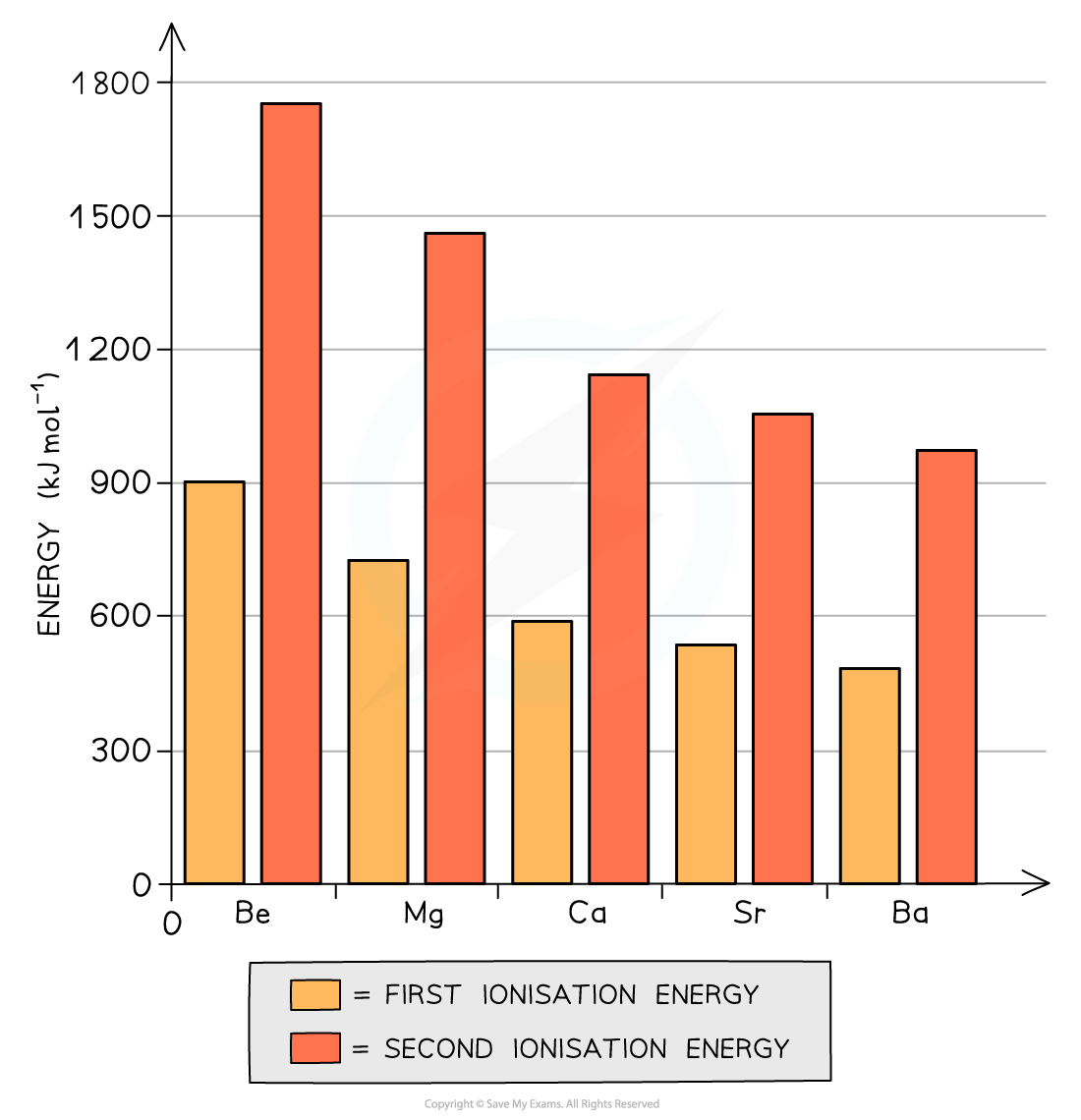
The graph shows that both the first and second ionization energies decrease going down the group
- The same trend is observed with Group 1 alkali metals
- The first ionisation energy is the energy needed to remove the first outer electron of an atom
- The second ionisation energy is the energy needed to remove the second outer electron of an atom
- The graph above shows that going down the group, it becomes easier to remove the outer two electrons of the metals
- Though the nuclear charge increases going down the group (because there are more protons), factors such as an increased shielding effect and a larger distance between the outermost electrons and nucleus outweigh the attraction of the higher nuclear charge
Was this revision note helpful?