Reactivity - Groups 1 & 2 (Edexcel IAL Chemistry)
Reactivity Trend
Spec point —
8.12
Group 1 metals
-
The reactivity of the group 1 metals increases as you go down the group
-
When a group 1 element reacts its atoms only need to lose electron, as there is only 1 electron in the outer shell
- When this happens, 1+ ions are formed
-
The next shell down automatically becomes the outermost shell and since it is already full, a group 1 ion obtains noble gas configuration
-
As you go down group 1, the number of shells of electrons increases by 1
- This means that the outermost electron gets further away from the nucleus, so there are weaker forces of attraction between the outermost electron and the nucleus
- Less energy is required to overcome the force of attraction as it gets weaker, so the outer electron is lost more easily
- So, the alkali metals get more reactive as you descend the group
Group 2 metals
-
The reactivity of the Group 2 metals also increases down the group for the same reasons
- The outermost electron gets further away from the nucleus, so there are weaker forces of attraction between the outermost electron and the nucleus
- Less energy is required to overcome the force of attraction as it gets weaker, so the outer electron is lost more easily
-
This can be observed when the Group 2 metals react with water as well
- Magnesium reacts extremely slowly with cold water
- Calcium reacts fairly vigorously with cold water in an exothermic reaction
Reactions with Oxygen, Chlorine & Water
Spec point —
8.13
Group 1 metals
Reaction with oxygen
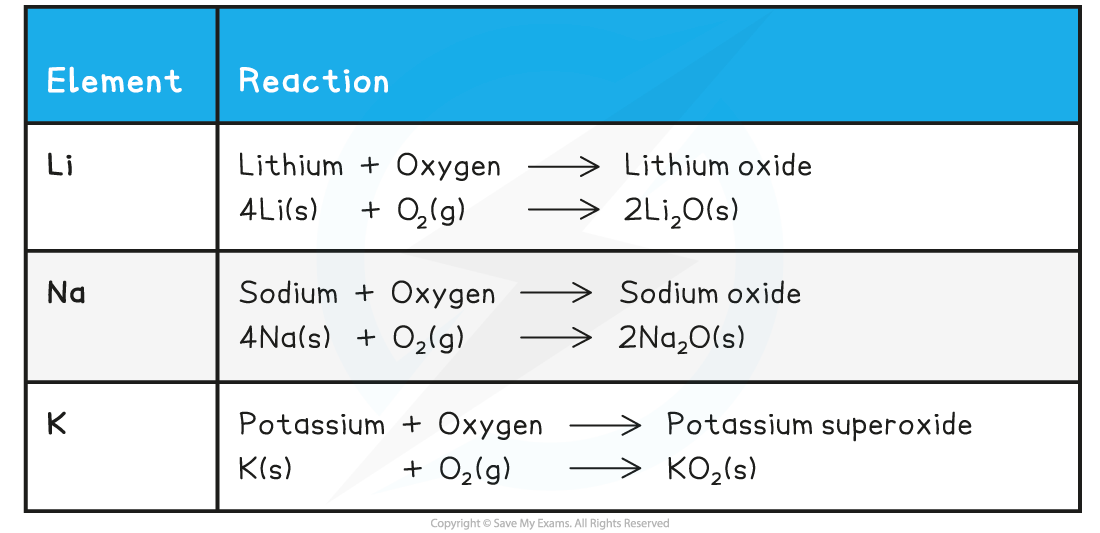
- The alkali metals react with oxygen in the air forming metal oxides, which is why the alkali metals tarnish when exposed to the air
- The metal oxide produced is a dull coating which covers the surface of the metal
- The metals tarnish more rapidly as you go down the group
Summary of the Reactions of the First Three Alkali Metals with Oxygen
Reaction with chlorine
-
The reactions of the Group 1 elements with chlorine are similar in appearance to the reactions of the Group 1 metals with oxygen
-
Sodium, for example, burns with an intense orange flame in chlorine in exactly the same way that it does in pure oxygen
-
The other metals also behave the same way in both gases
- In each case, a white solid is formed, the simple chloride
2M (s) + Cl2(g) → 2MCl (s)
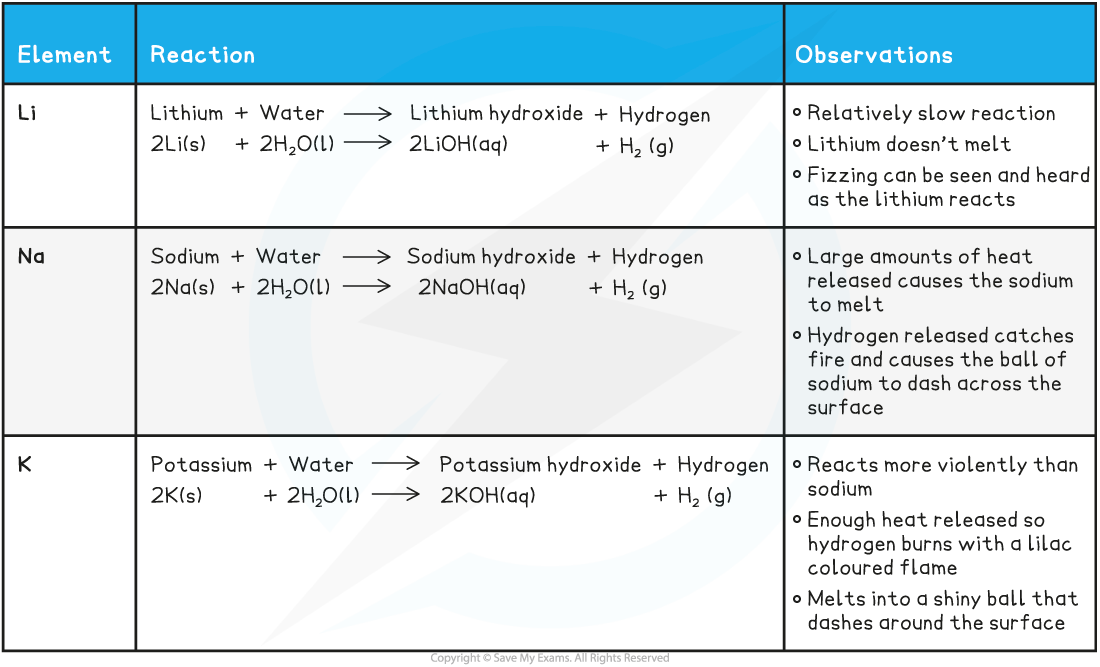
Reactions with water
- The reactions of the alkali metals with water get more vigorous as you descend the group
Summary of the Reactions of the First Three Alkali Metals with Water
Group 2 metals
Reactions with water and oxygen
- The reaction of Group 2 metals with oxygen follows the following general equation:
2M (s) + O2 (g) → 2MO (s)
- Where M is any metal in Group 2
- Remember than Sr and Ba also form a peroxide, MO2
- The reaction of all metals with water follows the following general equation:
M (s) + 2H2O (l) → M(OH)2 (s) + H2 (g)
- Except for, Be which does not react with water
Group 2 Metals Reacting with Water and Oxygen - Equations
| Reaction with oxygen | Reaction with water | |
|---|---|---|
| Mg | 2Mg (s) + O2 (g) → 2MgO (s) | Mg (s) + 2H2O (l) → Mg(OH)2 (aq) + H2 (g |
| Ca | 2 Ca (s) + O2 (g) → 2CaO (s) | Ca (s) + 2H2O (l) → Ca(OH)2 (aq) + H2 (g) |
| Sr | 2Sr (s) + O2 (g) → 2SrO (s) Sr (s) + O2 (g) → SrO2 (s) | Sr (s) + 2H2O (l) → Sr(OH)2 (aq) + H2 (g) |
| Ba | 2Ba (s) + O2 (g) → 2BaO (s) Ba (s) + O2 (g) → BaO2 (s) | Ba (s) + 2H2O (l) → Ba(OH)2 (aq) + H2 (g) |
- Magnesium reacts extremely slowly with cold water:
Mg (s) + 2H2O (l) → Mg(OH)2 (aq) + H2 (g)
- The solution formed is weakly alkaline (pH 9-10) as magnesium hydroxide is only slightly soluble
- However, when magnesium is heated in steam, it reacts vigorously with steam to make magnesium oxide and hydrogen gas:
Mg (s) + H2O (g) → MgO (s) + H2 (g)
Reactions with chlorine
-
Group 2 metals react with chlorine gas to give the metal chloride
- For example
Mg (s) + Cl2(g) → MgCl2 (s)
Was this revision note helpful?