Acyl Chlorides & Esters (Edexcel IAL Chemistry)
Spec point —
15.13
Acyl Chlorides & Esters
Acyl groups can be built into many molecules using acyl chlorides or acid anhydrides (known as acylating agents). Acyl chlorides are derivatives of carboxylic acids by substitution of the -OH group by a chlorine atom. They are named by identifying the parent hydrocarbon chain and adding the suffix -oyl chloride. They can also be named by removing the -oic acid from the carboxylic acid and adding -oyl chloride
-
Acid anhydrides are also derivatives of carboxylic acids formed by substitution of the -OH group by an alkanoate
- Acid anhydrides are named by identifying the parent hydrocarbon chain and adding the suffix -oic anhydride
- They can also be named by removing the -oic acid from the carboxylic acid and adding -oic anyhydride
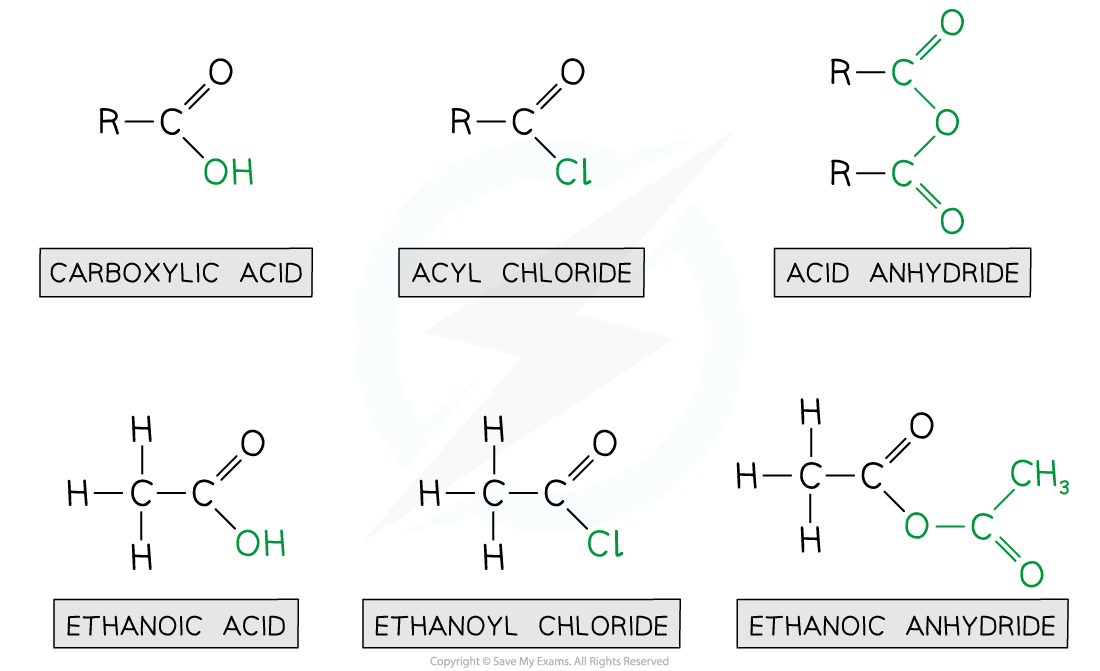
Ethanoic acid derivatives
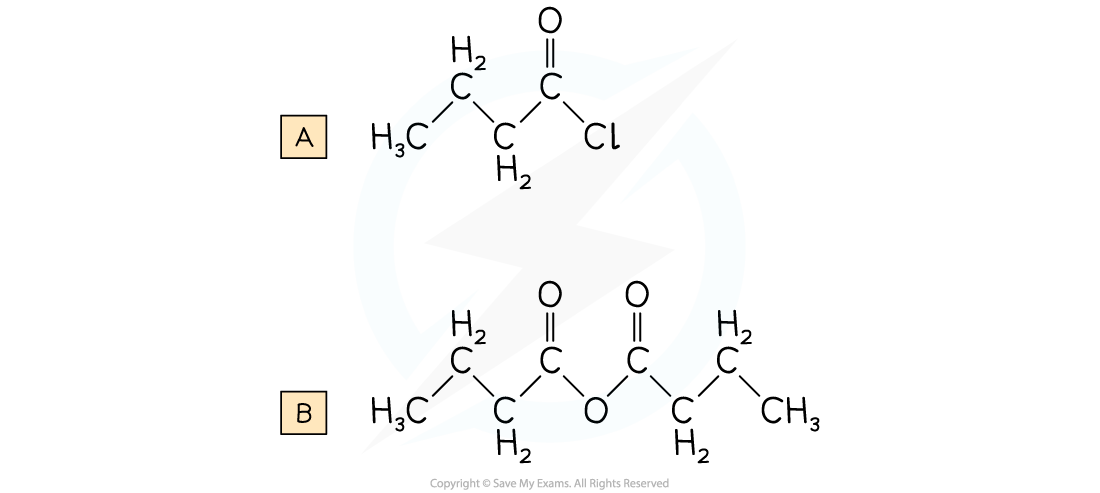
Worked Example Draw the displayed formula for the following:
A. Butanoyl chloride
B. Butanoic anhydride
Answer:
-
Acyl chlorides are reactive organic compounds that undergo many reactions such as nucleophilic addition-elimination reactions
-
In nucleophilic addition-elimination reactions, the nucleophilic addition of a small molecule across the C=O bond takes place followed by elimination of a small molecule
-
Examples of these nucleophilic addition-elimination reactions include:
- Hydrolysis
- Reaction with alcohols to form esters
- Reaction with ammonia and primary amines to form amides
Hydrolysis
-
The hydrolysis of acyl chlorides results in the formation of a carboxylic acid and HCl **molecule
-
This is a** nucleophilic addition-elimination reaction
- A water molecule adds across the C=O bond
- A hydrochloric acid (HCl) molecule is eliminated
-
An example is the hydrolysis of propanoyl chloride to form propanoic acid and HCl
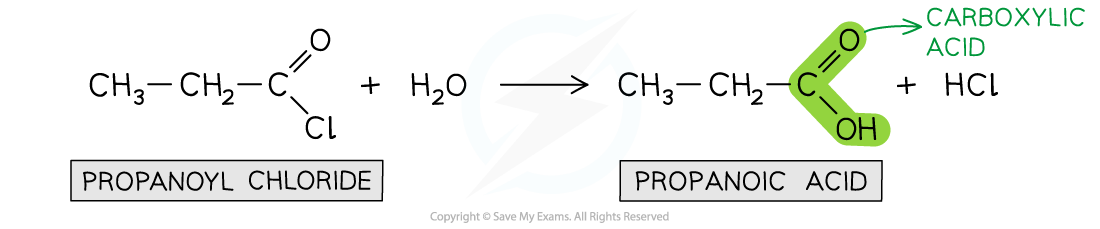
Acyl chlorides are hydrolysed to carboxylic acids
Formation of esters
-
Acyl chlorides can react with alcohols to form esters
-
The esterification of acyl chlorides is also a nucleophilic addition-elimination reaction
- The alcohol adds across the C=O bond
- A HCl molecule is eliminated
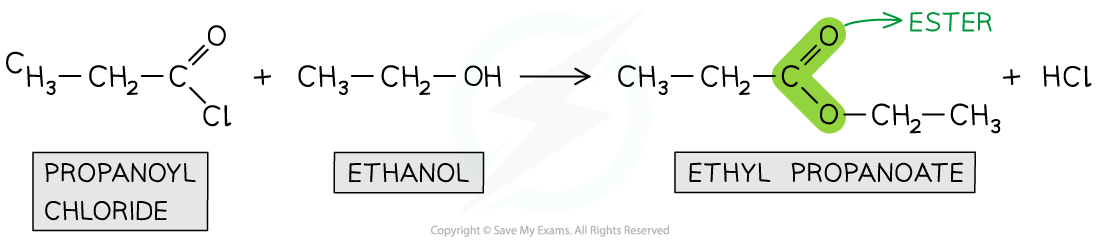
Acyl chlorides undergo esterification with alcohols to form esters
Formation of amides
-
Acyl chlorides react with ammonia or primary amines to form amides in a condensation reaction.
-
A lone pair on the nitrogen atom attacks the carbonyl carbon in the acyl chloride.
-
The reaction proceeds via a nucleophilic addition–elimination mechanism:
- The nucleophile adds to the C=O bond
- A chloride ion (Cl⁻) is eliminated
- Hydrogen chloride (HCl) is formed
What happens to the HCl?
- The HCl formed does not remain unreacted.
- It is immediately neutralised by a second molecule of ammonia or amine present in excess.
- This forms an ammonium salt (e.g. NH₄Cl, CH₃NH₃Cl).
Why 2 molecules are needed
- The 1st molecule of ammonia/amine forms the amide
- The 2nd molecule of ammonia/amine neutralises the HCl and forms ammonium salt
Examples
- Reaction with ammonia
- Product: Primary amide (propanamide) and ammonium chloride
CH3CH2COCl + 2NH3 → CH3CH2CONH2 + NH4Cl
- Reaction with methylamine
- Product: Secondary (substituted) amide and methylammonium chloride
CH3COCl + 2CH3NH2 → CH3CONHCH3 + CH3NH3Cl
- Reaction with ethylamine
- Product: Secondary (substituted) amide and ethylammonium chloride
CH3COCl + 2CH3CH2NH2 → CH3CONHCH2CH3 + CH3CH2NH3Cl
Summary for formation of amides
- All reactions form HCl, which is not observed as a separate product
- The HCl is neutralised by excess ammonia or amine
- The final products are an amide and an ammonium salt
Exam Hint Acyl chlorides also react with secondary amines to form secondary amides. They do not react with tertiary amines.
- acyl chloride + primary amine → secondary amide + HCl
- acyl chloride + secondary amine → tertiary amide + HCl
- acyl chloride + tertiary amine → no reaction
Was this revision note helpful?