VSEPR Theory (Edexcel IAL Chemistry)
Shapes & Angles
Spec point —
3.18
-
The valence shell electron pair repulsion theory(VSEPR) predicts the shape and bond angles of molecules
-
Electrons are negatively charged and will repel other electrons when close to each other
-
In a molecule, the bonding pairs of electrons will repel other electrons around the central atom forcing the molecule to adopt a shape in which these repulsive forces are minimised
-
When determining the shape and bond angles of a molecule, the following VSEPR rules should be considered:
- Valence shell electrons are those electrons that are found in the outer shell
- Electron pairs repel each other as they have the same charge
- Lone pair electrons repel each other more than bonded pairs
- Repulsion between multiple and single bonds is treated the same as for repulsion between single bonds
- Repulsion between pairs of double bonds are greater
- The most stable shape is adopted to minimize the repulsion forces
-
Different types of electron pairs have different repulsive forces
- Lone pairs of electrons have a more concentrated electron charge cloud than bonding pairs of electrons
- The cloud charges are wider and closer to the central atom’s nucleus
- The order of repulsion is therefore: lone pair – lone pair > lone pair – bond pair > bond pair – bond pair
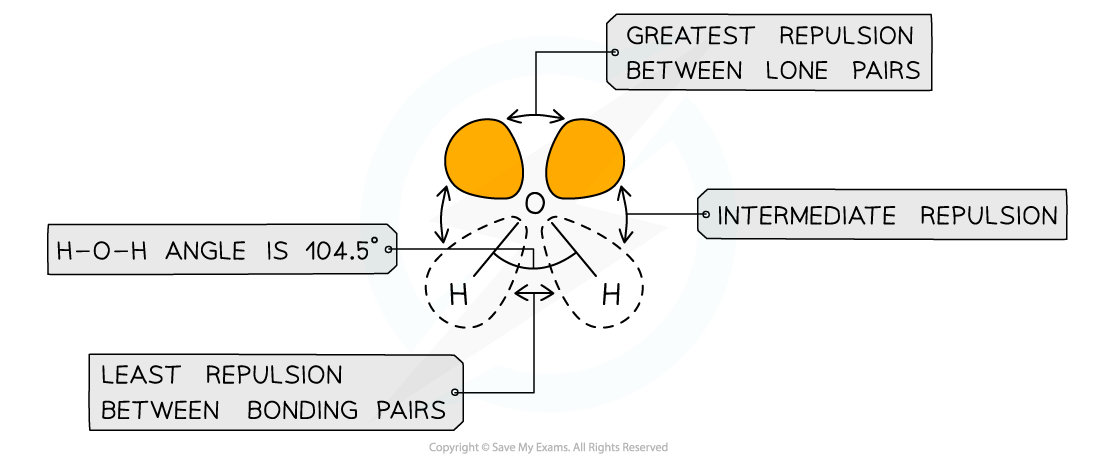
Different types of electron pairs have different repulsive forces
Bond length
-
The bond length is internuclear distance of two covalently bonded atoms
- It is the distance from the nucleus of one atom to another atom which forms the covalent bond
-
The greater the forces of attraction between electrons and nuclei, the more the atoms are pulled closer to each other
-
This decreases the bond length of a molecule and increases the strength of the covalent bond
-
Triple bonds are the shortest and strongest covalent bonds due to the large electron density between the nuclei of the two atoms
-
This increase the forces of attraction between the electrons and nuclei of the atoms
-
As a result of this, the atoms are pulled closer together causing a shorter bond length
-
The increased forces of attraction also means that the covalent bond is stronger
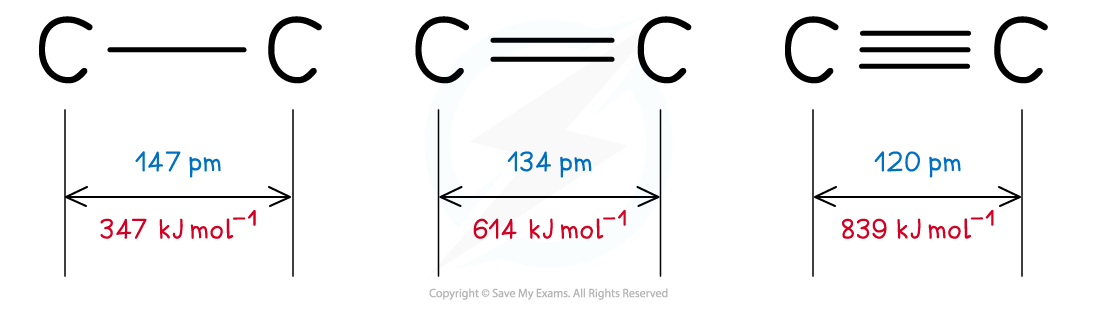
Triple bonds are the shortest covalent bonds and therefore the strongest ones
Bond Angle
- Molecules can adapt the following shapes and bond angles:
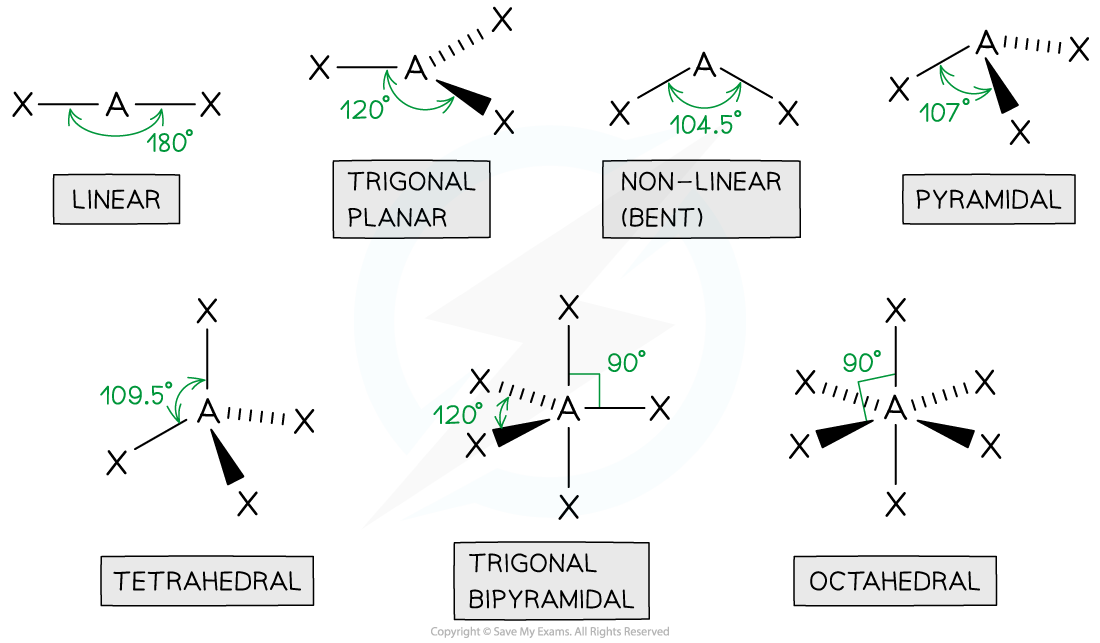
Molecules of different shapes can adapt with their corresponding bond angles
Was this revision note helpful?
Build on this topic