Measuring the Growth of Microorganisms (Edexcel IAL Biology)
Spec point —
6.2
Measuring the Growth of Microorganisms
-
Bacteria and most other microorganisms are too small to count with the naked eye
-
There are a variety of methods that can be used to count microorganisms and it is important to be able to make an appropriate choice when conducting investigations
-
These methods include
- Cell counts
- Dilution plating
- Measuring area and mass
- Optical methods
Cell counts
-
A microscope and haemocytometer can be used to count single-celled microorganisms
-
A haemocytometer is a microscope slide with a rectangular chamber that is marked with grid lines
-
The chamber can hold a standard volume of 0.1 mm3
-
Haemocytometers were originally used to count blood cells
- Haemo = blood
-
-
Counting cells using a haemocytometer involves the following
-
A nutrient broth is diluted with an equal volume of trypan blue
- This is a dye that will stain dead cells blue
- It enables the investigator to only count the living cells
-
The chamber of the haemocytometer is filled with the stained nutrient broth
-
The number of living cells in the four corner squares of the grid are counted
-
Each corner square consists of 16 smaller squares
-
Consistency needs to be used when deciding whether to count cells that are on the lines that border the corner squares
- E.g. Counting cells on the top and right-hand borders and ignoring cells on the bottom and left-hand borders
-
-
The mean number of cells from the four corner squares can be calculated
-
-
The haemocytometer is calibrated to allow the calculation of the number of cells in a known volume of broth
- Because the haemocytometer chamber can hold exactly 0.1 mm3 of liquid, it is possible to estimate of the cell count in 1 ml of nutrient broth using the following calculation
No. of cells per ml nutrient broth = mean cell count x dilution factor x 104
-
Multiplying by the dilution factor enables calculation of the bacterial cell count in the original broth rather than the diluted broth
-
The multiplication by 104 enables calculation of the bacterial cell count in 1 ml rather than in 0.1 mm3
- 1 ml = 1 cm3
- 1 cm3 = 0.1 mm3 x 10 000
- 10 000 = 1 x 10⁴
-
-
E.g. in a scenario where a nutrient broth is diluted by a factor of 100 and the four corner grid squares contain 20, 14, 19, and 16 cells
- This gives a mean cell count of 17.25
- No. cells per ml nutrient broth = 17.25 x 100 x 104 = 17 250 000
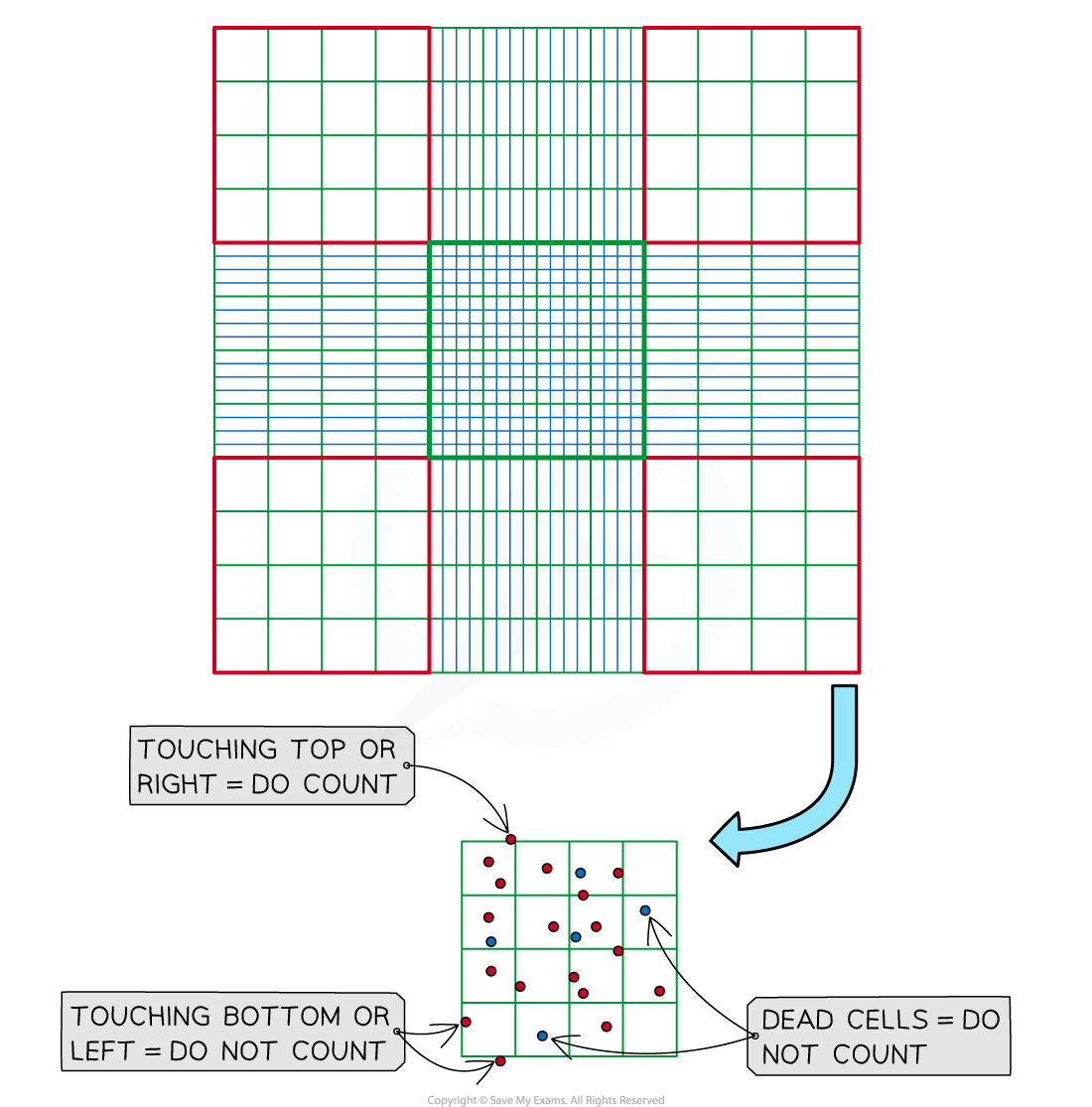
The living cells in the corner squares of a haemocytometer grid can be counted to determine the number of microorganisms in a standard volume of nutrient broth
Dilution plating
-
This method can be used to determine the total viable cell count in a nutrient broth
- The nutrient broth is transferred to agar where the bacteria use nutrients in the agar gel to reproduce
- A single cell that lands on agar reproduces by cloning itself, resulting in a mass of identical cells known as a colony
- Each microbial colony that grows on agar gel originated with one viable microorganism, so can be counted as one viable cell
-
Individual microbial colonies can be difficult to identify on an agar plate as they tend to form one large mass
-
This problem can be overcome by diluting the original cultures before transferring the samples to agar; this reduces the number of cells in the original sample so that individual colonies are visible on an agar plate
- This is why the technique is known as dilution plating
-
To calculate the total viable cell count, the number of colonies are multiplied by the dilution factor
-
A mean can be determined if more than one plate is used
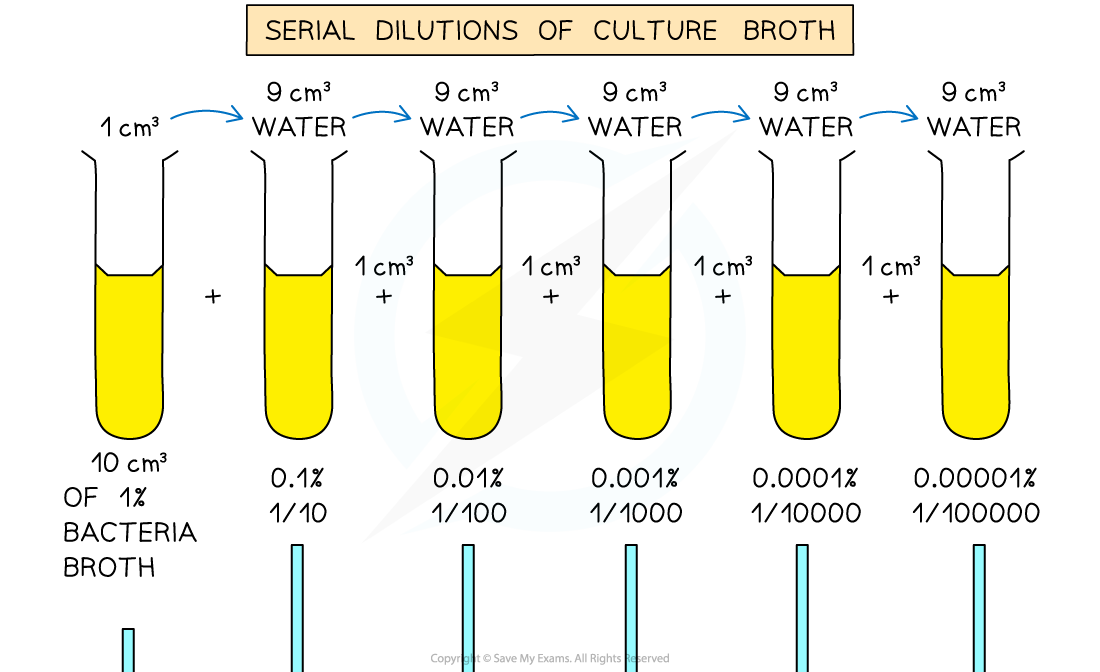
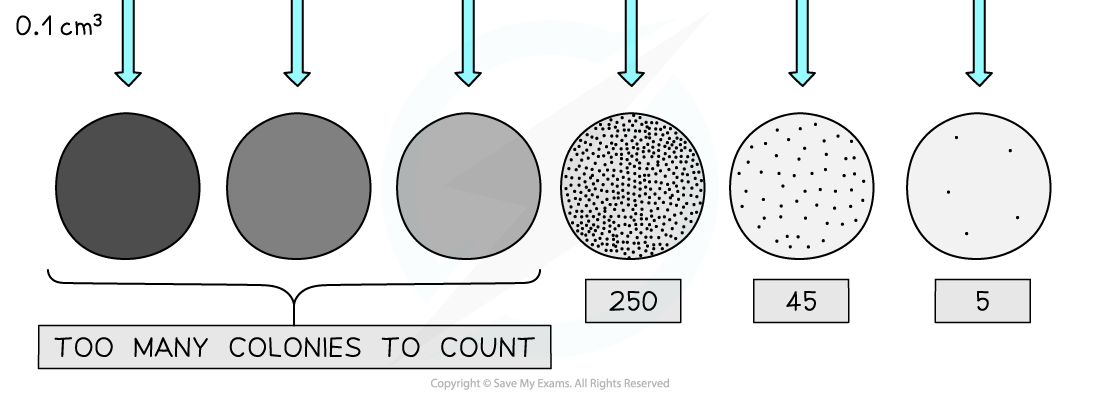
Dilution plating can provide a way to determine the total viable cell count of a microbial culture
Area and mass of fungi
-
Fungi do not always live as single-celled organisms, but can form a mass of elongated cells known as a fungal mycelium(plural mycelia); this means that the methods described above can be unsuitable for measuring the growth of some fungi
-
Measuring the diameter of individual areas of the mycelium can be used to determine the growth of fungi
- Petri dishes of agar are inoculated with fungal spores and incubated at a suitable temperature
- The resulting areas of fungal mycelia are then measured
-
This can be used to compare growth rates in different conditions, e.g. at different temperatures
- The larger the mean diameter, the greater the growth of the fungi
-
Testing the dry mass of fungi is another effective way to measure fungal growth
- A liquid nutrient broth is inoculated with fungal spores
- Samples of the nutrient broth are removed at set time intervals
- The fungal mycelia are removed by filtering or centrifugation
- The material is dried in an oven overnight and its mass measured
-
The higher the mass, the more fungal growth has occurred
Optical methods
-
Turbidimetry is a specialised form of colorimetry that can be used as an alternative method to measure the number of cells in a sample
-
Turbidity is a measure of how cloudy a solution is
- More turbid = more cloudy
- Less turbid = less cloudy
-
Colorimetry uses a machine called a colorimeter to shine a beam of light at a sample and measure the amount of light that is either transmitted through or absorbed by the sample
-
-
The higher the number of cells the more turbid the solution becomes
-
More turbid solutions will absorb more light and allow less light through; this can be measured by a colorimeter
-
This provides an indirect measure of the number of microorganisms present
-
A calibration curve can be constructed by measuring the turbidity of a series of control cultures while also counting the cells in each culture using a haemocytometer; the results are plotted in a graph of turbidity against cell count
-
This curve can then be used to estimate the cell count of unknown samples by measuring their turbidity and then reading their cell count from the graph
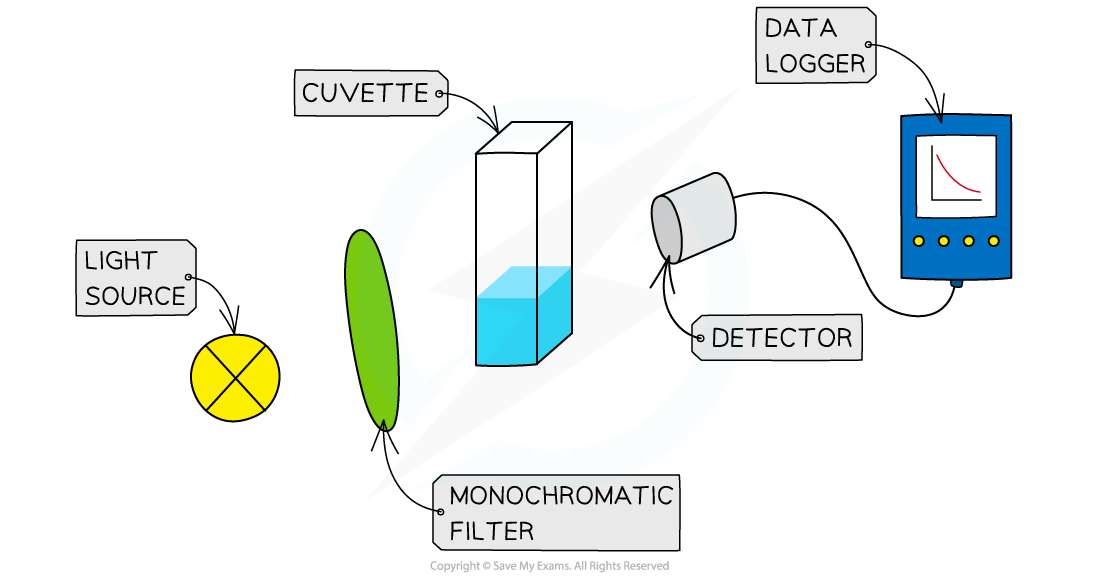
A colorimeter can be used to determine the turbidity of a solution containing microorganisms. The solution containing bacteria is placed into a container called a cuvette and the amount of light that can pass through, or is absorbed by, the solution can be measured.
Was this revision note helpful?