Thermal Conduction (Cambridge International IGCSE Physics)
Thermal conduction in solids
Spec point —
2.3.2· Describe thermal conduction in all solids in terms of atomic or molecular lattice vibrations and also in terms of the movement of free (delocalised) electrons in metallic conductors
Extended Tier Only
-
Thermal conduction is the transfer of thermal energy from one region to another through atomic or molecular lattice vibrations and, in metallic conductors, through the movement of free (delocalised) electrons
-
Thermal conduction is the main method of thermal energy transfer in solids
-
Metals are the best thermal conductors
- This is because they have a large number of free electrons
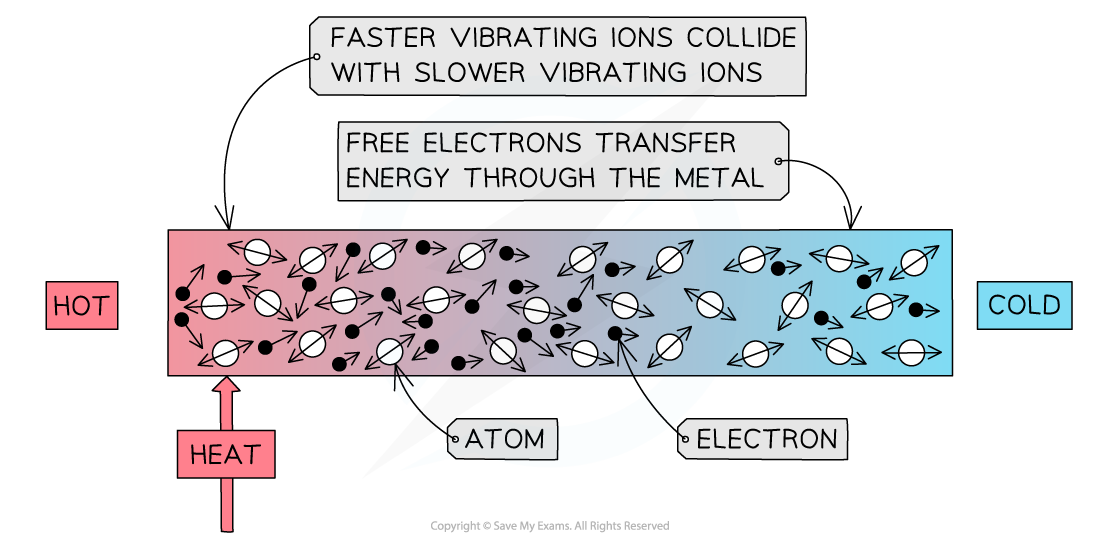
Conduction: the atoms in a solid vibrate and collide, transferring energy
-
Conduction can occur through two mechanisms:
- Lattice vibrations
- Movement of free (delocalised) electrons
-
When a substance is heated, the atoms, or ions, vibrate more vigorously about their fixed positions
- The atoms at the hotter end of the solid will vibrate more than the atoms at the cooler end
- As they do so they bump into each other, transferring energy from atom to atom
- These collisions transfer internal energy until thermal equilibrium is achieved throughout the substance
- This occurs in all solids, metals and non-metals alike
-
In a metal, the vibrating atoms also transfer energy to the free electrons
- These electrons then travel a large distance through the metal and collide with distant atoms, transferring energy to them
- This is much faster than lattice vibrations alone, which is why metals are the best thermal conductors
Exam Hint Make sure you check which mechanism is being asked about in the question. Use terms like lattice vibrations when atoms are involved, and movement when electrons are involved.
Thermal conduction in liquids & gases
Spec point —
2.3.2· Describe, in terms of particles, why thermal conduction is bad in gases and most liquids
Extended Tier Only
-
For thermal conduction to occur, the particles need to be close together so that when they vibrate, the lattice vibrations are passed along
-
Most liquids do not contain free (delocalised) electrons
-
In most liquids, particles are not in a regular, fixed lattice arrangement
- Particles are constantly moving around or sliding over one another
- So particles cannot efficiently pass on kinetic energy to their immediate neighbours through lattice vibrations
-
In gases, the particles are widely separated and move randomly rather than vibrating about fixed positions, so there are no lattice vibrations to pass energy along
- The consequence of this greater particle separation is that collisions, which transfer energy, are less frequent
-
Gases and most liquids are bad thermal conductors; liquid metals are an exception because they still contain free electrons
Relative thermal conductivity
Spec point —
2.3.2· Know that there are many solids that conduct thermal energy better than thermal insulators but do so less well than good thermal conductors
Extended Tier Only
-
Solids are not simply conductors or insulators
- Many solids conduct thermal energy better than thermal insulators but far less effectively than good thermal conductors such as metals
-
Better thermal conductors are those with free (delocalised) electrons which can easily transfer energy
- It is the lack of free (delocalised) electrons that makes non-metals less effective at conducting thermal energy than metals
-
This means that there is a wide range of thermal conductivity, and different materials have different levels of conductivity
- For example, copper is a better thermal conductor than iron, while rubber is a better thermal insulator than glass

Comparing the different levels of conductivity of different materials
Was this revision note helpful?
Build on this topic