Fission & Fusion (Cambridge International IGCSE Physics)
Spec point —
5.1.4· Describe the processes of nuclear fission and nuclear fusion
- as the splitting or joining of nuclei,
- to include the nuclide equation
- and qualitative description of mass and energy changes without values
Fission & fusion
- Nuclear fission & fusion are nuclear reactions that change the nucleus of an atom to produce high amounts of energy from the energy stored in the nucleus of an atom
Nuclear fission
- Nuclear fission is defined as:
The splitting of a large, unstable nucleus into two smaller nuclei
-
During fission:
-
a neutron collides with an unstable nucleus
- The neutron and the nucleus are the reactants
-
the nucleus splits into two smaller nuclei (called daughter nuclei) and two or three neutrons
- The daughter nuclei and the neutrons are the products of the reaction
-
gamma rays are also emitted
-
Nuclear fission process
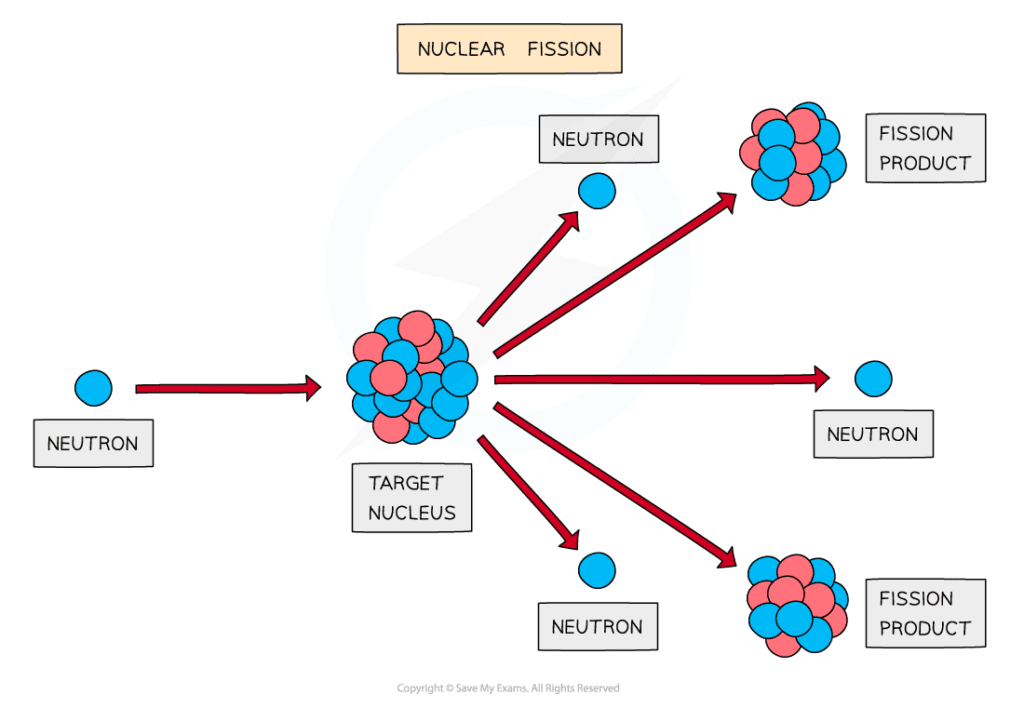
A neutron is fired into the target nucleus, causing it to split
Nuclear fission nuclide equations
- An example of a nuclide equation for the fission of uranium-235 is:
U _ 92 ^ 235 + n _ 0 ^ 1 -> Kr _ 36 ^ 92 + Ba _ 56 ^ 141 + 3 n _ 0 ^ 1 + energy
-
Where:
U _ 92 ^ 235is an unstable isotope of uraniumn _ 0 ^ 1is a neutron- is an unstable isotope of krypton
- is an unstable isotope of barium
Nuclear fission of uranium-235
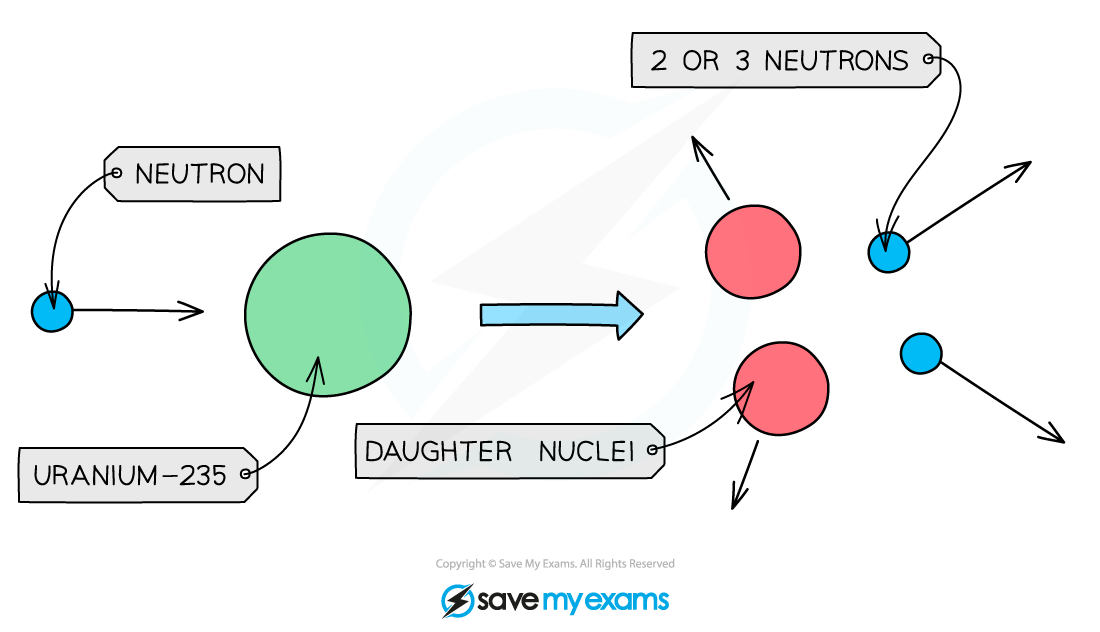
Large nuclei can decay by fission to produce smaller nuclei and neutrons with a lot of kinetic energy
Nuclear fission mass and energy values
-
Energy is conserved in a nuclear fission reaction
-
In the example:
U _ 92 ^ 235 + n _ 0 ^ 1 -> Kr _ 36 ^ 92 + Ba _ 56 ^ 141 + 3 n _ 0 ^ 1 + energy
- The sum of the nucleon (top) numbers of the reactants (left-hand side) is equal to the sum of the nucleon numbers of the products (right-hand side):
- The same is true for the proton (bottom) numbers:
-
The products of fission move away very quickly
- During a fission reaction, energy is transferred from nuclear energy store of the parent nucleus to the kinetic energy store of the products
-
The mass of the products is fractionally less than the mass of the original nucleus
- This is because the remaining mass has been converted into energy, which is released during the fission process
-
Large isotopes with a large nucleon number, such as uranium and plutonium, both undergo fission and are used as fuels in nuclear power stations
Nuclear fusion
- Nuclear fusion is defined as:
When two light nuclei join to form a heavier nucleus
-
Stars use nuclear fusion to produce energy
- In most stars, hydrogen nuclei (light nuclei) are fused together to form a helium nucleus (heavier nucleus) and a huge amount of energy is produced
Nuclear fusion of hydrogen
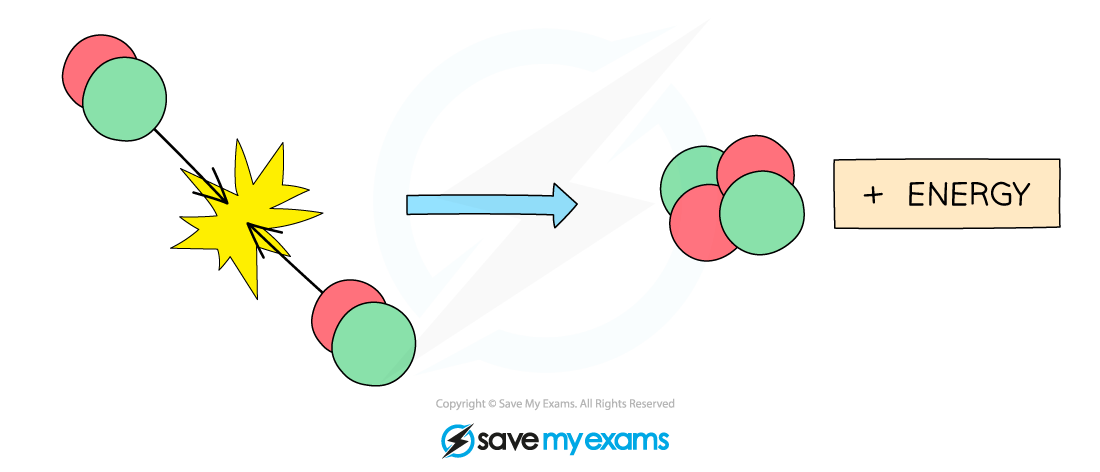
Two hydrogen nuclei fuse to form a helium nucleus
-
Nuclear fusion requires extremely high temperature and pressure
- So fusion is very hard to reproduce on Earth
Nuclear fusion nuclide equations
- An example of a nuclide equation for fusion is:
H _ 1 ^ 2 + H _ 1 ^ 1 -> He _ 2 ^ 3 + energy
-
Where:
H _ 1 ^ 2is deuterium (isotope of hydrogen with 1 proton and 1 neutron)- is hydrogen (with one proton)
- is an isotope of helium (with two protons and one neutron)
Nuclear fusion mass and energy values
-
The energy produced during nuclear fusion comes from a very small amount of a particle’s mass converted into energy
-
Therefore, the mass of the product (fused nucleus) is fractionally less than the mass of the two original nuclei (reactants)
- The remaining mass has been converted into the energy released when the nuclei fuse
-
The amount of energy released during nuclear fusion is huge:
- the energy from 1 kg of hydrogen that undergoes fusion is equivalent to the energy from burning about 10 million kilograms of coal
Worked Example A nuclide equation for nuclear fission is stated as:
U _ 92 ^ 235 + n _ 0 ^ 1 -> Rb _ 37 ^ 96 + Cs _ 55 ^ 137 + N n _ 0 ^ 1Calculate the number of neutrons, N emitted in this reaction.
[2]
Answer:
Step 1: Calculate the sum of the nucleon numbers of the reactants
- The reactants are on the left-hand side of the equation
- The nucleon numbers are the top numbers in the nuclide notation
Step 2: Calculate the sum of the nucleon numbers of the products
- The products are on the right-hand side of the equation
Step 3: Equate the total nucleons of the reactants and products
[1 mark]
Step 4: Rearrange for the number of neutrons, N
[1 mark]
Was this revision note helpful?