Ionising Power & Deflection (Cambridge International IGCSE Physics)
Ionising effect of radiation
Spec point —
5.2.3· Explain their relative ionising effects with reference to: (a) kinetic energy (b) electric charge
Ionising effect of radiation
Extended Tier Only
-
The relative ionising effects of nuclear radiation depend upon their:
- kinetic energy
- electric charge
Ionisation
-
Ionisation is when an atom becomes negatively or positively charged by gaining or losing electrons
-
Nuclear radiation can ionise the atoms that it hits
- This is mostly done by removing an electron so the atom loses a negative charge and is left with an overall positive charge
Nuclear radiation ionising an atom
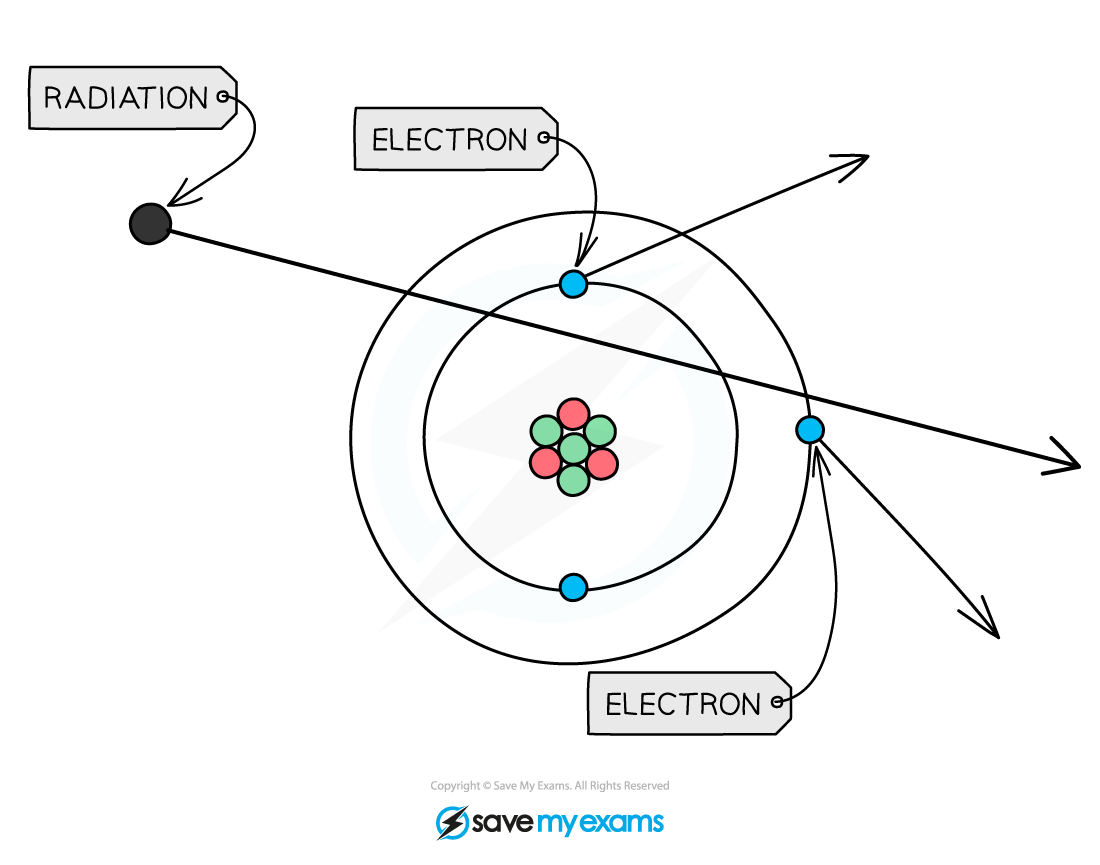
When radiation passes close to atoms it can knock out electrons, ionising the atom
Effects of kinetic energy and charge on ionising power
-
The greater the charge of the radiation, the more ionising it is
- This means alpha radiation is the most ionising as it has a charge of +2
- A beta particle has a charge of –1 so it is moderately ionising
- This means gamma radiation is the least ionising as it has a charge of 0 (no charge)
-
The higher the kinetic energy of the radiation, the more ionising it is
- This means the alpha particle is still the most ionising because it has the greatest mass
- However, a beta particle is very light (it is an electron) but travels at high speeds, therefore, it has a lot of kinetic energy and is still moderately ionising
- Gamma radiation has virtually no mass so it is weakly ionising
Exam Hint Remembering the properties of alpha, beta and gamma radiation helps to deduce how much ionising power they have. E.g. An alpha particle is a helium nucleus which contains two protons and two neutrons. It therefore has a charge of +2 since each proton has a charge of +1 and a neutron has no charge.
Kinetic energy is defined by the equation mv2 therefore it depends on the mass m of the particle and its velocity v.
Deflection in electric & magnetic fields
Spec point —
5.2.3· Describe the deflection of α-particles, β-particles and γ-radiation in electric fields and magnetic fields
Extended tier only
-
α-particles, β-particles and γ-radiation are deflected differently in electric and magnetic fields
-
A particle is deflected in an electric field if it has charge
-
A particle is deflected in a magnetic field if it has charge and is moving perpendicular to it
- Therefore, since gamma (γ) particles have no charge, they are not deflected by either electric or magnetic fields
- Only alpha (α) and beta (β) particles are deflected
Electric fields
-
Alpha particles have a charge of +2 (the charge of a helium nucleus)
-
Beta particles have a charge of −1 (the charge of an electron)
-
Therefore, in an electric field created between negatively and positively charged plates
- Alpha particles are deflected towards the negative plate
- Beta particles are deflected towards the positive plate
- Gamma radiation is not deflected and travels straight through between the plates
Deflection in electric fields
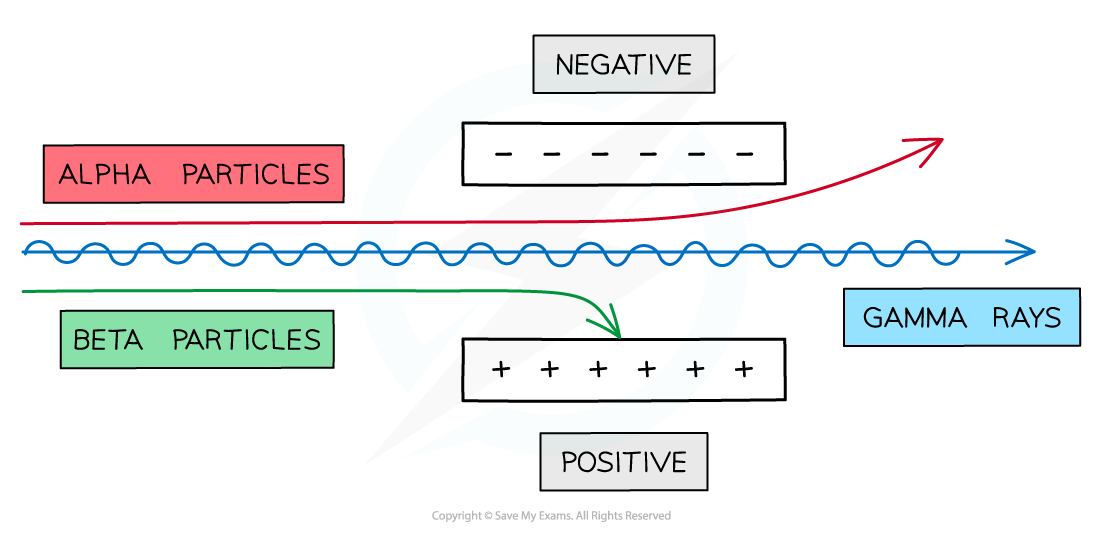
Alpha and beta particles can be deflected by electric fields
-
Alpha particles are heavier than beta particles
- Therefore, beta particles are deflected more in the electric field
Magnetic fields
- Similarly, alpha and beta particles are deflected by magnetic fields whilst they are moving
- They are deflected in opposite directions due to their opposite charges
Deflection of a beta particle in a magnetic field
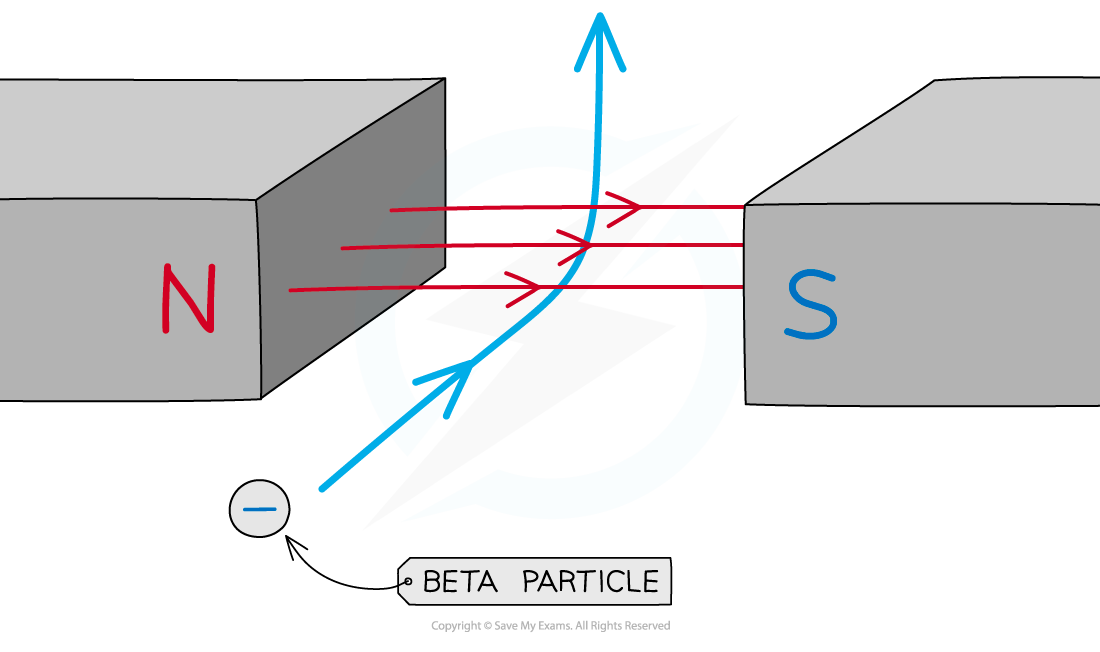
Alpha and beta particles can also be deflected by magnetic fields
Exam Hint It is important to note that because of their opposite charges, alpha and beta particles will deflect in opposite directions. You need to know in which direction alpha and beta particles are deflected in an electric field and a magnetic field.
Was this revision note helpful?
Build on this topic