The Atom (Cambridge International IGCSE Physics)
Atomic structure
Spec point —
5.1.1· Describe the structure of an atom in terms of a positively charged nucleus and negatively charged electrons in orbit around the nucleus
- Atoms are the building blocks of all matter
- They consist of a small dense positively charged nucleus and negatively charged electrons in orbit around the nucleus
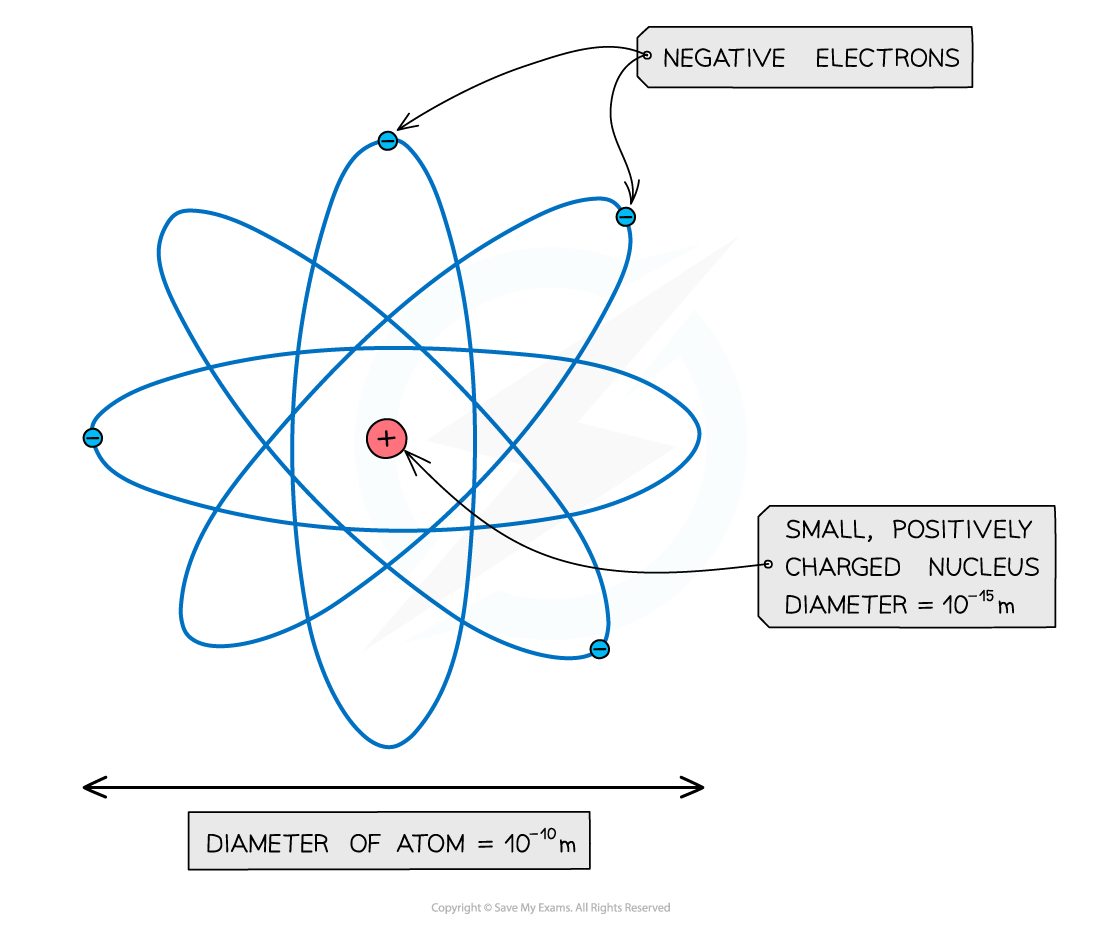
An atom is a small positive nucleus, surrounded by orbiting negative electrons
-
Atoms are incredibly small, with a radius of only 1 × 10⁻¹⁰ m
- This means that about one hundred million atoms could fit side by side across your thumbnail
-
The radius of the nucleus is over 10 000 times smaller than the whole atom, but it contains almost all of the mass of the atom
Rutherford's alpha scattering experiment
Spec point —
5.1.1· Describe how the scattering of alpha (α) particles by a sheet of thin metal supports the nuclear model of the atom, by providing evidence for: (a) a very small nucleus surrounded by mostly empty space (b) a nucleus containing most of the mass of the atom (c) a nucleus that is positively charged
Rutherford's alpha scattering experiment
Extended Tier Only
-
In Rutherford's alpha scattering experiment the scattering of alpha (α) particles by a sheet of thin metal supports the nuclear model of the atom, by providing evidence for:
- a very small nucleus surrounded by mostly empty space
- a nucleus containing most of the mass of the atom
- a nucleus that is positively charged
-
In 1909 a group of scientists were investigating the Plum Pudding model of atomic structure
- Physicist Ernest Rutherford was instructing two of his students, Hans Geiger and Ernest Marsden to carry out the alpha scattering experiment
-
They directed a beam of alpha particles (He2+ ions) at a thin gold foil
- They expected the alpha particles to travel through the gold foil, and maybe change direction a small amount
-
As shown in the diagram, instead they discovered that:
- most of the alpha particles passed straight through the foil because the atom is mostly empty space (A)
- some of the alpha particles were deflected (changed direction ) as they passed through the foil because they came close to the positively charged nucleus, which repelled the positively charged alpha particles (B)
- a few of the alpha particles bounced back off the gold foil because the nucleus is tiny
-
This bouncing back could not be explained by the Plum Pudding model of atomic structure, so a new model had to be created
- This was the first evidence of the nuclear atom as atomic structure
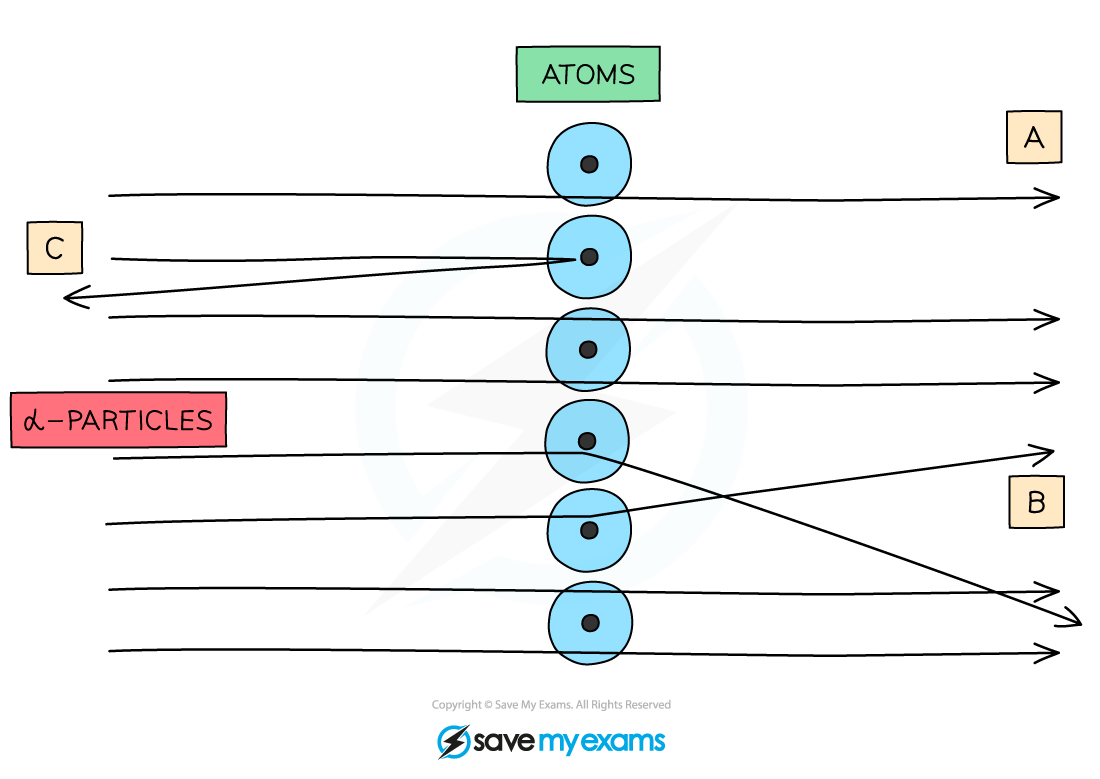
*When α-particles are fired at thin gold foil, most of them go straight through but a very small number bounce straight back *
Atoms & ions
Spec point —
5.1.1· Know how atoms may form positive ions by losing electrons or form negative ions by gaining electrons
-
An ion is an electrically charged atom or group of atoms formed by the loss or gain of electrons
- An atom will lose or gain electrons to become more stable
-
A stable atom is normally electrically neutral
- This means it has the same number of protons (positive charge) and electrons (negative charge)
-
Positive ions are therefore formed when atoms lose electrons
- There will be more protons than electrons
-
Negative ions are therefore formed when atoms gain electrons
- There will be more electrons than protons
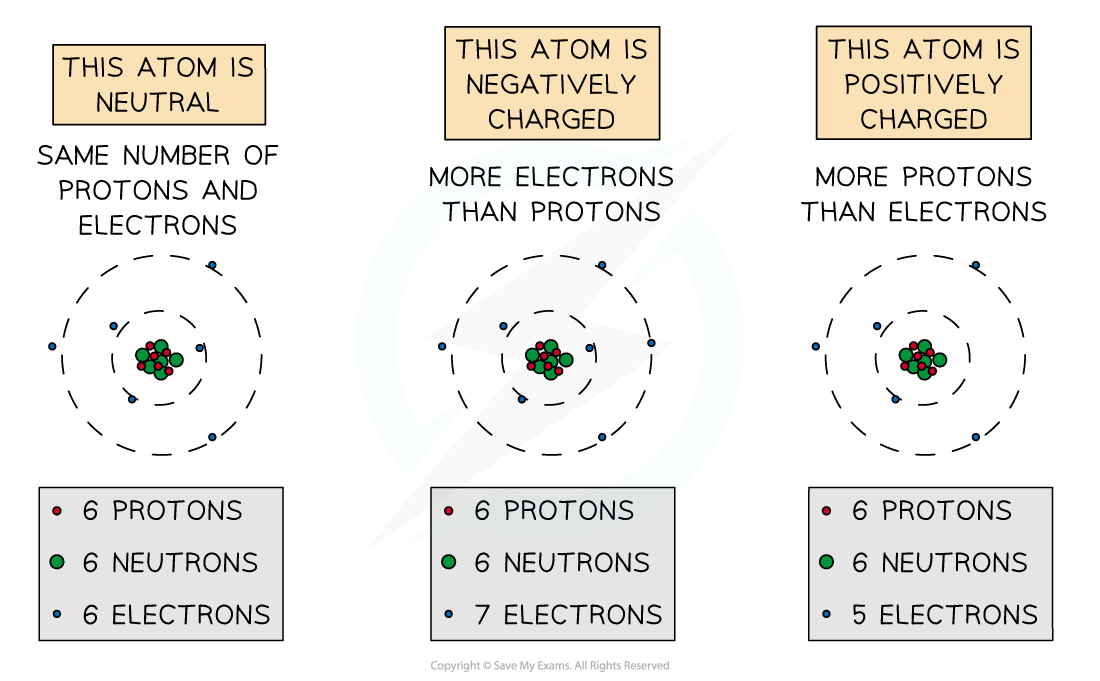
The difference between positive and negative ions
Exam Hint You may hear the term 'net charge'. This just means the 'overall' charge of the atom. If an atom has 5 protons, 5 neutrons and 6 electrons, it has a net negative charge because it's a negative ion (more electrons than protons).
Remember which way around the charges are by proton being positive.
Was this revision note helpful?