Digital & Analogue Signals (Cambridge International IGCSE Physics)
Spec point —
3.3.5· Know the difference between a digital and analogue signal
Digital & analogue signals
Extended Tier Only
-
There are two types of signals:
- analogue
- digital
-
Analogue signals vary continuously - they can take any value
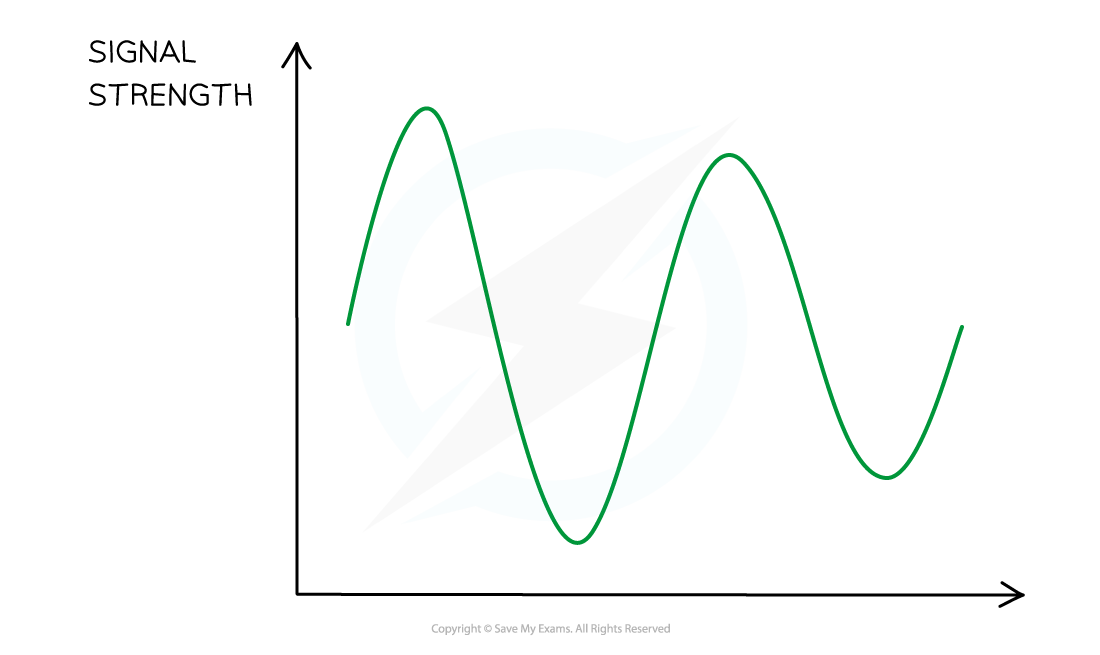
An analogue signal is continuously varying, taking any value
-
A digital signal can only take one of two (discrete) states
-
These are usually referred to as:
- 1s and 0s
- highs and lows
- ons and offs
-
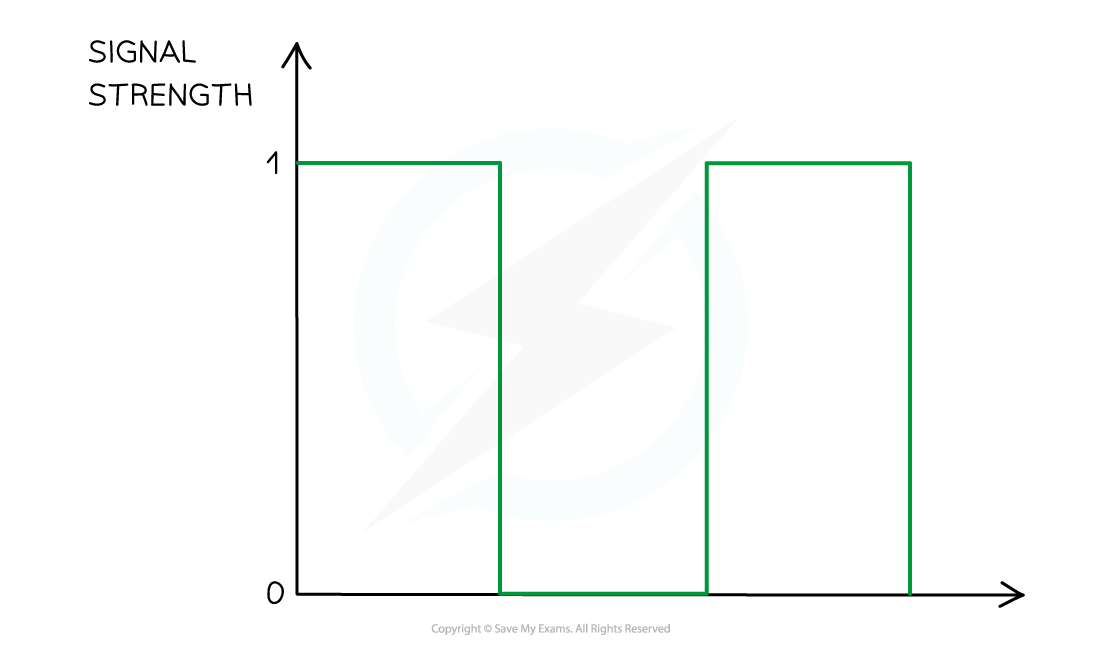
A digital signal can only take one of two values – 0 or 1
Transmission of sound
Spec point —
3.3.5· Know that a sound can be transmitted as a digital or analogue signal
Extended Tier Only
-
Sound waves can be transmitted as a digital or analogue signal
-
Signals for speech or music are made up of varying frequencies
- To make out the information clearly, the signal needs to be transmitted with as little interference as possible
-
The signal undergoes digital sampling
-
It is converted both before transmission and after being received
- Before transmission: the signal is converted from analogue to digital
- After being received: the signal is converted back from digital to analogue
Benefits of digital signalling
Spec point —
3.3.5· nan
Extended Tier Only
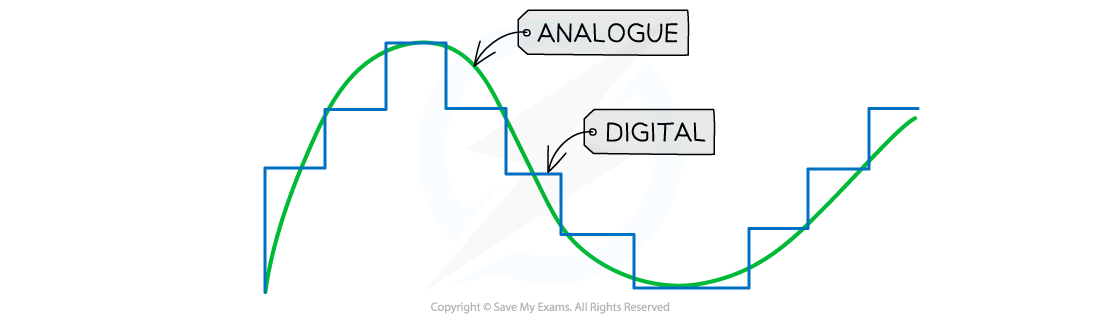
Digitally sampling an analogue signal
-
The key advantages of data transmission in digital form compared to analogue are:
- The signal can be regenerated so there is minimal noise
- Due to accurate signal regeneration, the range of digital signals is larger than the range of analogue signals (they can cover larger distances)
- Digital signals enable an increased rate of data transmission compared to analogue
- Extra data can be added so that the signal can be checked for errors
Exam Hint Remember that digital sampling is when you convert an analogue signal into a digital signal by recording sound at set time intervals.
Was this revision note helpful?
Build on this topic