Star Formation (Cambridge International IGCSE Physics)
Spec point —
6.2.3· Describe the life cycle of a star: (a) a star is formed from interstellar clouds of gas and dust that contain hydrogen (b) a protostar is an interstellar cloud collapsing and increasing in temperature as a result of its internal gravitational attraction (c) a protostar becomes a stable star when the inward force of gravitational attraction is balanced by an outward force due to the high temperature in the centre of the star
Star formation
Extended Tier Only
- Stars go through a sequence of evolutionary stages, known as the life cycle of a star
- All stars follow the same initial stages:
nebula → protostar → stable star
Nebula
- Stars form from a giant interstellar cloud of gas and dust called a nebula
Protostar
- The gravitational attraction within a nebula pulls the particles closer together until a hot ball of gas forms, known as a protostar
- As the particles are pulled closer together, the density of the protostar increases
- This results in more frequent collisions between the particles, which causes the temperature to increase
Stable star
-
Once the protostar becomes hot enough, nuclear fusion reactions occur within its core
- The hydrogen in the core of the star is converted into helium
- Every fusion reaction releases heat and light, which keeps the core of the star hot
-
Once a star initiates fusion, it is known as a stable star
-
During this stage, the star is in equilibrium as the forces acting on it are balanced
-
Gravitational forces act inwards
- This is an attractive force which pulls the outer layers inwards
-
Thermal pressure acts outwards
- This is exerted by the expanding hot gases inside the star as energy is released during fusion
Balanced forces in a stable star
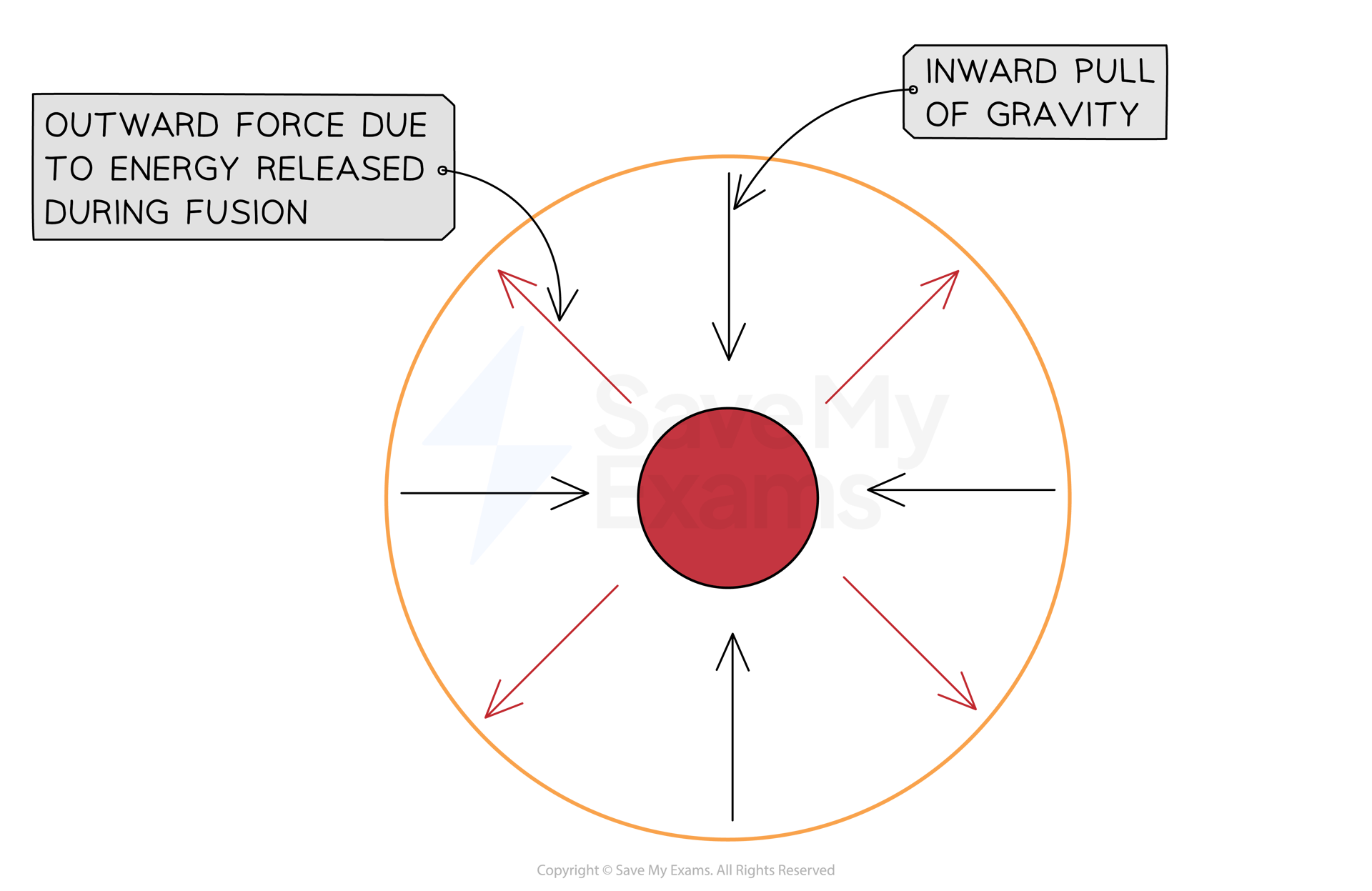
The outward and inward forces within a star are in equilibrium. The centre red circle represents the star's core and the orange circle represents the star's outer layers
- Once a stable star is formed, the final stages of its life cycle depend on its mass
- The different life cycles are shown below:
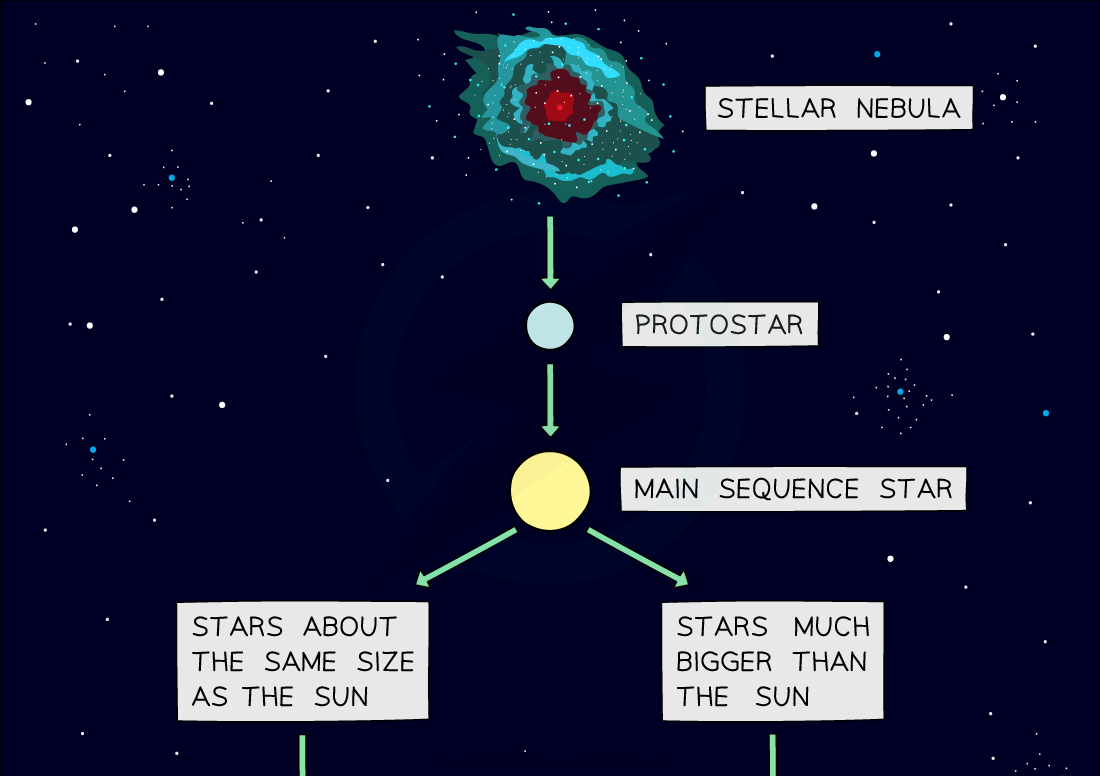
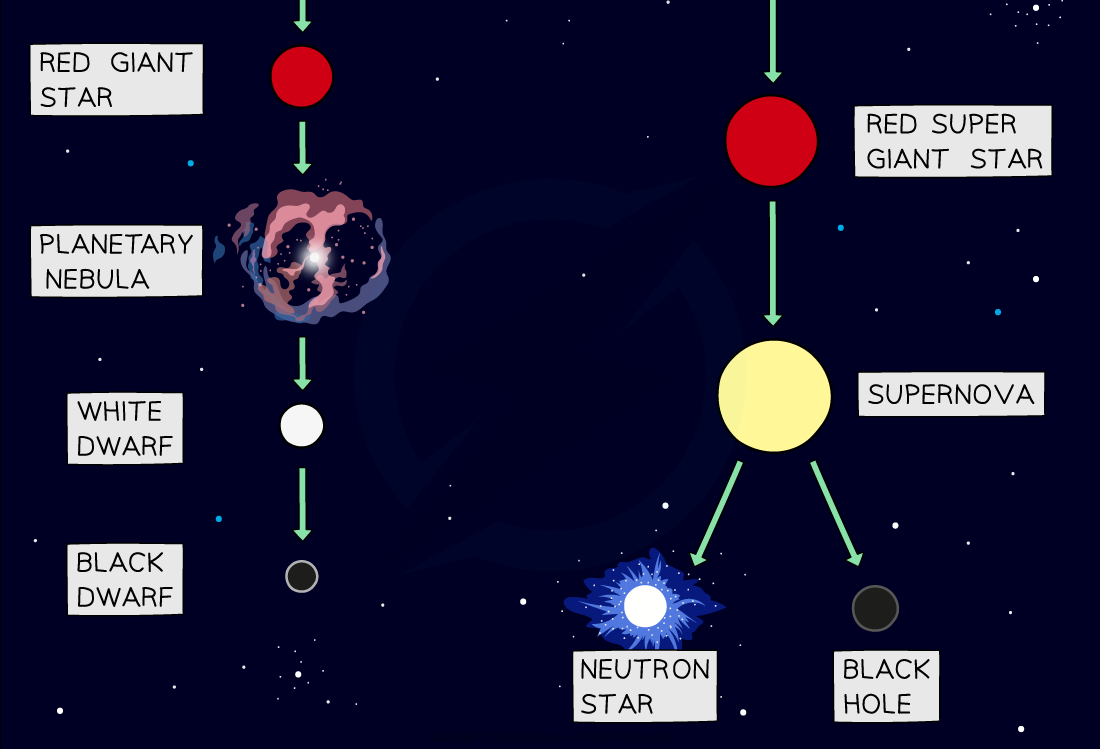
Flow diagram showing the life cycle of a star which is the same size as the Sun (solar mass) and the life cycle of a star which is much more massive than the Sun
Was this revision note helpful?
Build on this topic