Reflection of Light (Cambridge International IGCSE Physics)
Ray diagrams
Spec point —
3.2.1· Define and use the terms normal, angle of incidence and angle of reflection
-
In optics, a normal line is drawn at right angles to the boundary between two media
-
In reflection, angles are measured between the ray (showing the wave direction) and the normal line
- The angle between the incident ray and the normal is called the angle of incidence ()
- The angle between the reflected ray and the normal is called the angle of reflection ()
-
When drawing a ray diagram, an arrow is used to show the direction the wave is travelling
- An incident ray has an arrow pointing towards the boundary
- A reflected ray has an arrow pointing away from the boundary
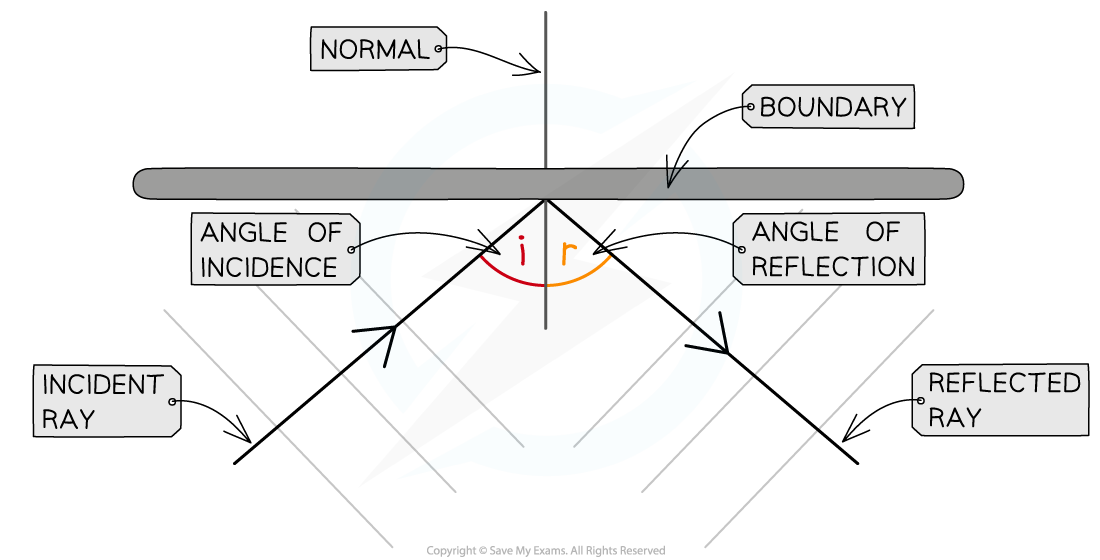
A ray diagram for light reflecting at a boundary, showing the normal, angle of incidence and angle of reflection
The law of reflection
Spec point —
3.2.1· State that for reflection, the angle of incidence is equal to the angle of reflection; recall and use this relationship
- The law of reflection states that the angles of incidence and reflection are equal:
-
Where:
- = angle of incidence in degrees (°)
- = angle of reflection in degrees (°)
-
This law of reflection is used in many devices such as:
- mirrors
- cameras
- optical fibres
- periscopes
Reflection in a plane mirror
Spec point —
3.2.1· Describe the formation of an optical image by a plane mirror, and give its characteristics, i.e.
- same size,
- same distance from mirror,
- virtual
Reflection in a plane mirror
-
When an object is placed in front of a plane mirror, an image of that object can be seen in the mirror
-
The image will be:
- the same size as the object
- the same distance behind the mirror as the object is in front of it
- virtual
-
A plane mirror defines a flat, smooth and polished surface
-
The formation of this image can be understood by drawing a ray diagram
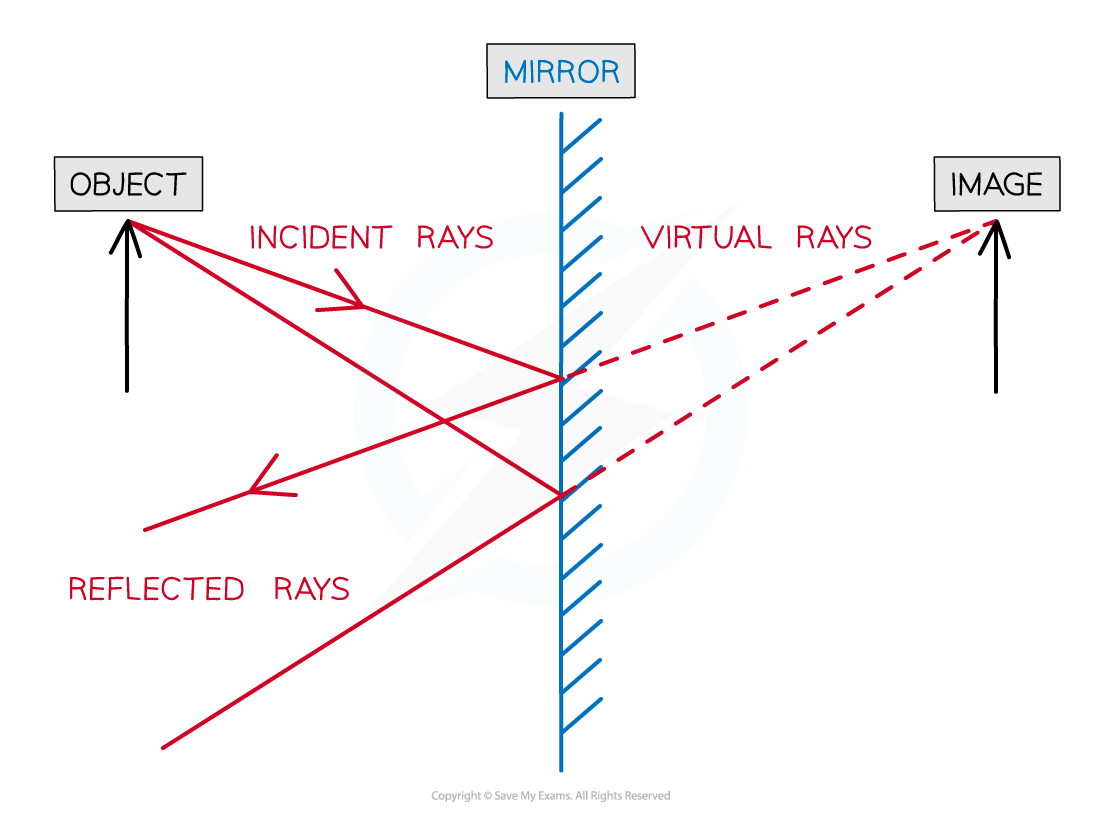
Ray diagram showing the formation of an image in a mirror by the reflection of light
-
Each incident ray on the diagram above can be drawn following these steps:
- Light from the object hits the mirror, reflecting from it (i=r)
- To an observer, the reflected ray appears to have come from behind the mirror
- The reflected ray can be traced back in this same direction behind the mirror, forming a virtual ray
- This process is repeated for another ray travelling in a slightly different direction
-
An image of the object will appear where these two virtual rays cross
-
The type of image formed in the mirror is called a virtual image because of the divergence of the rays from the image
- It cannot be projected onto a piece of paper (because the rays don’t go through the image)
Exam Hint When drawing light waves being reflected take care to get the angle about right.
If they are slightly out it won’t be a problem, but if there is an obvious difference between the angle of incidence and the angle of reflection then you will probably lose a mark.
Was this revision note helpful?
Build on this topic