Moments (Cambridge International IGCSE Physics)
Spec point —
1.5.1· Describe the moment of a force as a measure of its turning effect and give everyday examples Define the moment of a force as moment = force × perpendicular distance from the pivot; recall and use this equation
Moments
- A moment of a force is defined as:
The turning effect of a force about a pivot
-
Examples of the turning effect of a force are:
- A child on a see-saw
- Turning the handle of a spanner
- A door opening and closing
- Using a crane to move building supplies
- Using a screwdriver to open a tin of paint
- Turning a tap on and off
- Picking up a wheelbarrow
- Using scissors
-
Forces can cause the rotation of an object about a fixed pivot
-
This rotation can be clockwise or anticlockwise
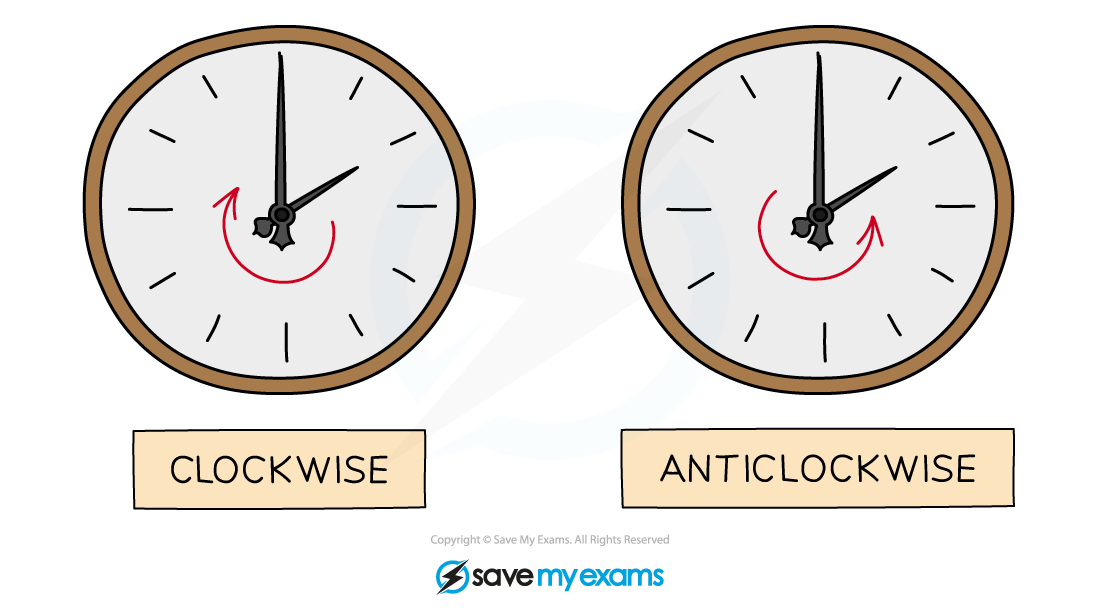
*Consider the hands of a clock when deciding if an object will rotate in a clockwise or anticlockwise direction *
- A force applied on one side of the pivot will cause the object to rotate
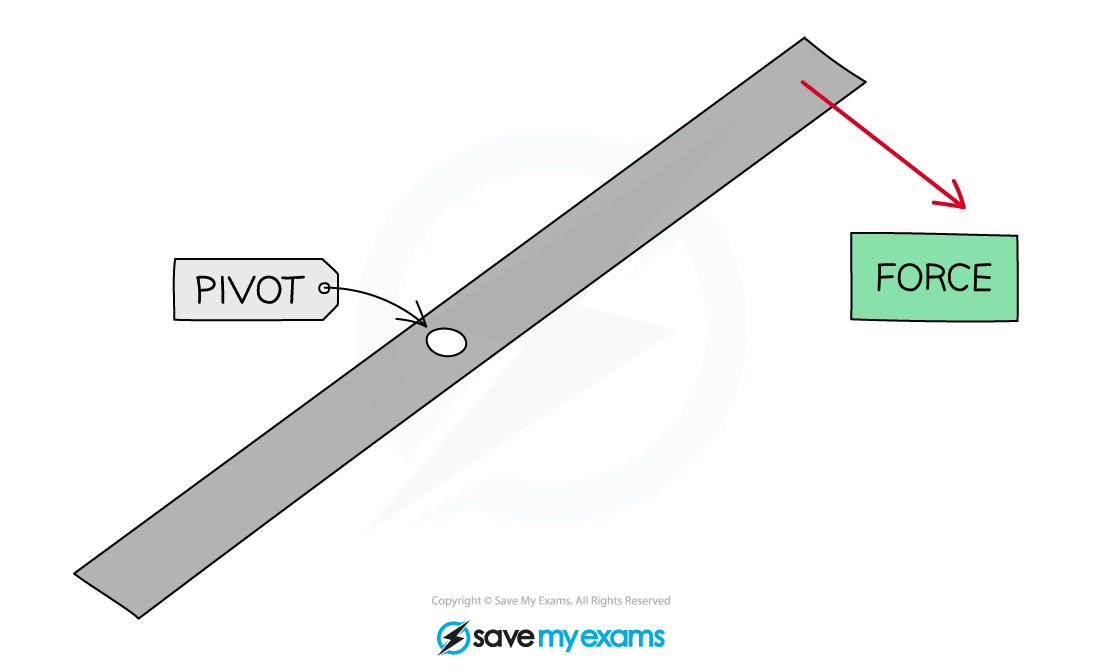
*The force applied will cause the object to rotate clockwise about the pivot *
The moment equation
- The size of a moment is defined by the equation:
-
The forces should be perpendicular to the distance from the pivot
- For example, on a horizontal beam, the forces which will cause a moment are those directed upwards or downwards
The turning effect of a force exerted on a spanner
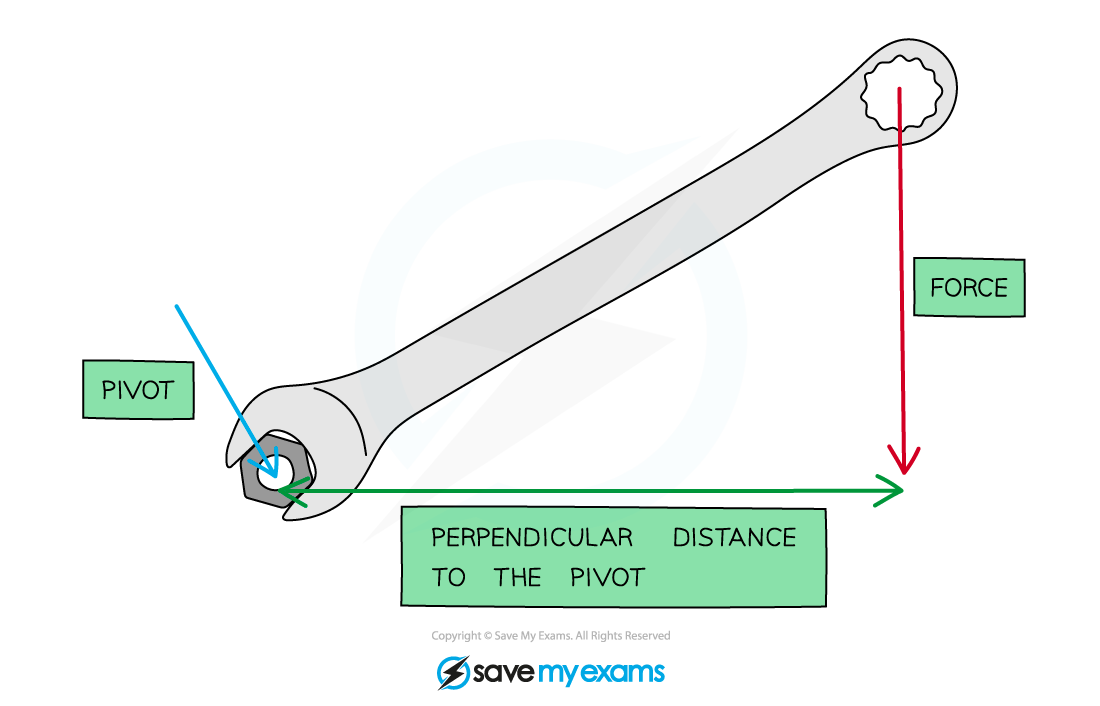
The moment depends on the force and perpendicular distance to the pivot
-
Increasing the distance at which a force is applied from a pivot decreases the force required
- If you try to push open a door right next to the hinge, it is very difficult, as it requires a lot of force
- If you push the door open at the side furthest from the hinge, then it is much easier, as less force is required
Forces required to open a door
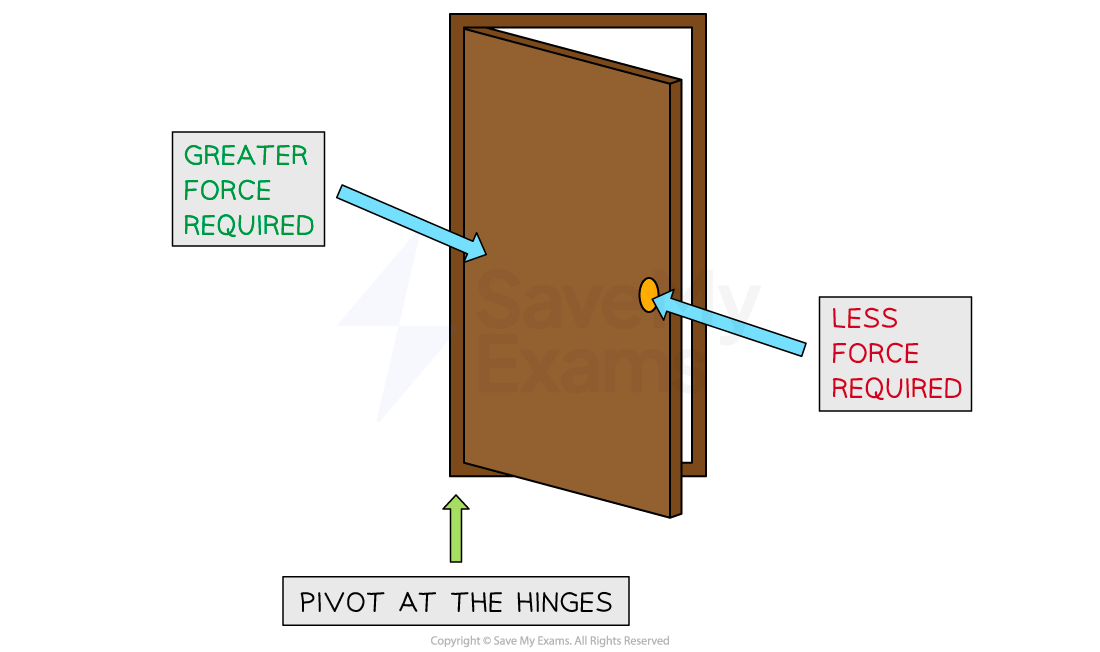
A greater force is required to push open a door next to the hinges than at the door handle
Worked Example A carpenter attempts to loosen a bolt that has rusted. To turn the bolt, they exert a force of 22 N using a spanner of length 20 cm. The force is exerted 5 cm from the end of the spanner.
Calculate the turning effect of the force.
[4]
Answer:
Step 1: List the known quantities
- Force,
- Length of spanner,
Step 2: Determine the perpendicular distance from the pivot
- The force is exerted 5 cm from the end of the spanner
- Therefore, the perpendicular distance from the force to the pivot, , is
[1 mark]
- Convert cm to m
[1 mark]
Step 3: Write out the equation for moments
[1 mark]
Step 4: Substitute in the known values to calculate
[1 mark]
Exam Hint Always work out the perpendicular distance from the pivot.
The moment of a force is measured in newton metres (N m), but can also be newton centimetres (N cm) if the distance is measured in cm instead. If your IGCSE moments exam question doesn't ask for a specific unit, always convert the distance into metres.
The following two units should be avoided when calculating the moment of a force: N/m, which suggests you have divided rather than multiplied, and joules, which are never accepted for a moment even though one joule is equal to one newton metre.
Principle of moments (core)
Spec point —
1.5.1· Apply the principle of moments to situations with one force each side of the pivot, including balancing of a beam
- The principle of moments states that:
If an object is balanced, the total clockwise moment about a pivot equals the total anticlockwise moment about that pivot
- The principle of moments means that for a balanced object, the moments on both sides of the pivot are equal
clockwise moment = anticlockwise moment
Exam Hint You must include direction words when stating the principle of moments. Only saying "the moments are equal" will not be credited.
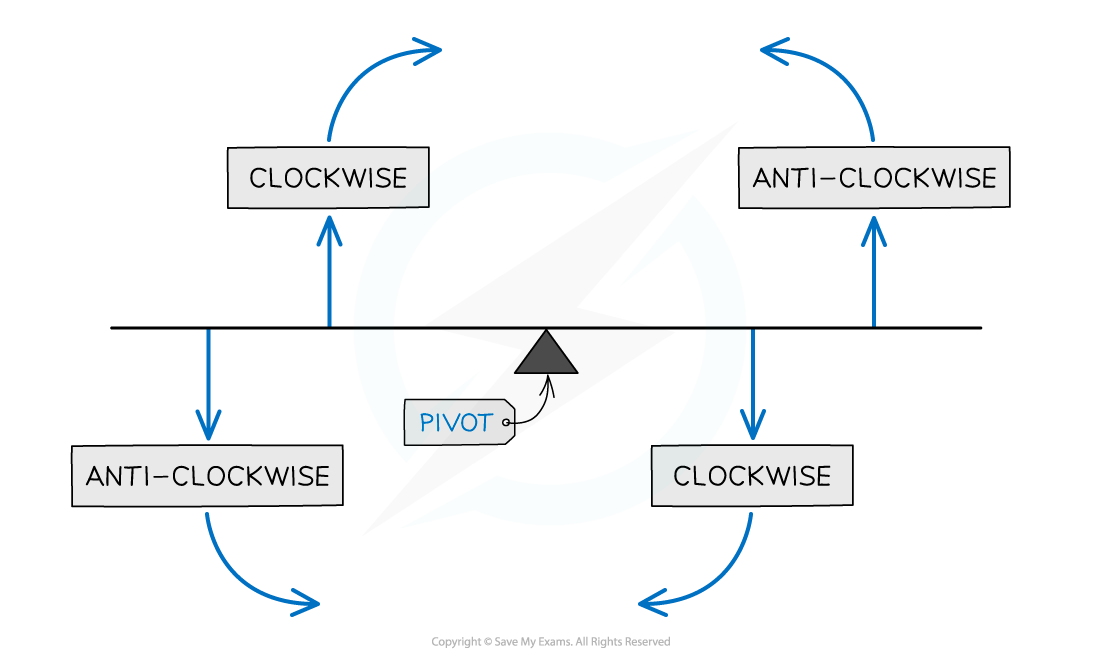
Imagine holding the beam about the pivot and applying just one of the forces. If the beam moves clockwise then the force applied is clockwise. This is how to decide whether a moment is clockwise or anticlockwise
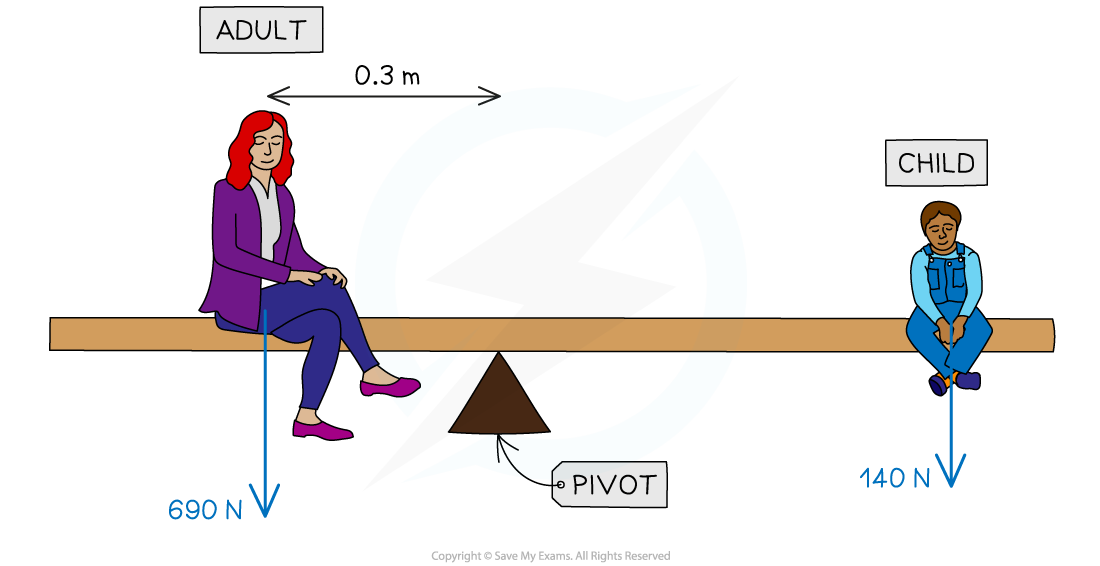
Worked Example An adult and child are at opposite ends of a playground see-saw.
The weight force acting on the adult is 690 N and the weight force acting on the child is 140 N.
The adult sits at a distance of 0.3 m from the pivot.
Calculate the distance the child must sit from the pivot for the see-saw to be balanced.
Use the principle of moments in your calculation.
[4]
Answer:
Step 1: List the known quantities
- Clockwise force (child),
- Anticlockwise force (adult),
- Distance of adult from the pivot,
Step 2: Write down the moment equation and the principle of moments
- Moment equation:
- Principle of moments:
[1 mark]
Step 3: Calculate the total clockwise moments
- The clockwise moment is from the child
Step 4: Calculate the total anticlockwise moments
- The anticlockwise moment is from the adult
[1 mark]
Step 5: Substitute into the principle of moments equation
Step 6: Rearrange for the distance of the child from the pivot
* [1 mark]
* *(to 2 significant figures)
- The child must sit 1.5 m from the pivot to balance the see-saw [1 mark]
Exam Hint Make sure that all the distances are in the same units and that you’re considering the correct forces as clockwise or anticlockwise
If you are studying the core tier for IGCSE Physics, you will only be expected to apply the principle of moments to a situation where one force acts on either side of the pivot
Principle of moments (extended)
Spec point —
1.5.1· Apply the principle of moments to other situations, including those with more than one force each side of the pivot
Extended Tier Only
- In the example below, the forces and distances of the objects on the beam are different, but they are arranged in a way that balances the whole system
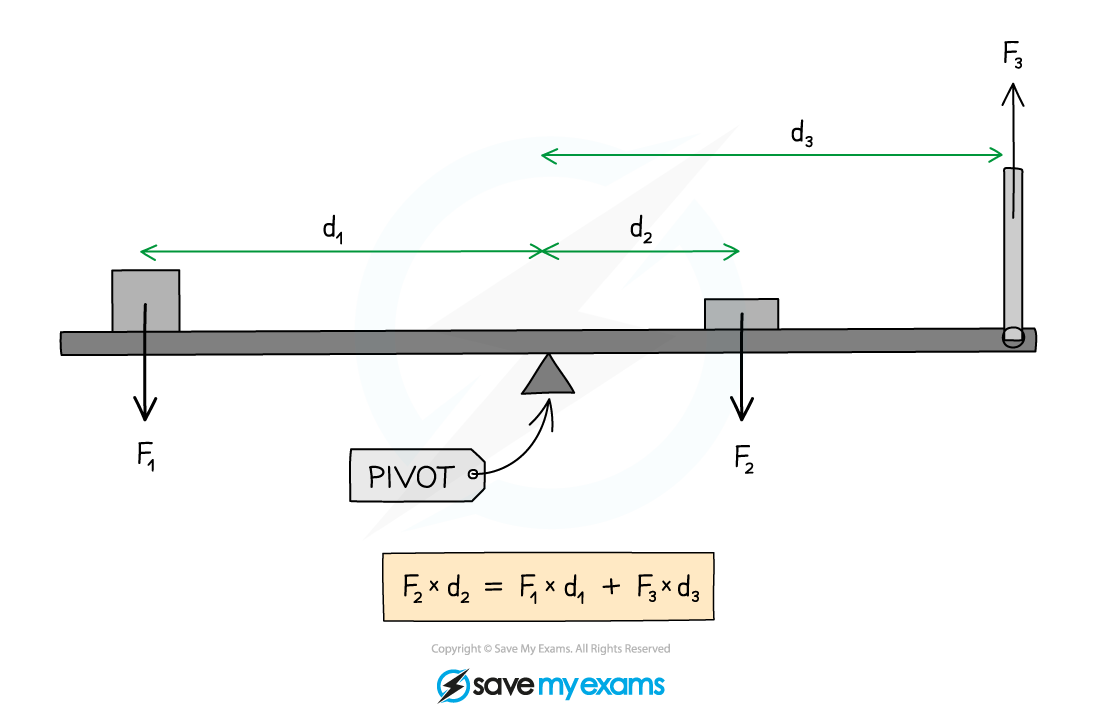
The clockwise and anticlockwise moments acting on a beam are balanced
-
In the above diagram:
- Force causes an anticlockwise moment of about the pivot
- Force causes a clockwise moment of about the pivot
- Force causes an anticlockwise moment of about the pivot
-
Collecting the clockwise and anticlockwise moments:
- Sum of the clockwise moments =
- Sum of the anticlockwise moments =
(F_ 1×d_ 1)+(F_ 3×d_ 3)
-
Using the principle of moments, the beam is balanced when:
sum of the clockwise moments = sum of the anticlockwise moments
F_ 2×d_ 2=(F_ 1×d_ 1)+(F_ 3×d_ 3)
Exam Hint Note that when a beam is pivoted at its centre of mass, it contributes no moment because the perpendicular distance from the pivot to its weight force is zero. If the pivot was not placed at the centre of mass of the beam, the beam would contribute a moment and would need to be considered in calculations.
Was this revision note helpful?
Build on this topic