Force on a Current-Carrying Conductor (Cambridge International IGCSE Physics)
Spec point — Describe an experiment to show that a force acts on a current-carrying conductor in a magnetic field, including the effect of reversing: (a) the current (b) the direction of the field
Force on a current-carrying conductor
-
A current-carrying conductor produces its own magnetic field
- When interacting with an external magnetic field, it therefore will experience a force
-
A current-carrying conductor will only experience a force if the current through it is perpendicular to the direction of the magnetic field lines
- A simple situation would be a copper rod placed within a uniform magnetic field
- When current is passed through the copper rod, it experiences a force which makes it move
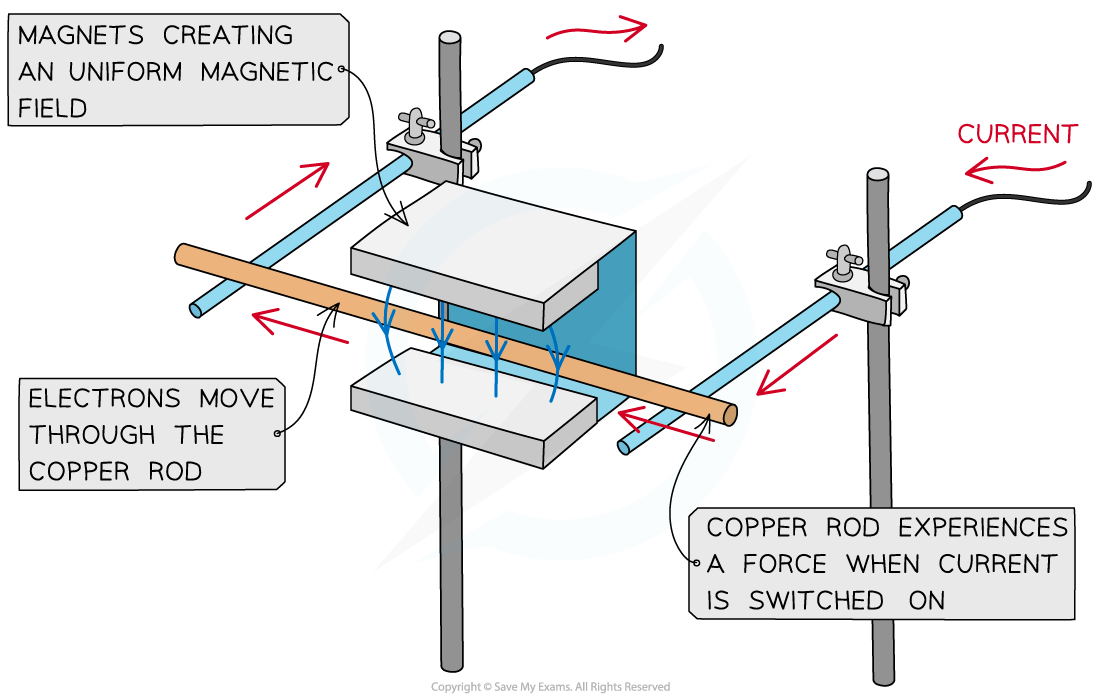
A copper rod moves within a magnetic field when current is passed through it
-
Two ways to reverse the direction of the force (and therefore, the copper rod) are by:
- reversing the direction of the current
- reversing the direction of the magnetic field
Exam Hint This phenomenon is sometimes referred to as 'the motor effect'. The direction of the force is determined by Fleming’s left-hand rule.
Fleming's left-hand rule
Spec point —
4.5.2d· Recall and use the relative directions of force, magnetic field and current
Fleming’s left-hand rule
-
The direction of the force (also called the thrust) on a current-carrying wire depends on the direction of:
- the current
- the magnetic field
-
The direction of the force (or thrust) can be worked out by using Fleming’s left-hand rule:
- the thumb points in the direction of the force, or thrust, on the conductor
- the first finger points in the direction of the magnetic field
- the second finger points in the direction of current flow (from positive to negative)
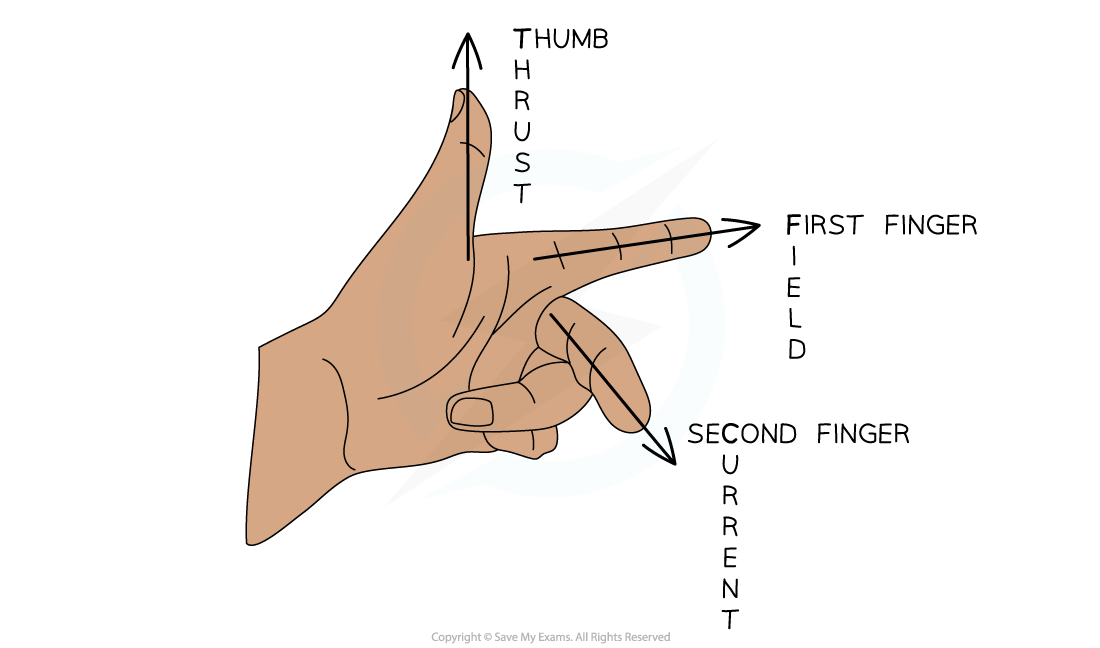
Fleming’s left-hand rule can be used to determine the directions of the force, magnetic field and current
-
All three will be perpendicular to each other in Fleming’s left-hand rule questions
- This means that sometimes the force could be into and out of the page (in 3D)
Worked Example A current-carrying wire is placed into the magnetic field between the poles of the magnet, as shown in the diagram.
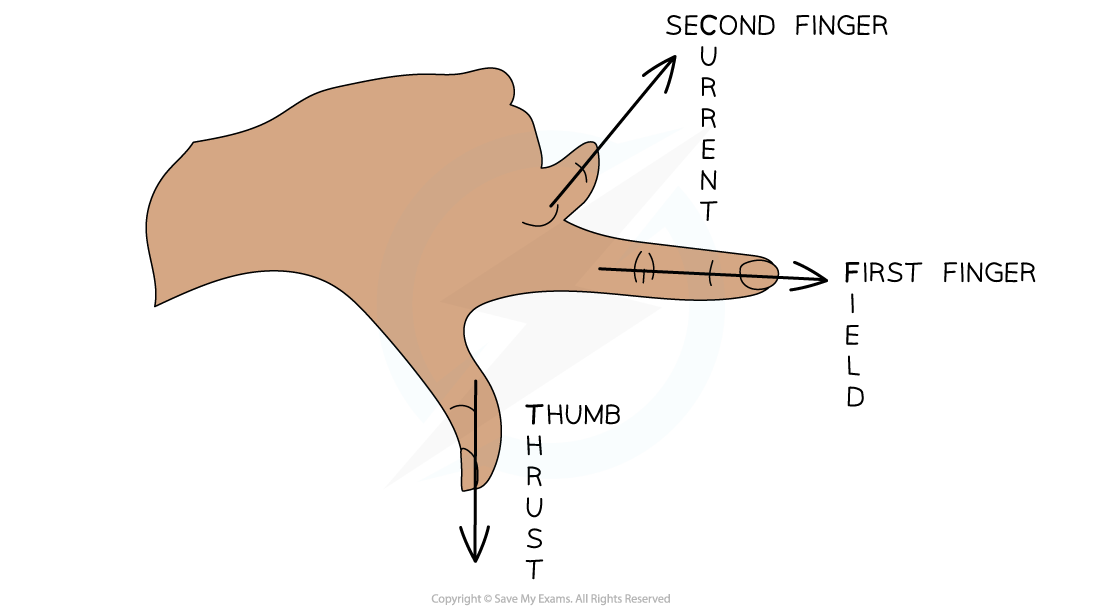
Use Fleming’s left-hand rule to show that there will be a downward force acting on the wire.
[3]
Answer:
Step 1: Determine the direction of the magnetic field
- Start by pointing your First Finger in the direction of the (magnetic) Field [1 mark]
Step 2: Determine the direction of the current
- Now rotate your hand around the first finger so that the seCond finger points in the direction of the Current [1 mark]
Step 3: Determine the direction of the force
- The THumb will now be pointing in the direction of the THrust (the force)
- Therefore, this will be the direction in which the wire will move [1 mark]
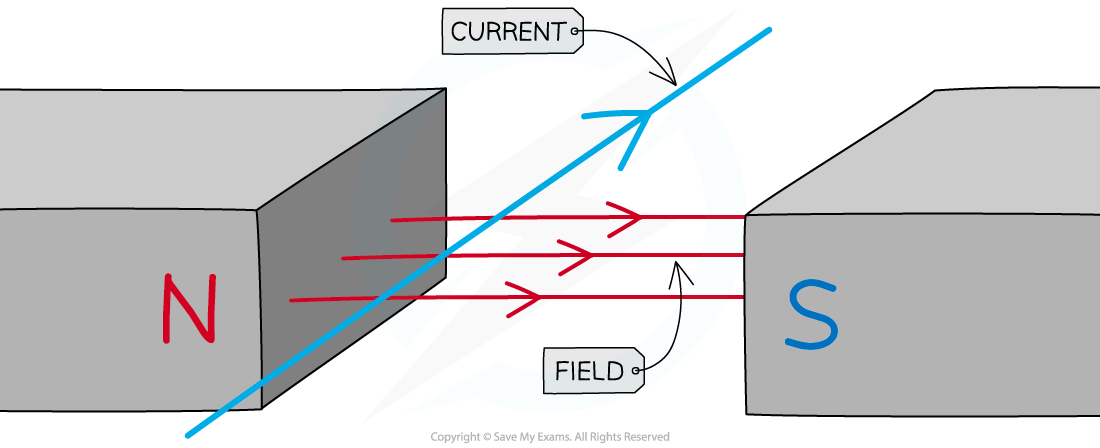
Exam Hint Remember that the magnetic field is always in the direction from North to South and current is always in the direction of a positive terminal to a negative terminal.
Charged particles in a magnetic field
Spec point —
4.5.3· Determine the direction of the force on beams of charged particles in a magnetic field
Extended Tier Only
-
When a current-carrying wire is placed in a magnetic field, it will experience a force if the wire is perpendicular to the magnetic field
- This is because the magnetic field exerts a force on each individual electron flowing through the wire
-
Therefore, when a charged particle passes through a magnetic field, the field can exert a force on the particle, causing it to deflect
- The force is always at 90 degrees to both the direction of travel and the magnetic field lines
- The direction can be worked out by using Fleming’s left-hand rule
-
In the case of an electron in a magnetic field:
- the second finger (current) points in the opposite direction to the direction of motion
- this is because conventional current flows in the opposite direction to electron flow
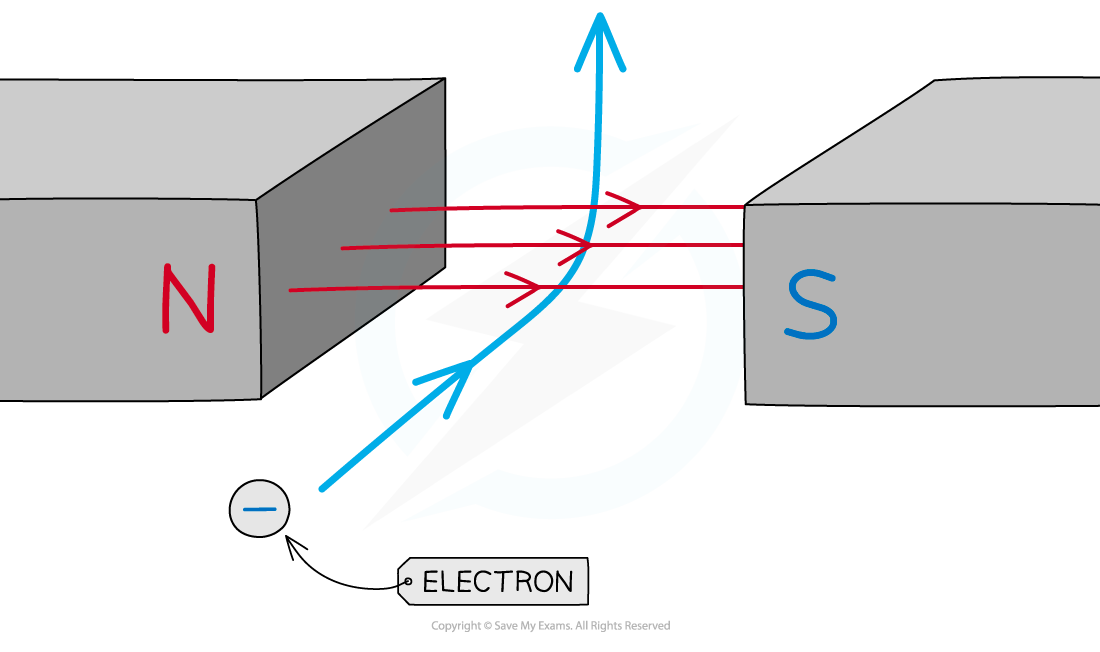
When a charged particle (such as an electron) enters a magnetic field, it is deflected by the field
-
If the particle is travelling perpendicular to the field lines:
- it will experience the maximum force
-
If the particle is travelling parallel to the field lines:
- it will experience no force
-
If the particle is travelling at an angle to the field lines:
- it will experience a small force
Exam Hint Remember that the direction of current is the direction of positive charge. Therefore, if a particle has a negative charge (such as an electron), then the second finger (current) must point in the opposite direction to its direction of travel.
The left-hand rule can be applied to any charged particles, but in the IGCSE exam questions are likely to stick to electrons.
Video of the motor effect
Spec point — nan
Was this revision note helpful?
Build on this topic