Kinetic Energy (Cambridge International IGCSE Physics)
Spec point —
1.7.2· Recall and use the equation for kinetic energy Ek = 1/2 mv^2
Kinetic energy
Extended Tier Only
- Energy in an object's kinetic energy store is defined as:
The amount of energy an object has as a result of its mass and speed
-
This means that any object in motion has energy in its kinetic energy store
- If an object speeds up, energy is transferred to its kinetic energy store
- If an object slows down, energy is transferred away from its kinetic energy store
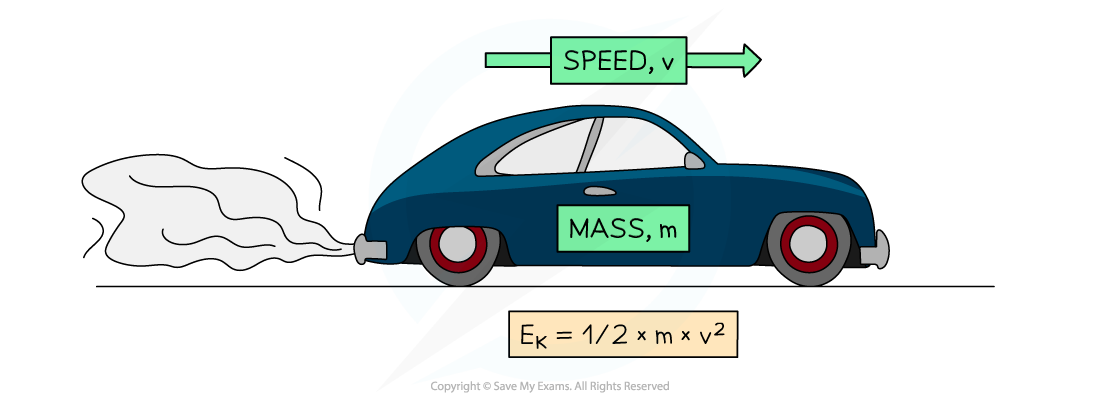
A moving car has energy in its kinetic energy store
Kinetic energy equation
- The amount of energy in an object's kinetic energy store can be calculated using the equation:
-
Where:
- = kinetic energy, measured in joules (J)
- = mass of the object, measured in kilograms (kg)
- = speed of the object, measured in metres per second (m/s)
-
The kinetic energy equation demonstrates that if the mass of an object is doubled for a given speed, then its kinetic energy will double
- This is because kinetic energy is directly proportional to mass
-
If the speed of the object is doubled for a given mass, it will have four times the kinetic energy
- This is because kinetic energy is directly proportional to speed squared
- Since kinetic energy is directly proportional to speed squared, doubling the kinetic energy does not double the speed; it increases it by a factor of (approximately 1.41)
- The change in an object's kinetic energy can be calculated using:
-
Where:
- = final speed of the object, measured in metres per second (m/s)
- = initial speed of the object, measured in metres per second (m/s)
Worked Example Calculate the kinetic energy stored in a cricket ball of mass 160 g moving at a speed of 35 m/s.
[3]
Answer:
Step 1: List the known quantities
- Mass of the cricket ball,
- Speed of the cricket ball,
Step 2: Write down the equation for kinetic energy
Step 3: Convert the mass into kilograms
m=160 / 1000=0.16 kg[1 mark]Step 4: Calculate the kinetic energy
E_ k=1 half×0.16×(35)²* [1 mark]* [1 mark]
Exam Hint When performing calculations using the kinetic energy equation, always double-check that you have squared the speed, even when the term has been written down. Also ensure that you have included the 1/2 factor in your calculation. Forgetting to do these two steps are the most common mistakes that students make.
Remember that the units of kinetic energy are joules (J).
Worked Example A cyclist and a bicycle have a total mass of 70 kg and a kinetic energy of 1400 J. Calculate their speed.
[3]
Answer:
Step 1: List the known quantities
- Total mass of cyclist and bicycle,
- Kinetic energy,
Step 2: Write down the equation for kinetic energy
Step 3: Rearrange for the speed, v
2 E_ k=m v²
[1 mark]
Step 4: Calculate the speed
* [1 mark]
* (2 s.f.) [1 mark]
Exam Hint You will most likely need to rearrange the kinetic energy equation in your IGCSE exam. The kinetic energy equation is one of the more difficult rearrangements at IGCSE.
Was this revision note helpful?
Build on this topic