Elliptical Orbits (Cambridge International IGCSE Physics)
Spec point —
6.1.7· Know that planets, minor planets and comets have elliptical orbits, and recall that the Sun is not at the centre of the elliptical orbit, except when the orbit is approximately circular
Elliptical orbits
Extended Tier Only
-
The orbits of planets, minor planets and comets are elliptical
- An ellipse is a 'squashed' circle
-
Planets and minor planets have slightly elliptical orbits
- Their orbits are approximately circular, so the Sun is generally considered to be at the centre
-
Comets have highly elliptical orbits
- The Sun is not at the centre of the orbit, it is at one of the two foci of the ellipse
Exam Hint You will not be asked to do any calculations with elliptical orbits. If you are asked to calculate the time period, orbital speed or radius of an orbit, it can be assumed that it is circular.
Comet speed
Spec point —
6.1.7· Know that an object in an elliptical orbit travels faster when closer to the Sun and explain this using the conservation of energy
Extended Tier Only
-
An object in an elliptical orbit around the Sun travels at a different speed depending on its distance from the Sun
-
Although these orbits are not circular, they are still stable
- For a stable orbit, the radius must change if the comet's orbital speed changes
-
As the comet approaches the Sun:
- the radius of the orbit decreases
- the orbital speed increases due to the Sun's strong gravitational pull
-
As the comet travels further away from the Sun:
- the radius of the orbit increases
- the orbital speed decreases due to a weaker gravitational pull from the Sun
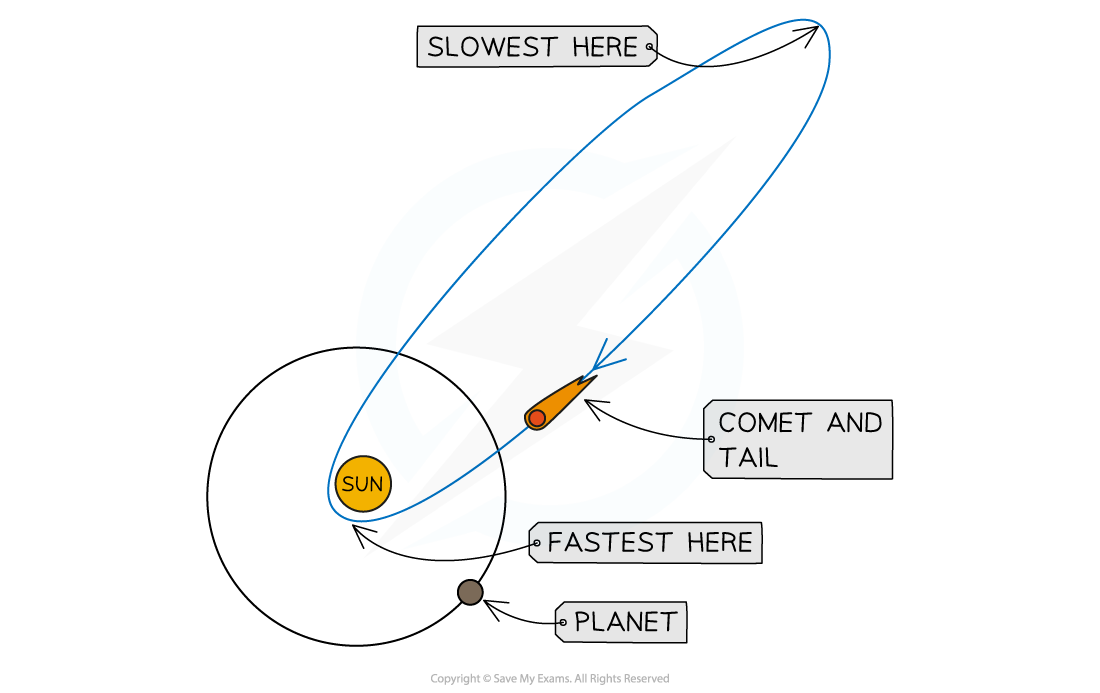
Comets travel in highly elliptical orbits, speeding up as they approach the Sun
Conservation of energy in elliptical orbits
-
When an object moves in an elliptical orbit, energy must be conserved
-
Throughout the orbit, gravitational potential energy is transferred to kinetic energy, and vice versa
- When a comet travels closer to the Sun, it has greater kinetic energy
- When a comet travels further from the Sun, it has greater gravitational potential energy
-
As the comet approaches the Sun:
- it loses gravitational potential energy and gains kinetic energy
- the increase in kinetic energy causes it to speed up
-
As the comet moves away from the Sun:
- it gains gravitational potential energy and loses kinetic energy
- the decrease in kinetic energy causes it to slow down
Exam Hint Remember that an object's kinetic energy is defined by: where m is the mass of the object and v is its speed. Therefore, if the speed of an object increases, so does its kinetic energy. Its gravitational potential energy therefore must decrease for energy to be conserved.
Was this revision note helpful?
Build on this topic