Half-Life (Cambridge International IGCSE Physics)
Half-life basics
Spec point —
5.2.5· Define the half-life of a particular isotope as the time taken for half the nuclei of that isotope in any sample to decay; recall and use this definition in simple calculations, which might involve information in tables or decay curves (calculations will not include background radiation)
- The half-life of a particular isotope is defined as:
The time taken for half the nuclei of that isotope in any sample to decay
-
The rate at which the activity of a sample decreases is measured in terms of half-life
- This is the time it takes for the activity of a sample to fall to half its original level
-
This is the time it takes for the activity of the sample to decrease from 100 % to 50 %
- It is the same length of time as it would take to decrease from 50 % activity to 25 % activity
-
Different isotopes have different half-lives and half-lives can vary from a fraction of a second to billions of years in length
- The half-life is constant for a particular isotope
Representing half-life
- Half-life can be determined from an activity–time graph
A half-life graph
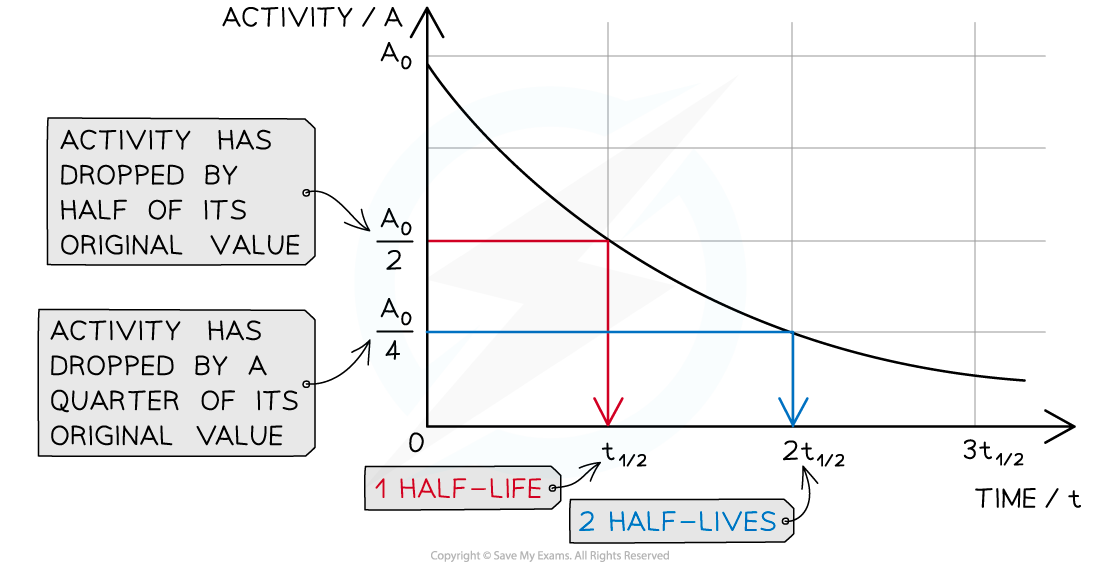
The graph shows how the activity of a radioactive sample changes over time. Each time the original activity halves, another half-life has passed
-
Half-life can also be represented on a table
- As the number of the half-life increases, the proportion of the isotope remaining halves
Table showing the number of half-lives to the proportion of isotope remaining
| Number of half-lives | Proportion of isotope remaining |
|---|---|
| 0 | 1 |
| 1 | |
| 2 | |
| 3 | |
| 4 | |
| ... | ... |
Worked Example An isotope of protactinium-234 has a half-life of 1.17 minutes.
Calculate the amount of time it takes for a sample to decay from a mass of 10 mg to 2.5 mg.
[2]
Answer:
Step 1: Calculate the fraction of the sample remaining
- Initial mass of sample = 10 mg
- Final mass of sample = 2.5 mg
- The fraction of the sample remaining is
Step 2: Calculate the number of half-lives that have passed
- Using the table above, we can see that two half-lives have passed [1 mark]
Step 3: Calculate the time for the sample to decay
- Two half lives have passed
- So the time for the sample to decay is twice the half-life
- The time for the sample to decay to a mass of 2.5 mg is 2.34 minutes [1 mark]
Half-life graphs
Spec point —
5.2.5· Calculate half-life from data or decay curves from which background radiation has not been subtracted
Extended Tier Only
-
The half-life of an isotope should be calculated by removing the background radiation from data or decay curves
-
To calculate the half-life of a sample from a graph:
- Check the original activity or count rate (where the line crosses the y-axis), C0
- Halve this value and look for this activity
- Go across from the halved value (on the y-axis) to the best-fit curve, and then straight down to the x-axis
- The point where you reach the x-axis should be the half-life
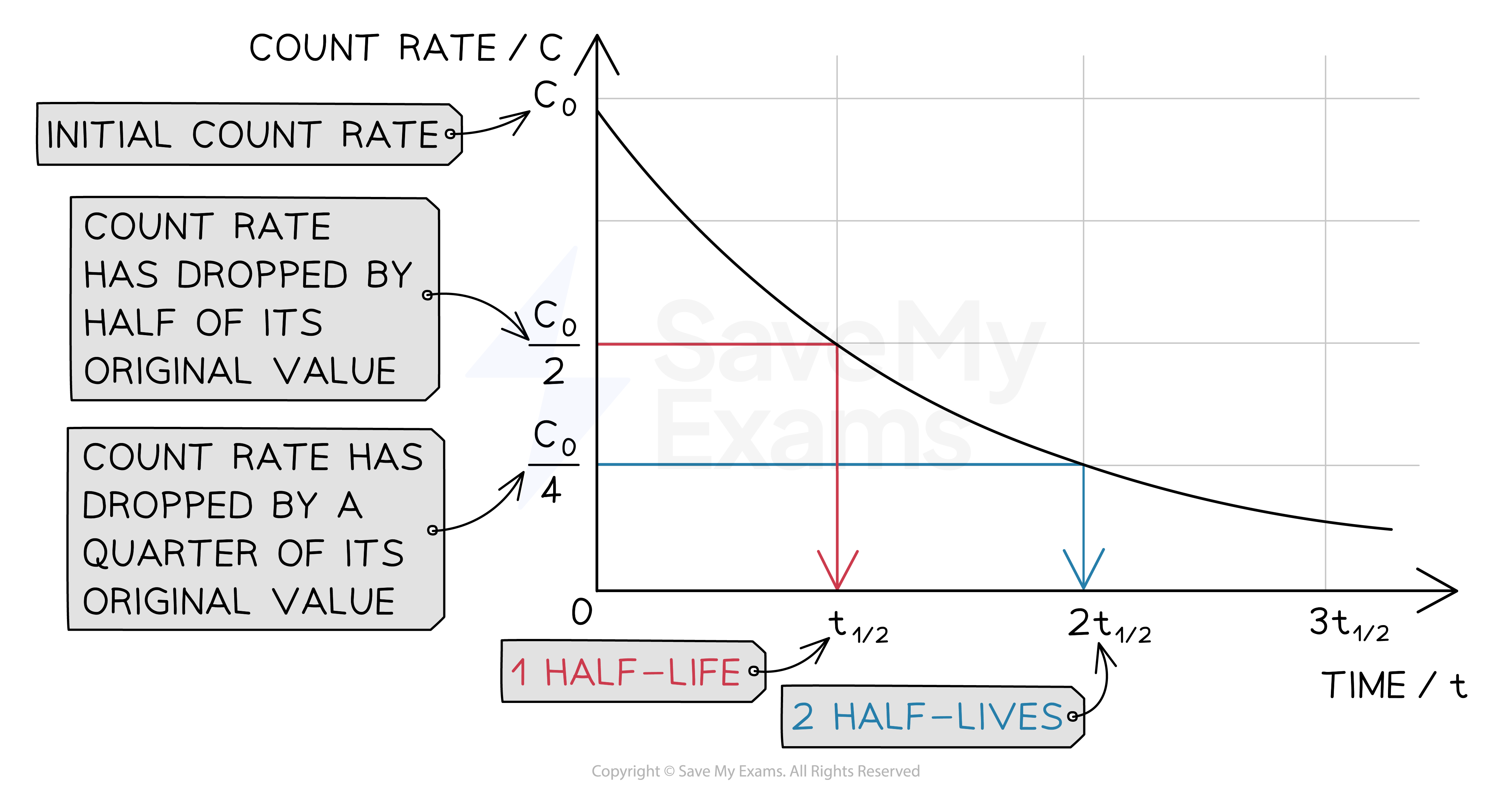
To find the time for the half-life, find half of the activity first
-
To remove background radiation from the decay curve:
- Start by measuring the background radiation (with no sources present) – this is called the background count
- Then carry out the experiment
- Subtract the background count from each reading, to provide a corrected count
- The corrected count is your best estimate of the radiation emitted from the source and should be used to measure its half-life
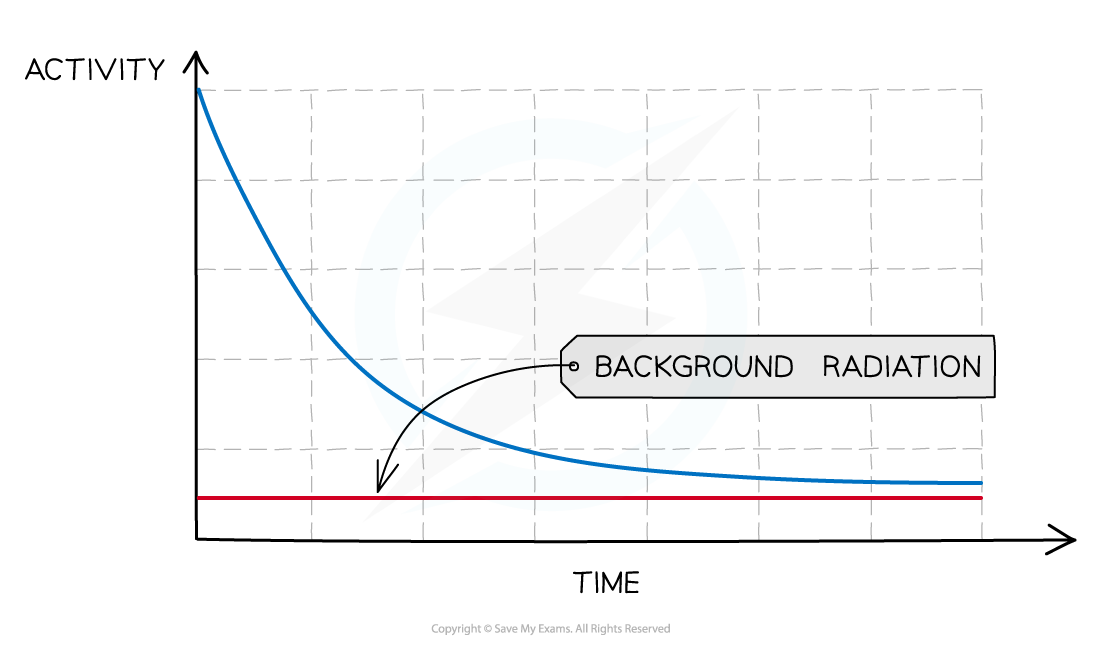
When measuring radioactive emissions, some of the detected radiation will be background
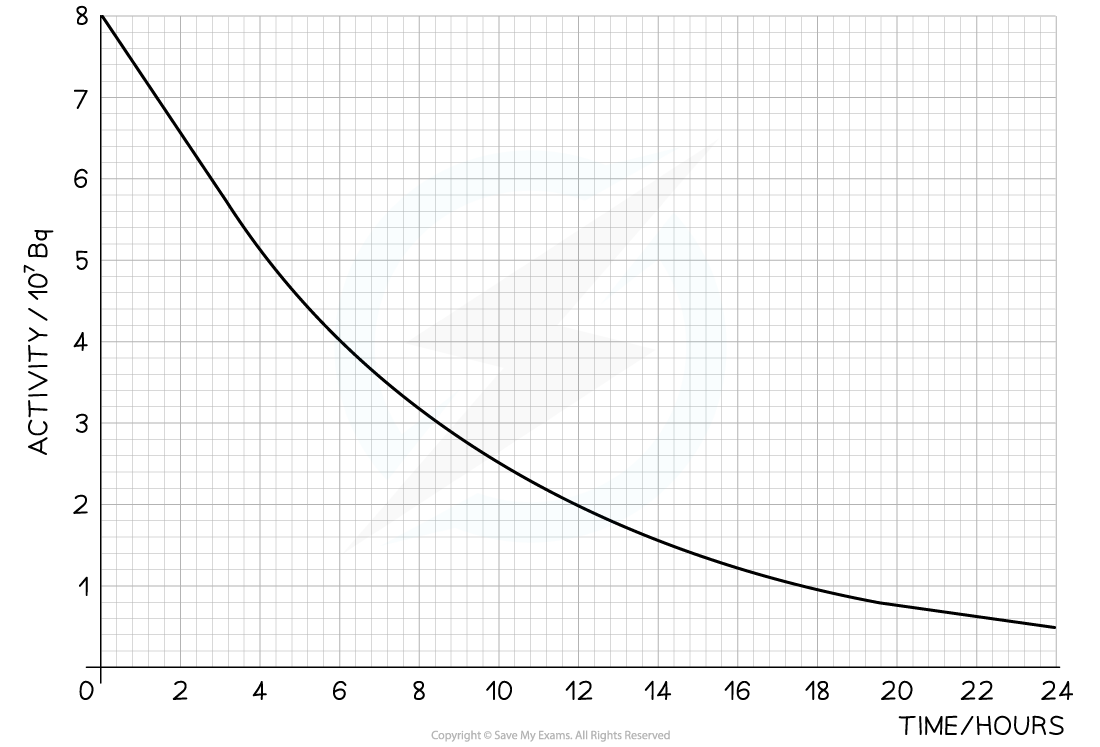
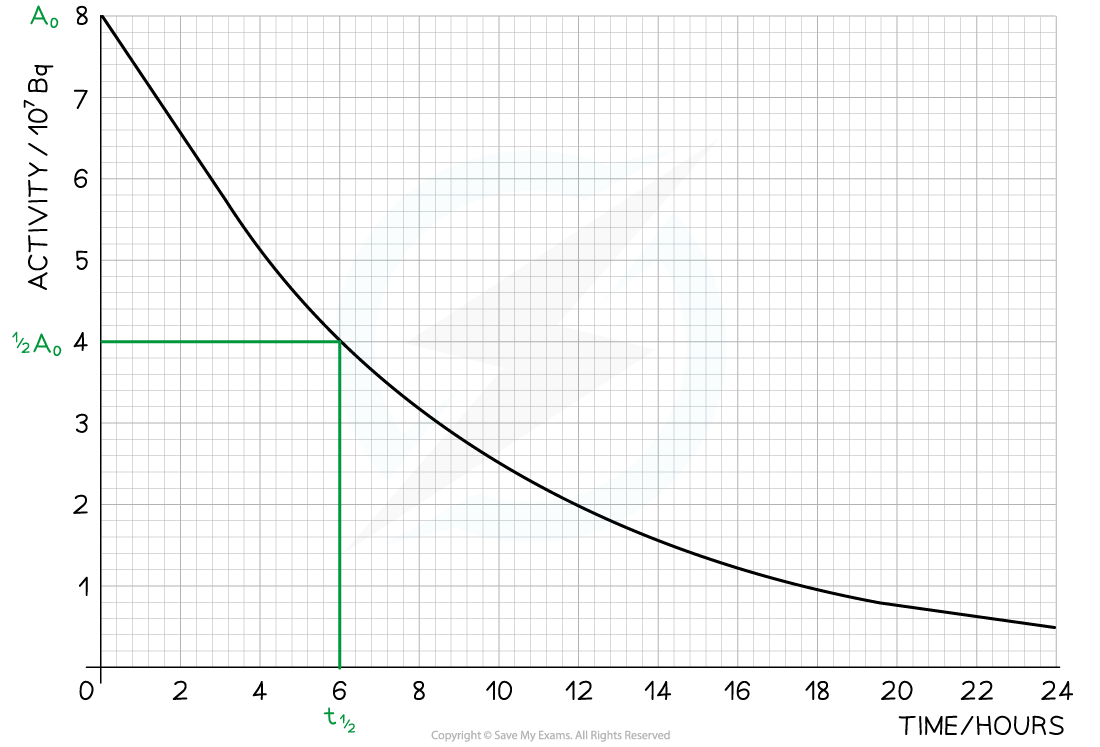
Worked Example The radioisotope technetium is used extensively in medicine. The graph below shows how the activity of a sample varies with time.
Determine the half-life of this material.
[2]
Answer:
Step 1: Draw lines on the graph to determine the time it takes for technetium to drop to half of its original activity
[1 mark]
Step 2: Read values off the graph
- Activity dropped by half of its original value after 6 hours
- Therefore, the half-life of this material is 6 hours [1 mark]
Worked Example A particular radioactive sample contains 2 million un-decayed atoms. After a year, there are only 500 000 atoms left un-decayed. What is the half-life of this material?
[2]
Answer:
Step 1: Calculate how many times the number of un-decayed atoms has halved
- There were 2 000 000 atoms to start with
- 1 000 000 atoms would remain after 1 half-life
- 500 000 atoms would remain after 2 half-lives
- Therefore, the sample has undergone 2 half-lives [1 mark]
Step 2: Divide the time period by the number of half-lives
- The time period is a year
- The number of half-lives is 2
2 000 000 → from text 6 months end text to text 1 half life end text of 1 000 000 → from text 1 year end text to text 2 half lives end text of 500 000
- So two half-lives is 1 year, and one half-life is 6 months
- Therefore, the half-life of the sample is 6 months [1 mark]
Exam Hint When looking for the corresponding time for the activity, it is good practice to draw a line on the graph with your ruler, as in the mark scheme of the worked example. This ensures you're reading the most accurate value possible.
Was this revision note helpful?
Build on this topic