Measuring the Speed of Sound (Cambridge International IGCSE Physics)
Speed of sound in air
Spec point —
3.4.2· Know that the speed of sound in air is approximately 330–350 m/s
-
The speed of sound in air varies from 330 – 350 m/s
- The higher the air temperature, the greater the speed of sound
Speed of sound in materials
Spec point —
3.4.2· Know that, in general, sound travels faster in solids than in liquids and faster in liquids than in gases
Extended Tier Only
-
Sound travels at different speeds in different media:
- Sound travels fastest in solids
- Sound travels slowest in gases
-
Sound travels at:
- around 1500 m/s in liquids
- around 5000 m/s in solids
Measuring the speed of sound
Spec point —
3.4.2· Describe a method involving a measurement of distance and time for determining the speed of sound in air
Equipment
Equipment list
| Equipment | Purpose |
|---|---|
| Trundle wheel | To measure the distance travelled by the sound waves |
| Wooden blocks | To create a sound when banged together |
| Stopwatch | To time how long it takes the sound waves to travel |
| Oscilloscope | To display the sound wave electronically |
| Microphones2 | To detect sound waves and turn them into an electrical signal |
| Tape measure | To measure the distance between microphones |
-
Resolution of measuring equipment:
- Trundle wheel = 0.01 m
- Tape measure = 0.1 cm
- Stopwatch = 0.01 s
Experiment 1: measuring the speed of sound between two points
- This experiment aims to measure the speed of sound in air between two points
Variables
-
Independent variable = distance
-
Dependent variable = time
-
Control variables:
- Same location to carry out the experiment
Method
Measuring the speed of sound in air
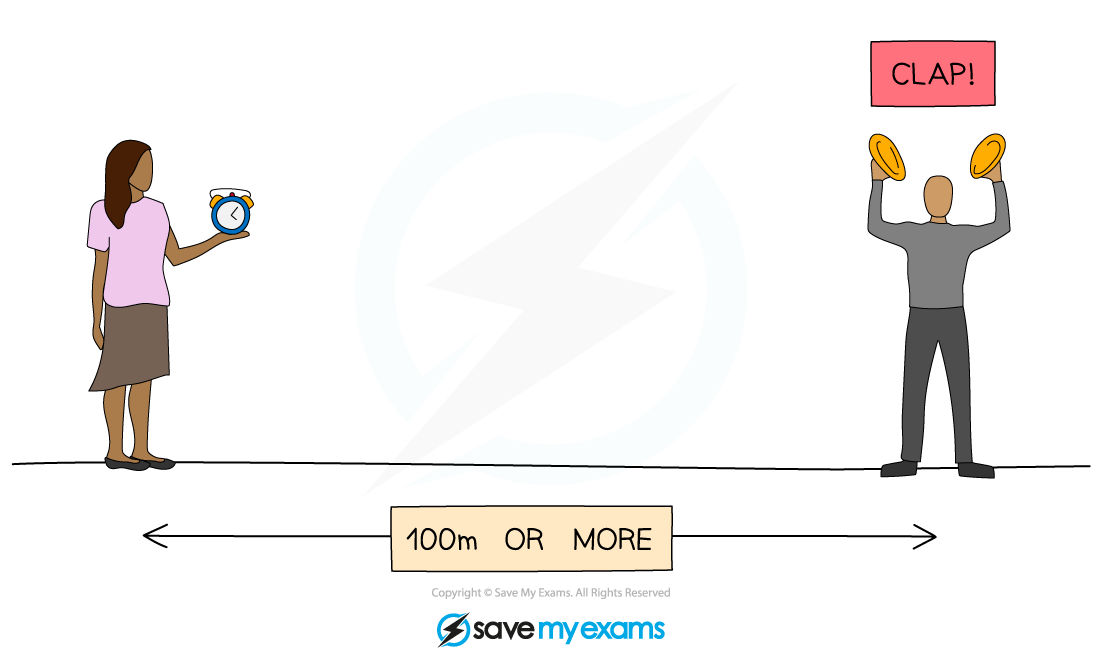
Measuring the speed of sound directly between two points
- Use the trundle wheel to measure a distance of 100 m between two people
- One of the people should have two wooden blocks, which they will bang together above their head to generate sound waves
- The second person should have a stopwatch which they start when they see the first person banging the blocks together and stop when they hear the sound
- This should be repeated several times and an average taken for the time travelled by the sound waves
- Repeat this experiment for various distances, e.g. 120 m, 140 m, 160 m, 180 m
Results
An example results table for the speed of sound in air
| Distance / m | Time 1 / s | Time 2 / s | Time 3 / s | Average time / s |
|---|---|---|---|---|
| 100 | ||||
| 120 | ||||
| 140 | ||||
| 160 | ||||
| 180 |
Analysis of results
- The speed of sound can be calculated using the equation:
- The speed of sound in the air should work out to be about 340 m/s
Experiment 2: measuring the speed of sound with oscilloscopes
- This experiment aims to measure the speed of sound in air between two points using an oscilloscope
Variables
-
Independent variable = Distance
-
Dependent variable = Time
-
Control variables:
- Same location to carry out the experiment
- Same set of microphones for each trial
Method
Measuring the speed of sound with an oscilloscope
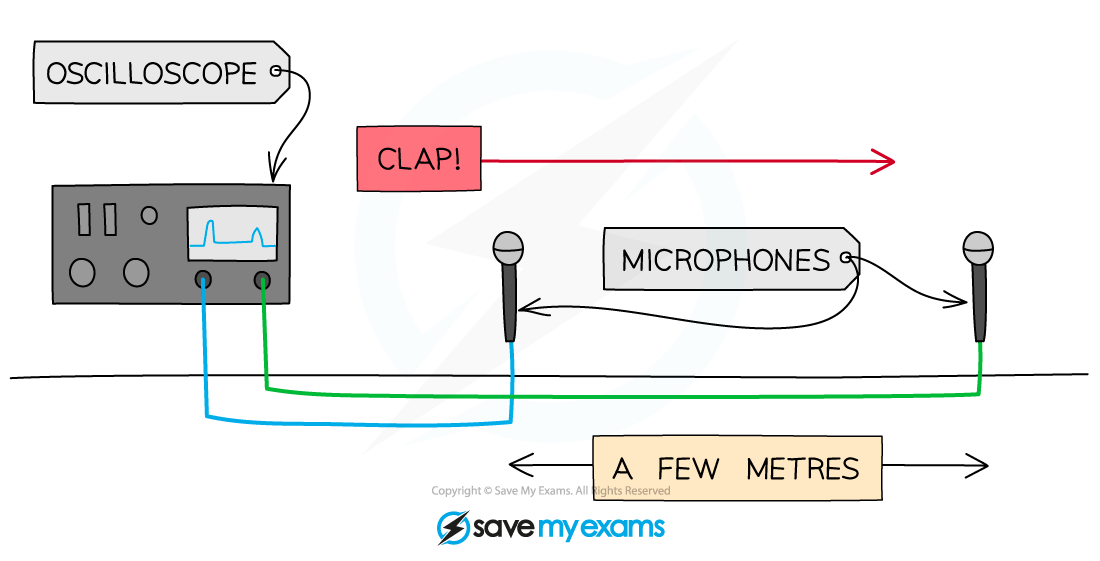
Measuring the speed of sound using an oscilloscope
- Connect two microphones to an oscilloscope
- Place them about 2 m apart using a tape measure to measure the distance between them
- Set up the oscilloscope so that it triggers when the first microphone detects a sound, and adjust the time base so that the sound arriving at both microphones can be seen on the screen
- Make a large clap using the two wooden blocks next to the first microphone
- Use the oscilloscope to determine the time at which the clap reaches each microphone and the time difference between them
- Repeat this experiment for several distances, e.g. 2 m, 2.5 m, 3 m, 3.5 m
Results
An example results table for obtaining the speed of sound using an oscilloscope
| Distance / m | Time 1 / s | Time 2 / s | Time 3 / s | Average time / s |
|---|---|---|---|---|
| 2.0 | ||||
| 2.5 | ||||
| 3.0 | ||||
| 3.5 | ||||
| 4.0 |
Analysis of results
- The speed of sound can be calculated using the equation:
- The speed of sound in the air should work out to be about 340 m/s
Evaluating the experiments
-
Systematic errors:
-
In experiment 2, ensure the scale of the time base is accounted for correctly
- The scale is likely to be small (e.g. milliseconds) so ensure this is taken into account when calculating speed
-
-
Random errors:
-
The main cause of error in experiment 1 is the measurement of time
-
Ensure to take repeat readings when timing intervals and calculate an average to keep this error to a minimum
-
Maximise the distance between the two people where possible
- This will reduce the error in measurements of time because the time taken by the sound waves to travel will be greater
-
-
Exam Hint When answering questions about methods to measure waves, the question could ask you to comment on the accuracy of the measurements.
In the case of measuring the speed of sound:
- Experiment 2 is the most accurate because the timing is done automatically
- Experiment 1 is the least accurate because the time interval is very short
Whilst this may not be too important when giving a method, you should be able to explain why each method is accurate or inaccurate and suggest ways of making them better (use bigger distances)
- For example, if a manual stopwatch is being used there could be variation in the time measured which can be up to 0.2 seconds due to a person's reaction time
- The time interval could be as little as 0.3 seconds for sound travelling in the air
- This means that the variation due to the stopwatch readings has a big influence on the results and they may not be reliable
Was this revision note helpful?
Build on this topic