Magnetism (Cambridge International IGCSE Physics)
Spec point —
4.1.1· Describe the forces between magnetic poles and between magnets and magnetic materials, including the use of the terms:
- north pole (N pole),
- south pole (S pole),
- attraction and repulsion,
- magnetised and unmagnetised
Magnetism
Forces between magnetic poles
- The ends of a magnet are called poles
- Magnets have two poles: a north and a south
- Magnetic forces are strongest at the poles
North and south poles of a magnet
Poles of a magnet
-
When two magnets are held close together, there will be a force between the magnets
-
Like poles repel (push each other apart)
- A north pole will repel a north pole
- A south pole will repel a south pole
-
Opposite poles attract (are pulled towards each other)
- A north pole will be attracted to a south pole
-
Magnet attraction and repulsion
Opposite poles attract and like poles repel
- The attraction or repulsion between two magnetic poles is an example of a non-contact force
Exam Hint In your exam, you need to be able to predict the interaction that will occur between magnets when given their physical arrangement.
Uses of magnets
Spec point —
4.1.1· Describe the uses of permanent magnets and electromagnets
Uses of permanent magnets
-
Uses of permanent magnets include:
- Compasses: for thousands of years humans have used compasses for navigation, since the needle always points north
- School lab experiments: the magnets used in school science demonstrations are permanent magnets
- Toys: toy trains and trucks often have magnets which attach the carriages or trailers to the engine or cab
- Fridge magnets: these are made either of flexible magnetic material or by sticking a magnet to the back of something
Some uses of magnets
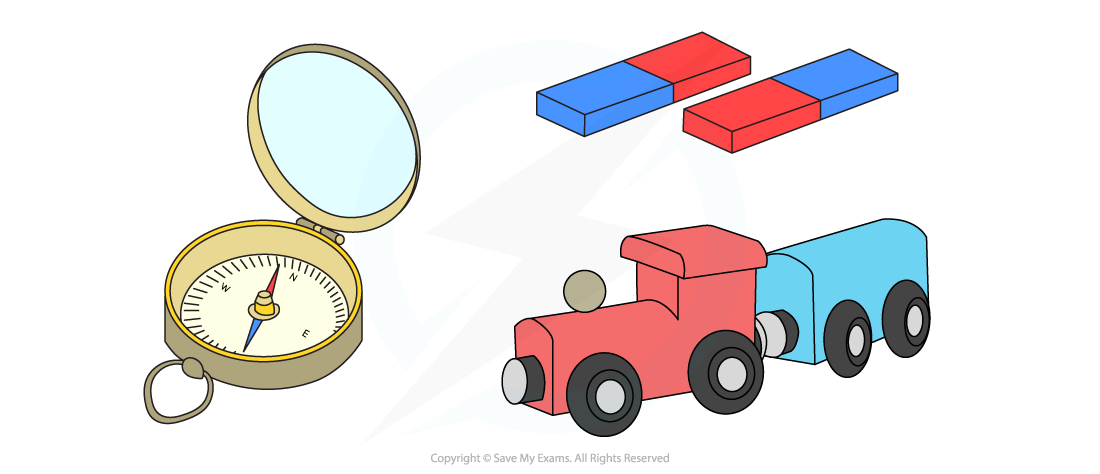
Compasses and toy trains are two examples of the use of permanent magnets
Uses of electromagnets
-
Electromagnets have many uses including:
-
MRI scanners: in hospitals, an MRI scanner is a large, cylindrical machine using powerful electromagnets to produce diagnostic images of the organs of the body
-
Speakers and earphones: the loudspeakers, microphones and earphones used in phones and laptops use electromagnets to sense or send soundwaves
-
Recycling: because steel is a magnetic material it can be easily separated from other metals and materials using electromagnets
- Once recovered the steel is re-used and recycled, reducing mining for iron ore and processing ore into steel
-
Mag-Lev trains: the ability of Mag-Lev trains to hover above the rails is due to them being repelled by large electromagnets on the train and track
- This reduces friction and allows speeds of nearly 640 km/h
-
Some uses of electromagnets
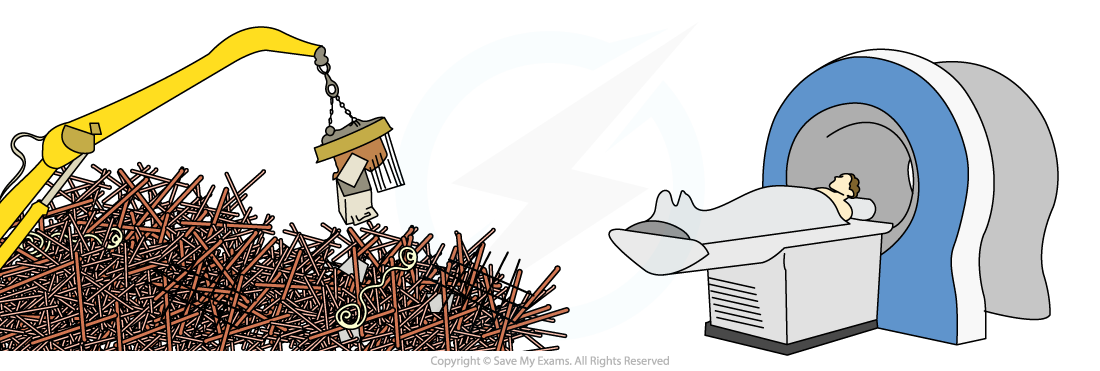
Picking and sorting scrap metal and an MRI scanner are two examples of the uses of electromagnets
Was this revision note helpful?