Transformers (Cambridge International IGCSE Physics)
Structure of a transformer
Spec point —
4.5.1e· Describe the construction of a simple transformer with a soft iron core, as used for voltage transformations
-
A transformer is a device used to change the size of an alternating potential difference or current
- This is achieved using the generator effect
-
A basic transformer consists of:
- a primary coil
- a secondary coil
- a soft iron core
-
Iron is used because it is easily magnetised
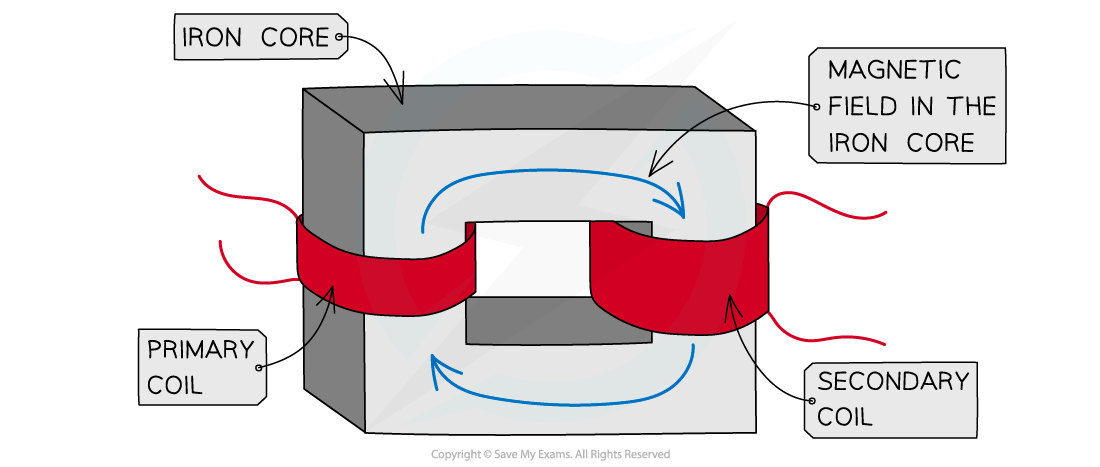
A simple transformer is made up of a primary coil and a secondary coil wound on a soft iron core
Step-up & step-down transformers
Spec point —
4.5.2c· Use the terms primary, secondary, step-up and step-down
-
A transformer consists of a primary and secondary coil:
- The primary coil is the first coil
- The secondary coil is the second coil
Step-up transformer
-
A step-up transformer:
- increases the potential difference of a power source
(V_ s greater than V_ p) - has more turns on the secondary coil than on the primary coil
(N_ s greater than N_ p)
- increases the potential difference of a power source
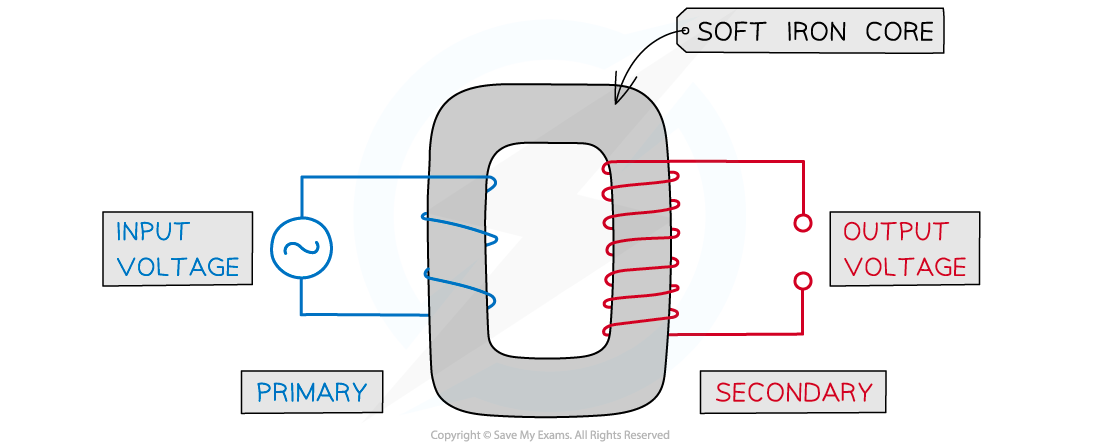
A step-up transformer has more turns on the secondary coil, which increases the size of the potential difference
Step-down transformer
-
A step-down transformer:
- decreases the potential difference of a power source
(V_ s less than V_ p) - has fewer turns on the secondary coil than on the primary coil
(N_ s less than N_ p)
- decreases the potential difference of a power source
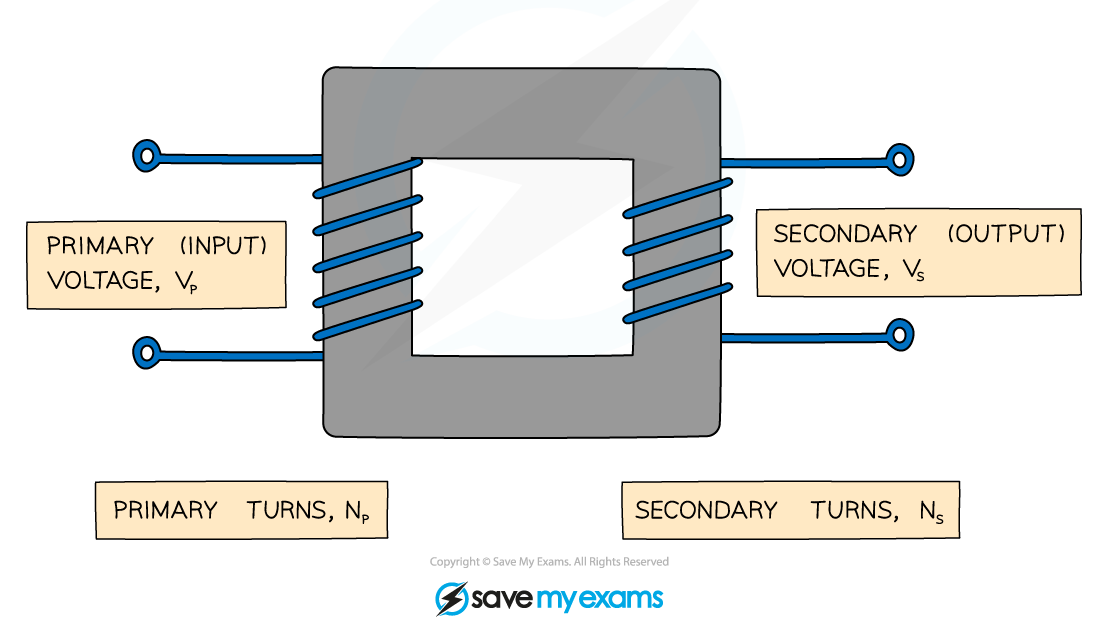
A step-down transformer has fewer turns on the secondary coil, which decreases the size of the potential difference
Operation of a transformer
Spec point — Explain the principle of operation of a simple iron-cored transformer
Extended Tier Only
-
An alternating current is supplied to the primary coil
-
The current is continually changing direction
- This means it will produce a changing magnetic field around the primary coil
-
The iron core is easily magnetised, so the changing magnetic field passes through it
-
As a result, there is now a changing magnetic field inside the secondary coil
- This changing field cuts through the secondary coil and induces an e.m.f. (potential difference)
-
As the magnetic field is continually changing, the induced e.m.f. will be alternating
- The alternating e.m.f. will have the same frequency as the alternating current supplied to the primary coil
-
If the secondary coil is part of a complete circuit it will cause an alternating current to flow
Was this revision note helpful?
Build on this topic