Electromagnetic Induction (Cambridge International IGCSE Physics)
Induced e.m.f.
Spec point —
4.4.1· Know that a conductor moving across a magnetic field or a changing magnetic field linking with a conductor can induce an e.m.f. in the conductor
-
An electromotive force (e.m.f.) is induced in a conductor whenever there is relative movement between the conductor and a magnetic field
-
This could be when:
- the conductor moves in a stationary magnetic field
- the conductor is stationary in a changing magnetic field
Induced e.m.f. due to a moving conductor
-
For an electrical conductor moving in a fixed magnetic field:
- the conductor (e.g. a wire) cuts the field lines
- an e.m.f. is induced in the wire
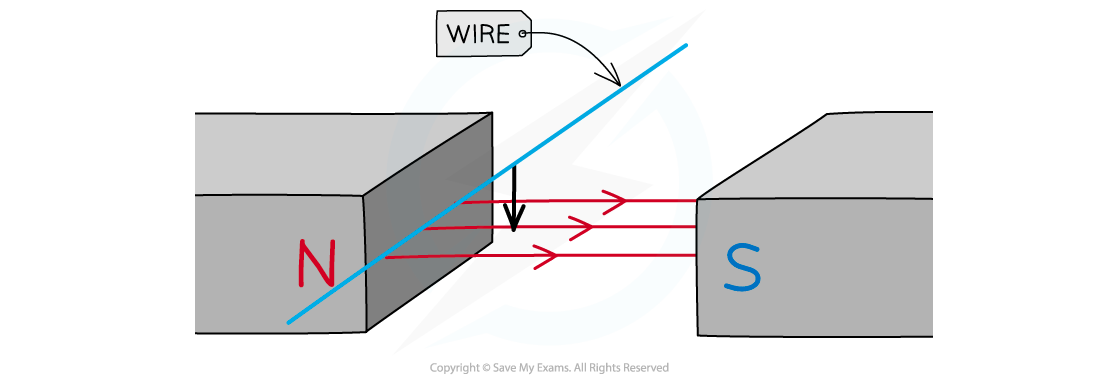
When an electrical conductor moves in a magnetic field an e.m.f. is induced
Induced e.m.f. due to a moving field
-
For a fixed conductor in a changing magnetic field:
- as the magnet moves through the conductor (e.g. a coil), the field lines cut through the turns on the conductor (each individual wire)
- an e.m.f. is induced in the coil
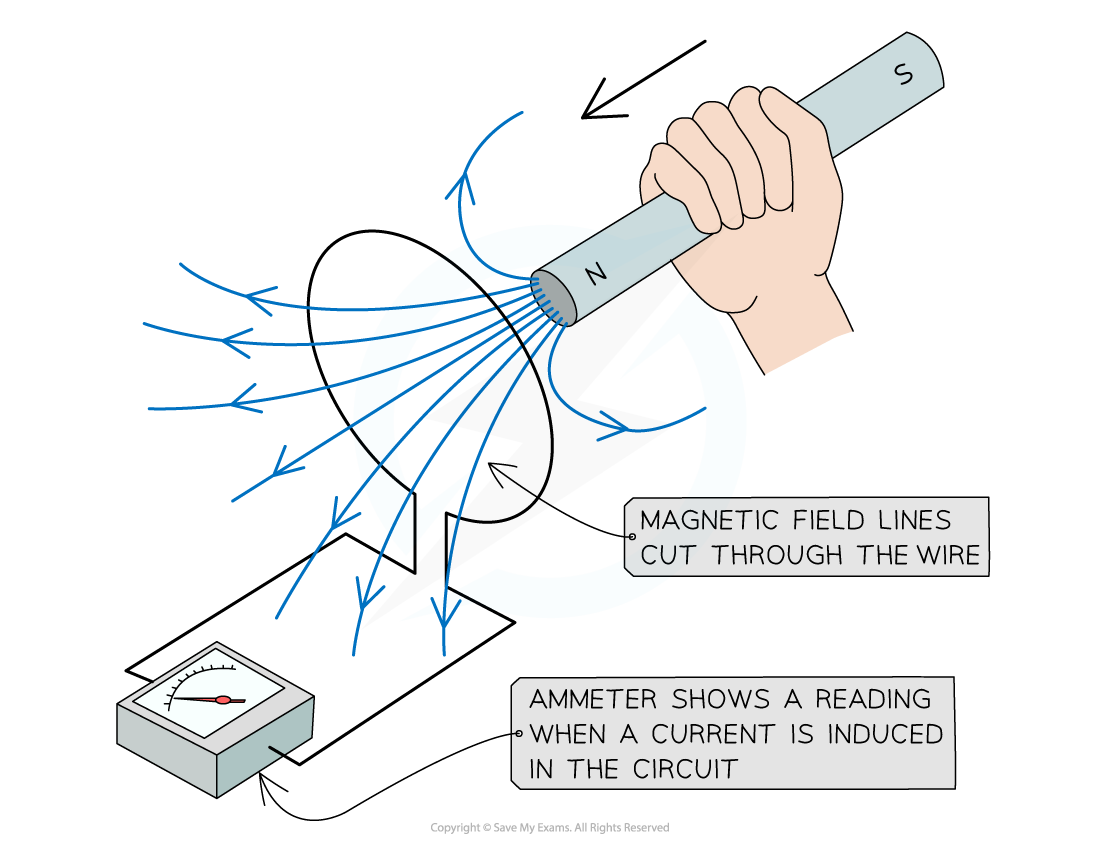
When a magnet is moved towards a wire, the changing magnetic field induces a current in the coil of wire
-
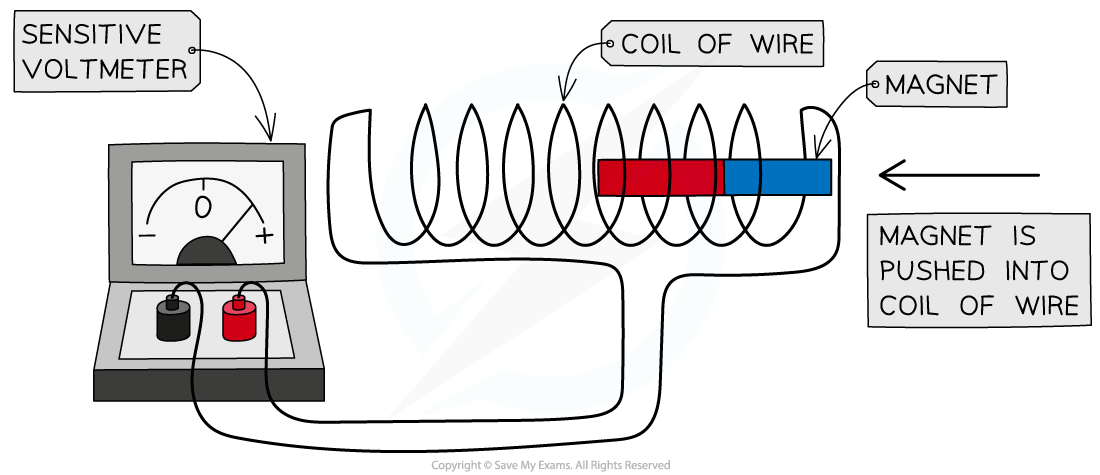
A sensitive voltmeter can be used to measure the size of the induced e.m.f.
-
If the conductor is part of a complete circuit then a current is induced in the conductor
- This can be detected by an ammeter
Worked Example A coil of wire is connected to a sensitive voltmeter.
When a magnet is pushed into the coil the needle on the voltmeter will deflect to the right as shown in the diagram below.
What will happen to the pointer on the voltmeter when the magnet is stationary in the centre of the coil?
A. The needle will deflect to the left
B. The needle will deflect to the right
C. There will be no deflection of the needle
D. The needle will deflect to the left and then to the right
[1]
Answer:
There is no relative movement between the coil and the magnetic field when both the magnet and coil are stationary
Since no magnetic field lines are being cut, no e.m.f. will be induced
- Therefore, the needle will not deflect
- This means that the correct answer is C [1 mark]
A, B & D are incorrect because a deflection on the voltmeter would indicate that an e.m.f. has been induced
This would only happen if there was relative movement between the coil and the magnetic field
Lenz's law
Spec point —
4.4.1· Know that the direction of an induced e.m.f. opposes the change causing it
Extended Tier Only
- Lenz's law states:
The direction of an induced e.m.f. always opposes the change causing it
- This means that any magnetic field created by an induced e.m.f. will act so that it tries to stop the wire or magnet from moving
Demonstrating Lenz's law
-
Lenz's law can be demonstrated when a magnet is pushed into, or out of, a coil of wire
-
If the magnet is pushed north end first into the coil, the end of the coil closest to the magnet will become a north pole
-
This happens because:
- the changing magnetic field induces an e.m.f. in the coil
- the induced e.m.f. causes a current to flow and generates a magnetic field in the coil
- the magnetic field due to the current opposes the magnet being pushed into the coil
- therefore, the end of the coil closest to the magnet acts as a north pole
- this means it repels the north pole of the magnet
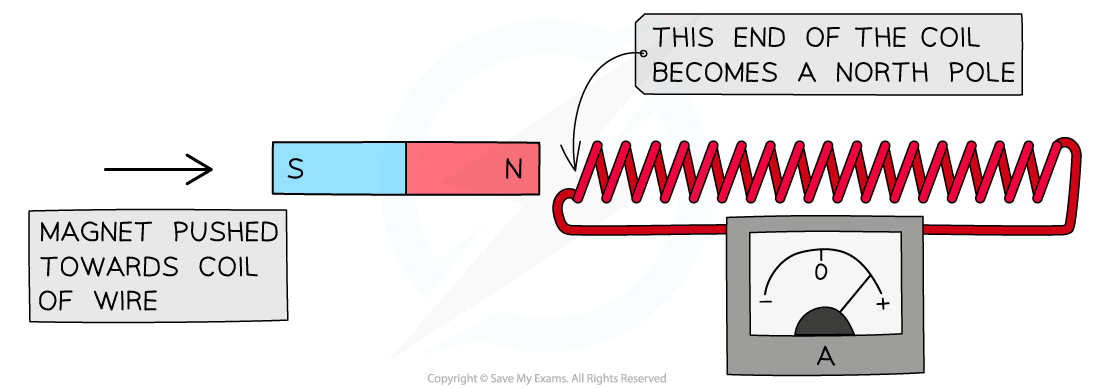
When a magnet is pushed into a coil of wire, the end of the coil closest to the magnet will become a north pole and oppose its motion
-
If a magnet is now pulled away from the coil of wire, the end of the coil closest to the magnet will become a south pole
-
This happens because:
- the changing magnetic field induces an e.m.f. in the coil
- the induced e.m.f. causes a current to flow and generates a magnetic field in the coil
- the magnetic field due to the current opposes the magnet being pulled away from the coil
- therefore, the end of the coil closest to the magnet becomes a south pole
- this means it attracts the north pole of the magnet
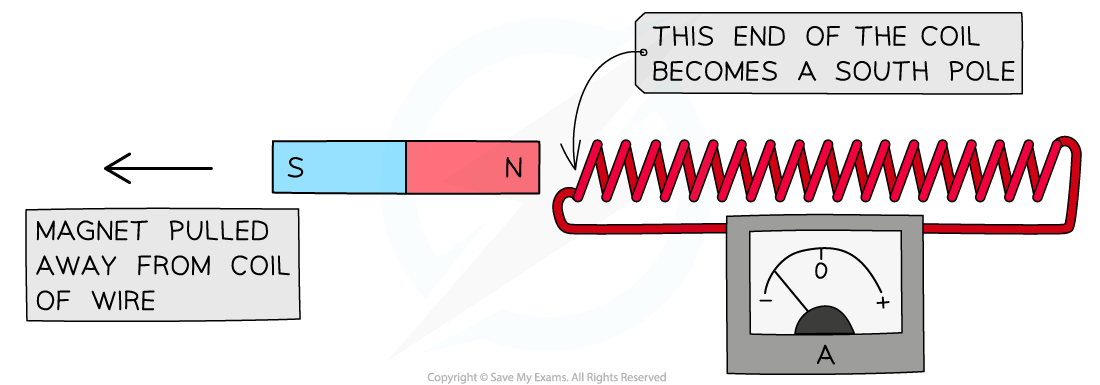
When a magnet is pulled away from a coil of wire, the end of the coil closest to the magnet will become a south pole and oppose its motion
Right-hand dynamo rule
Spec point —
4.4.1· State and use the relative directions of force, field and induced current
Extended Tier Only
-
When moving a wire through a magnetic field, the direction of the induced e.m.f. can be determined using the right-hand dynamo rule
-
First Finger = Field:
- Start by pointing the first finger (on the right hand) in the direction of the field
-
ThuMb = Motion:
- Next, point the thumb in the direction that the wire is moving in
-
SeCond = Current:
- The Second finger will now be pointing in the direction of the current (or, strictly speaking, the e.m.f.)
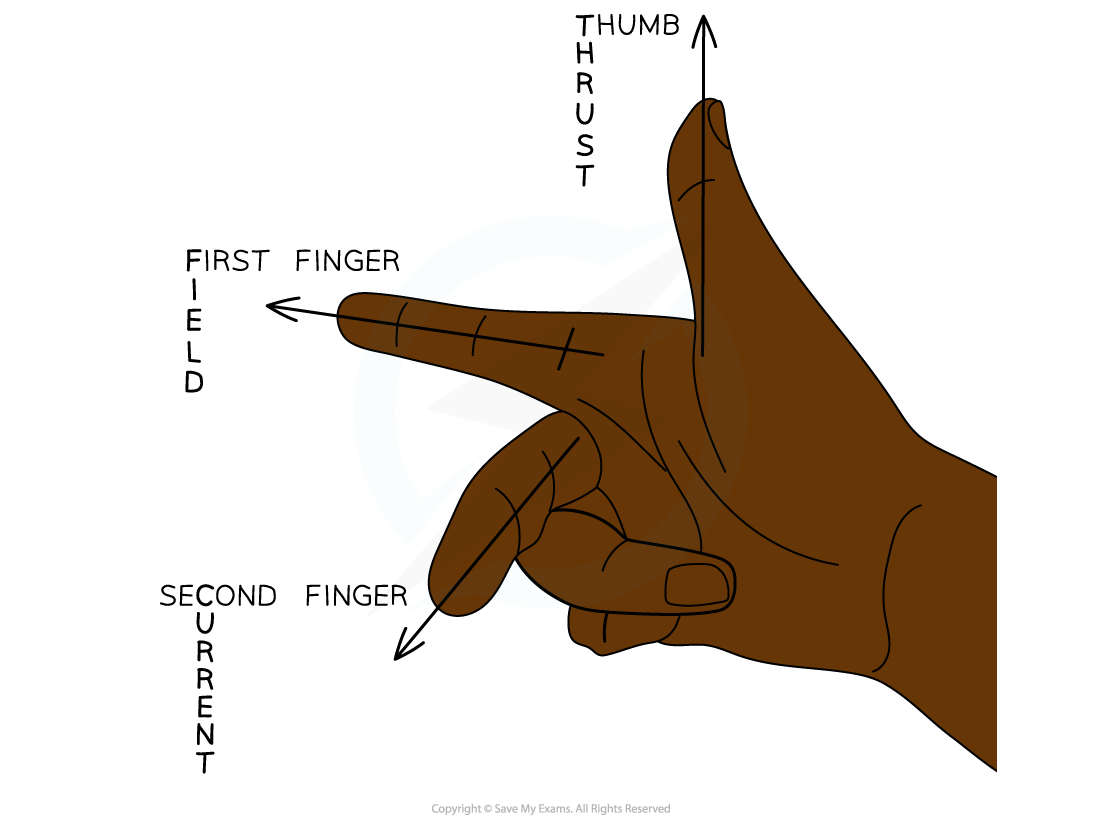
The right-hand dynamo rule can be used to deduce the direction of the induced e.m.f.
Exam Hint Remember that current is always in the direction of positive charge carriers. Therefore, current flows from the positive to the negative terminal of the battery.
Was this revision note helpful?
Build on this topic