Set Notation & Venn Diagrams (Cambridge International IGCSE Mathematics)
Set Notation
What is a set?
-
A set is a collection of elements
-
Elements could be anything
- Numbers, letters, coordinates, ...
-
-
You could describe a set by writing its elements inside curly brackets {}
- {1, 2, 3, 6} , is the set of factors of 6
-
If the set of elements follow a rule then you can write this using a colon inside the curly brackets {... : ...}
-
The bit before the colon is the type of element
-
The bit after the colon is the rule
- {x is a positive integer : x2 < 30} is the set of positive integers which, when squared, are less than 30
- This is equal to {1, 2, 3, 4, 5}
-
The colon is often read as 'such that'
-
If no type is specified, x can take any value (fractions, decimals, irrationals, ...)
- {x: x2 < 30} means any value whose square is less than 30
-
{ (x, y) : y = mx + c } would mean the coordinates (x, y) where y = mx + c
- I.e. The set of all possible coordinates that lie on the line y = mx + c
-
A colon can also be replaced by a vertical bar
- {x | x2 < 30}
-
What do I need to know about set notation?
-
is the universal set (the set of everything)
-
For example, if we are only interested in factors of 24 then = {1, 2, 3, 4, 6, 8, 12, 24}
-
You may see alternative notations used for
- U is a common alternative (different to for union!)
- S or the Greek letter ξ (xi) may also be seen
-
-
We use upper case letters to represent sets (A,B,C, ...) and lower case letters to represent elements(a,b,c, ...)
-
n(A) is the number of elements in set A
- For example, if = {1, 2, 3, 4, 5, 6, 7, 8, 9, 10}, A = {1, 4, 9}, B = {1, 2, 3, 4, 5, 6} n(A) = 3, n(B) = 6
-
means "is an element of"
- And means "is not an element of"
- E.g. and
-
is the empty set
- This is the set which does not contain any elements
-
AB means "A is a subset of B"
-
Set A is a subset of set B if all the elements of A are also present in B
- E.g. If A = {1,2,3} and B = {0, 1, 2, 3, 4}, then AB
-
A
⊈B means "A is not a subset of B"
-
-
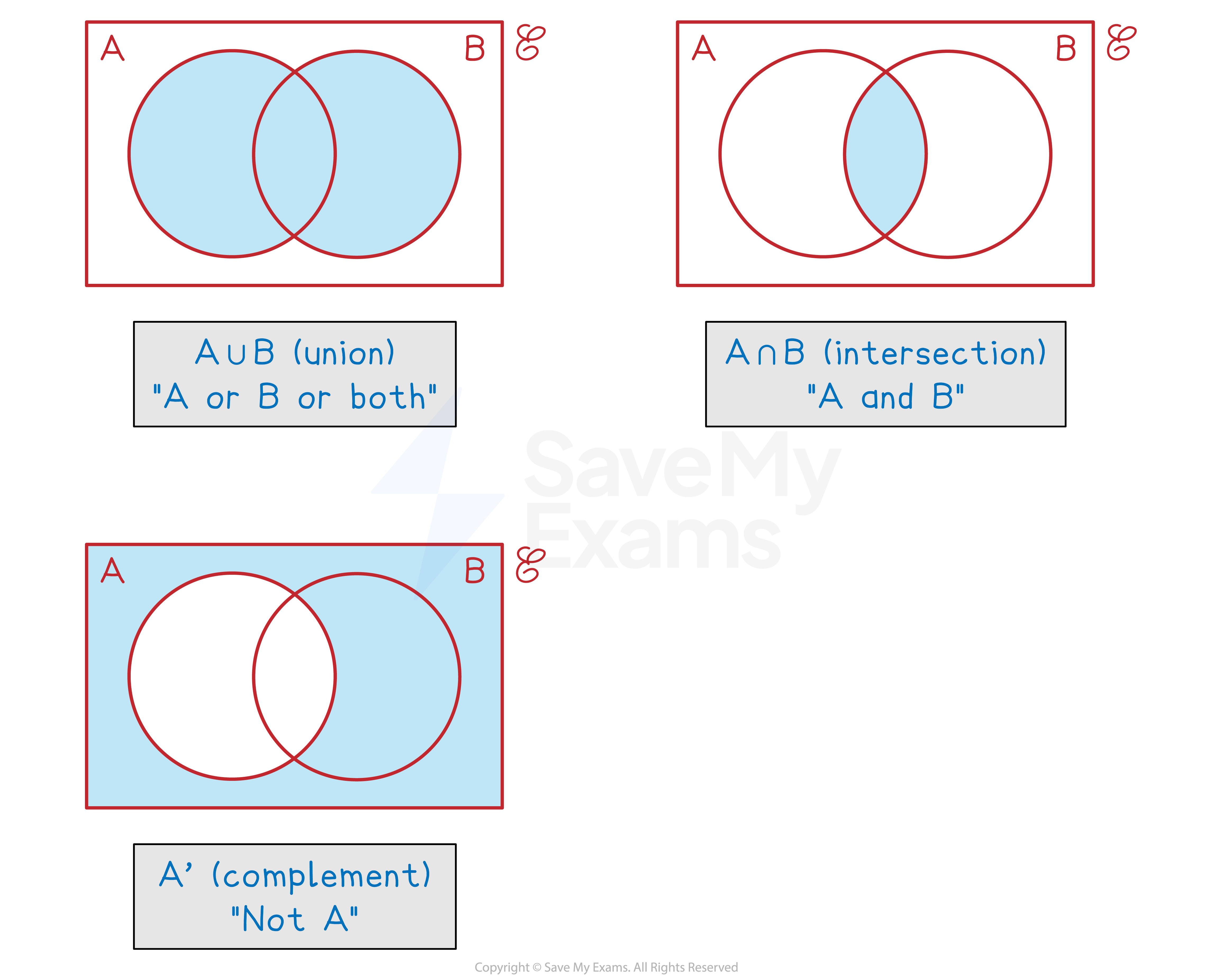
A B means the intersection of A and B (the overlap of A and B)
-
This is the set of elements that are in both set A and set B
- E.g. If A = {1, 2, 3, 4, 5} and B = {-1, 1, 4, 7, 8}, then A B = {1, 4}
-
-
A B means the union of A and B (everything in A or B or both)
-
This is the set of elements that are in at least one of the sets
-
This includes elements in both sets (in the intersection)
- E.g. If A = {5, 6, 7, 8} and B = {3, 7, 11}, then A B* *= {3, 5, 6, 7, 8, 11}
-
-
A' means the complement of A
-
It is the set of all elements in the universal set that are not in A
- E.g. If = {1, 2, 3, 4, 5} and A = {1, 3}, A' = {2, 4, 5}
-
Sets & Venn Diagrams
What is a Venn diagram?
-
A Venn diagram is a way to illustrate all the elements within sets and any intersections
-
A Venn diagram consists of
-
a rectangle representing the universal set ()
-
a circle for each set
- Circles may or may not overlap depending on which elements are shared between sets
-
What do the different regions mean on a Venn diagram?
- is represented by the regions that are in A or B or both
- is represented by the region where the A and B circles overlap
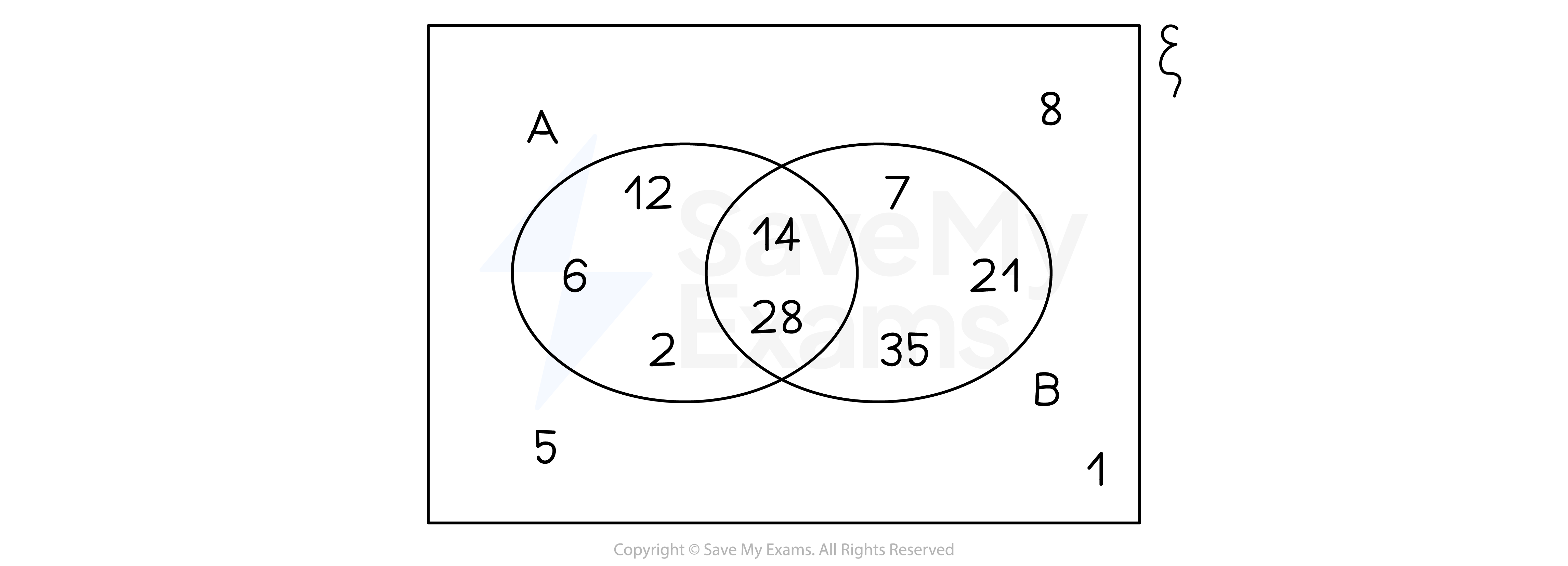
Worked Example Two sets A and B are shown in the Venn diagram.
(a) Write down n(A).
Answer:
The elements of A are anything inside the A circle
A = {2, 6, 12, 14, 28}*
n(A) means the number of elements in A There are 5 elements in A
n(A) = 5 **
(b) Use set notation to complete the sentence {14, 28} = ...
Answer:
- 14 and 28 are the elements that are both in** A and B* *This means they are in the intersection of A and *B
**Final answer:****{14, 28} = **A **∩ B
(c) Write down the elements that are in set A U B.
Answer:
A* = {2, 6, 12, 14, 28} and B = {7, 14, 21, 28, 35}* A* U B is the set of elements that are in at least one of the sets *
For elements in both, only write them out once
Final answer: A U B = {2, 6, 7, 12, 14, 21, 28, 35}
(d) Jamie states that
equationA'B' = .Explain if this statement is correct or not.
Answer:
The statement means Not A and Not B is equal to an empty set *i.e. There are no elements that are Not A and Not *B
However, there are 3 elements that are neither A nor* B*
There are 3 elements that aren't in A or B
equationA' B' = {1, 5, 8}Final answer: Therefore the statement is incorrect
Worked Example Consider the following sets.
equation= {letters of the alphabet} = {t, e, a, m} = { i } = {m, e}Fill in the blanks with the appropriate set.
equation(i)... ⊈ T(ii)
Answer:
The symbol means "is a subset of", so all of the elements of one feature in the other The symbol
⊈means "is not a subset of"The element in is not in
equation``I ⊈ TAll the elements of are also in
Was this revision note helpful?
Build on this topic