Upper & Lower Bounds (Cambridge International IGCSE Mathematics)
Bounds & Error Intervals
What are bounds?
-
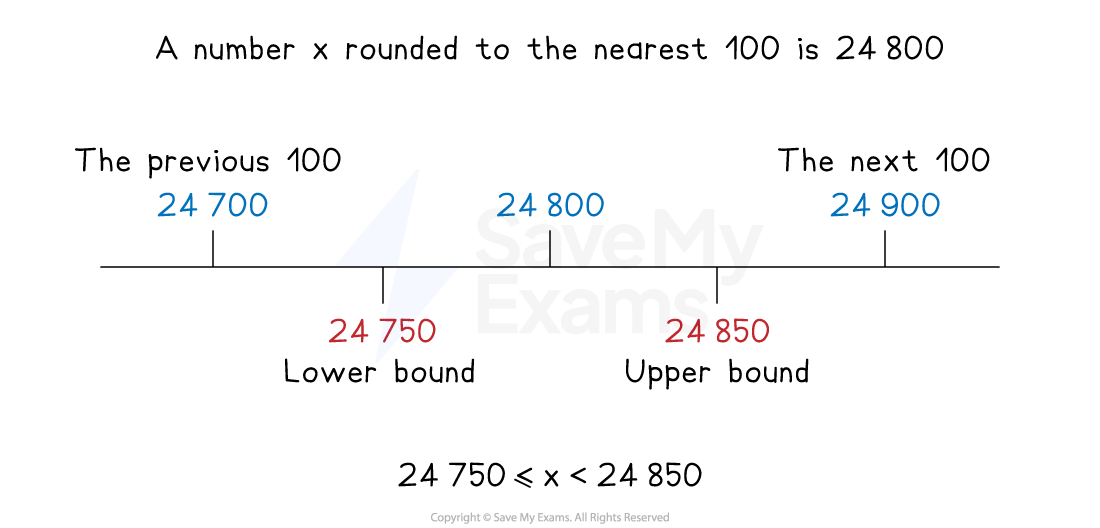
Bounds are the values that a rounded number can lie between
- The smallest value that a number can take is the lower bound (LB)
- The largest value that a number must be less than is the upper bound (UB)
-
The bounds for a number, , can be written as
- Note that the lower bound is included in the range of values * *but the upper bound is not
How do I find the upper and lower bounds for a rounded number?
-
Identify the degree of accuracy to which the number has been rounded
- E.g. 24 800 has been rounded correct to the nearest 100
-
Divide the degree of accuracy by 2
- E.g. If an answer has been rounded to the nearest 100, half the value is 50
-
Add this value to the number to find the upper bound
- E.g. 24 800 + 50 = 24 850
-
Subtract this value from the number to find the lower bound
- E.g. 24 800 - 50 = 24 750
-
The error interval is the range between the upper and lower bounds
- Error interval:LB ≤ x < UB
- E.g. 24 750 ≤ 24 800 < 24 850
Exam Hint It can help to draw a number line. Identify the numbers with the same accuracy that come immediately before and after the rounded number.
- The lower bound is the midpoint between the rounded number and the previous number at that accuracy
- The upper bound is the midpoint between the rounded number and the next number at that accuracy
Worked Example The length of a road, , is given as , correct to 1 decimal place.
Find the lower and upper bounds for
Answer:
The degree of accuracy is 1 decimal place, or 0.1 km Divide this value by 2
0.1 ÷ 2 = 0.05
The true value could be up to 0.05 km above or below the given value
Upper bound: 3.6 + 0.05 = 3.65 km
Lower bound: 3.6 - 0.05 = 3.55 km
Final answer: Upper bound: 3.65 km Lower bound: 3.55 km
Final answer: This could also be written as
Calculations using Bounds
How do I find the bounds of a calculation?
-
To find the upper bound of a calculation, consider how the result can be made as large as possible
-
To find the lower bound of a calculation, consider how the result can be made as small as possible
-
E.g. For an addition,
- The upper bound will be when both and are at their upper bounds
- The lower bound will be when both and are at their lower bounds
-
Sometimes you need different bounds in the same question
-
The upper bound of is the upper bound of divided by the lower bound of
- Increasing the numerator makes the fraction bigger,
- But increasing the denominator make the fraction smaller,
-
-
How to find the upper and lower bound for each operation is summarised in the table below
| Upper Bound | Lower Bound | |
|---|---|---|
| Upper + Upper | Lower + Lower | |
| Upper - Lower | Lower - Upper | |
| Upper × Upper | Lower × Lower | |
| Upper ÷ Lower | Lower ÷ Upper |
-
You will need to use more than one of these if the expression includes multiple operations
-
E.g. consider the upper bound for
- You need the upper bound for and lower bound for
- This means you need the lower bound for and upper bound for
-
E.g. consider the lower bound for
- You need the lower bound for and upper bound for
- This means you need the lower bound for and upper bound for
-
How do I use upper and lower bounds in contexts?
-
Questions often give real-life contexts and ask about bounds
-
For example
- To see if two cars will fit on the back of a truck
- Use the upper bounds of the lengths of the two cars
- This is like finding the upper bound of
-
For example
- To find the minimum speed (speed = distance time)
- Divide the lower bound of the distance by the upper bound of the time
- This is like finding the lower bound of
-
How can bounds help with calculations?
-
You can use bounds to determine the level of accuracy of a calculation
-
E.g. If a value has a upper bound of 8.33217... and lower bound of s 8.33198...
- The true value is between 8.33198... and 8.33217...
-
Find the level of accuracy for which both bounds round to the same number
- This happens at 4 sf (rounding to 8.332)
- To 5 sf they are different (lower is 8.3320 and upper is 8.3322)
-
Therefore you know the original value rounds to 8.332 to 4 significant figures
-
Worked Example A room measures 4 m by 7 m, where each measurement is made to the nearest metre.
Find the upper and lower bounds for the area of the room.
Answer:
Find the bounds for each dimension, you could write these as error intervals, or just write down the upper and lower bounds
As they have been rounded to the nearest metre, the true values could be up to 0.5 m bigger or smaller
3.5 ≤ 4 < 4.5 6.5 ≤ 7 < 7.5
Calculate the lower bound of the area, using the two smallest measurements
3.5 × 6.5
Final answer: Lower Bound = 22.75 m2
Calculate the upper bound of the area, using the two largest measurements
4.5 × 7.5
Final answer: Upper Bound = 33.75 m2
Worked Example David is trying to work out how many fencing panels he needs to buy in order to construct a fence along one side of his garden path.
Fencing panels are 50 cm long, measured to the nearest 10 cm.
The length of the path is 6 m, measured to the nearest 10 cm.
Find the minimum number of fencing panels David will need to buy.
Answer:
Find the bounds for each measurement
As they have been rounded to the nearest 10 cm, the true values could be up to 5 cm bigger or smaller
Change quantities into the same units
Length of the fencing panels: 45 ≤ 50 < 55 cm or in metres: 0.45 ≤ 0.5 < 0.55 m
Length of the path: 5.95 ≤ 6 < 6.05 m
The minimum number of fencing panels needed will be when the path is as short as possible (5.95 m), and the panels are as long as possible (0.55 m)
Minimum number of fencing panels =
Assuming we can only purchase a whole number of fencing panels, round up to nearest integer
Final answer: The minimum number of fencing panels to be bought is 11
Was this revision note helpful?
Build on this topic